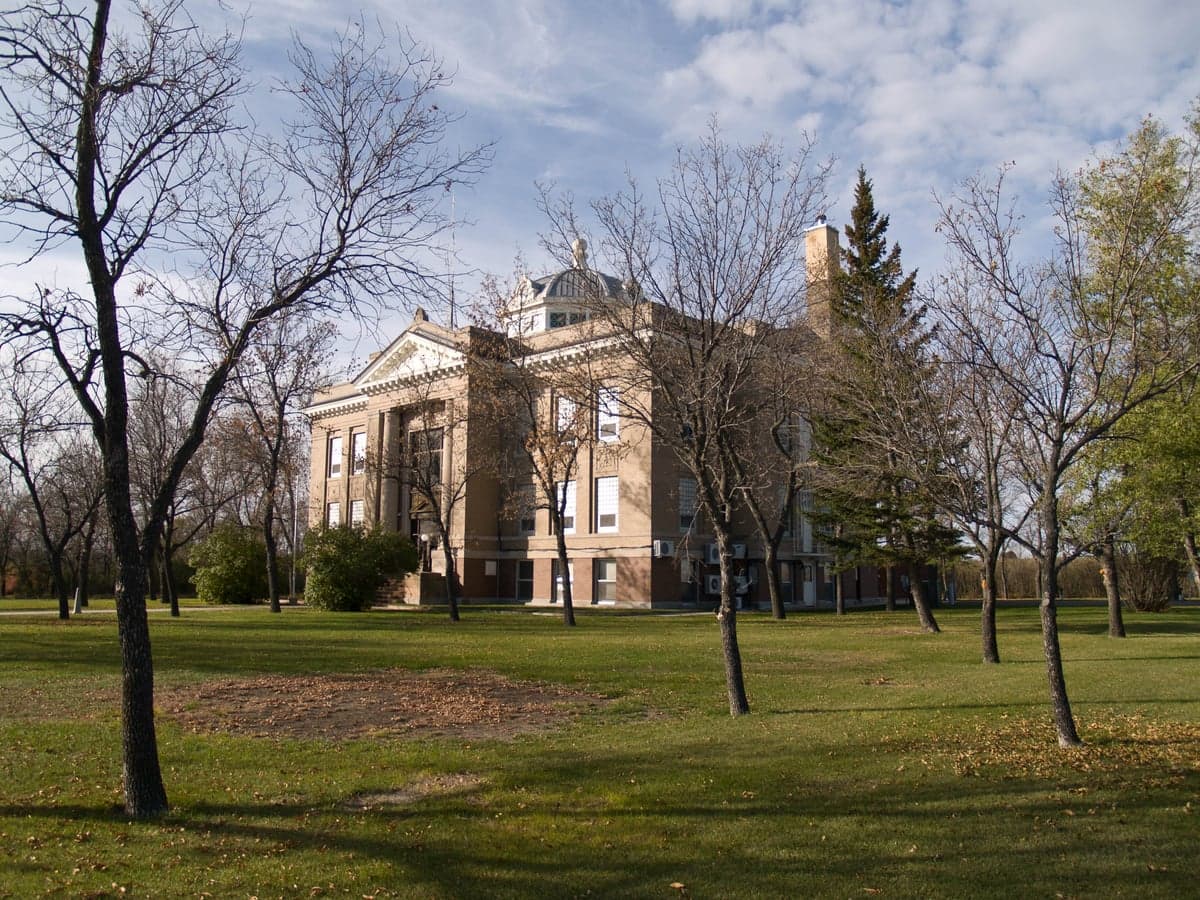
Photo: Wikipedia
Political ClimatePolitical Climate in Mountrail County
Showing state-level results — no local-only data available.
Local Political AnalysisPolitical Analysis of Mountrail County
Mountrail County is one of the most reliably Republican counties in North Dakota, with a Cook Partisan Voting Index (PVI) of R+18, meaning it votes about 18 points more Republican than the national average. That’s a deep red lean, but it’s not a monolith — the county’s politics are shaped by a mix of oil boom wealth, Native American communities, and agricultural roots. Over the last decade, the Republican advantage has actually widened slightly, driven by strong turnout in the western oil patch towns like Stanley and New Town, though local elections can still surprise you.
How it compares
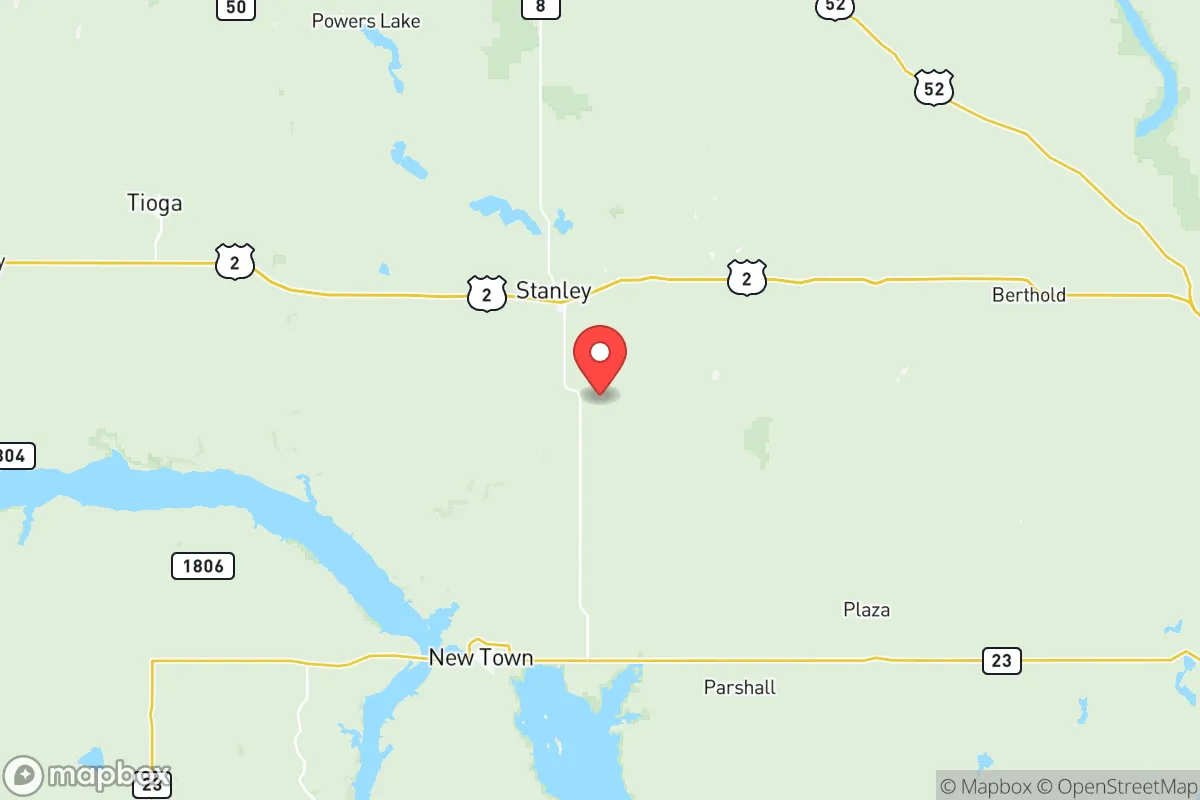
Compared to North Dakota as a whole, Mountrail County is noticeably more conservative. The state’s overall PVI isn’t officially calculated, but it’s widely considered R+20 or higher — so Mountrail is right in line with the state’s deep red character. But within the county, there’s real variation. The town of Stanley, the county seat and an oil boom hub, is reliably Republican, often voting 70% or more for GOP candidates. New Town, home to the Three Affiliated Tribes, leans more Democratic — precincts there can go 55-60% blue in presidential races, driven by tribal sovereignty issues and federal funding priorities. The rural precincts around Ross and Palermo are swingy, often splitting tickets between local Republicans and Democrats who focus on farm policy. So while the county’s overall R+18 PVI is accurate, it masks a genuine urban-rural and tribal divide that makes local politics more competitive than the top-line number suggests.
What this means for residents
For conservative residents, Mountrail County’s lean means their values are reflected in local governance — low taxes, limited regulation, and strong support for oil and gas development. The county commission and school boards in Stanley and New Town are dominated by Republicans, so policies around land use, energy permits, and school funding tend to favor industry. For liberal residents, especially in New Town, it means organizing around tribal issues and environmental concerns can feel uphill, but there are real wins — like the 2023 county resolution opposing a proposed carbon pipeline, which passed with bipartisan support. The practical effect is that political conversations here are less about national culture wars and more about local bread-and-butter issues: road maintenance from oil truck traffic, water quality near drilling sites, and school funding tied to property tax revenue from energy companies.
Culturally, Mountrail County stands apart from the rest of North Dakota in a few key ways. The presence of the Three Affiliated Tribes gives the county a distinct political voice — tribal elections and federal recognition issues are front-page news here, not just local asides. The oil boom also brought a wave of out-of-state workers, many from Texas and Oklahoma, who’ve shifted the county’s political center of gravity further right on energy policy but also introduced more libertarian streaks on issues like marijuana legalization (Stanley voted 52% in favor of Measure 3 in 2018, while the state overall rejected it). Longtime residents will tell you the county’s politics used to be more pragmatic — Democrats held local offices into the 1990s — but the combination of energy wealth and national polarization has hardened the lines. Looking ahead, expect the R+18 lean to hold steady, but watch the tribal precincts in New Town: if voter turnout there increases, it could nudge the county slightly toward the center on specific issues like environmental regulation and healthcare access.

State Political ClimatePolitical Climate in North Dakota
State Political AnalysisPolitical Environment in the State
North Dakota is one of the most reliably Republican states in the country, with a partisan lean that has only deepened over the past two decades. The state hasn't voted for a Democratic presidential candidate since Lyndon B. Johnson in 1964, and in 2024, Donald Trump carried it by a margin of roughly 20 points. The dominant political coalition is a blend of rural conservatives, energy-sector workers, and a growing number of out-of-state transplants drawn by low taxes and a business-friendly climate. Over the last 10-20 years, the state has shifted rightward even further, driven by the oil boom in the Bakken region and a steady exodus of the old Democratic-Farmer-Labor (DFL) coalition that once held sway in the eastern counties. Today, the state legislature is a Republican supermajority, and the governor's mansion has been in GOP hands since 1992.
Urban vs. rural divide
The political map of North Dakota is starkly divided between a handful of small urban centers and the vast, deeply conservative rural expanse. The largest city, Fargo, in Cass County, is the state's most competitive area—Cass County voted for Trump by only about 8 points in 2024, a far cry from the 40-point margins seen in rural counties like McKenzie or Williams. Fargo's growth, driven by North Dakota State University and a diversifying tech and healthcare economy, has brought in younger, more moderate voters, but it remains a Republican-leaning city overall. Bismarck, the capital, is reliably conservative, with Burleigh County consistently voting 20-25 points to the right. Grand Forks, home to the University of North Dakota, is a bit more moderate but still solidly red. The real engine of the state's rightward shift is the oil patch in the northwest—towns like Williston, Watford City, and Dickinson have seen explosive growth since 2010, bringing in a workforce that is overwhelmingly conservative, pro-energy, and skeptical of government regulation. The rural counties along the Missouri River and the Turtle Mountain region are the most conservative, while the Democratic remnant is mostly confined to a few Native American reservations (like the Standing Rock and Turtle Mountain reservations) and a handful of union-heavy precincts in the east.
Policy environment
North Dakota's policy environment is a textbook example of a low-tax, low-regulation state. There is no state income tax on individuals (the state phased it out starting in 2023, with full elimination by 2025), and the corporate income tax rate is a flat 1.5% on most businesses. Property taxes are relatively high compared to some Sun Belt states, but the state offers a homestead credit for homeowners and a separate credit for renters. The regulatory posture is aggressively pro-business, especially in the energy sector—permitting for oil and gas drilling is streamlined, and the state has fought federal environmental regulations in court repeatedly. Education policy is locally controlled, with school choice limited to charter schools (which are few) and a robust open enrollment system. The state has a strong parental rights law (HB 1522, passed in 2023) that requires schools to notify parents of any changes in a student's health or well-being. Healthcare is a mixed bag: the state expanded Medicaid under the Affordable Care Act in 2013, but the legislature has resisted further expansion of government-run programs. Election laws are among the most restrictive in the nation—voter ID is required, same-day registration is not allowed, and absentee voting requires an excuse. The state also has a strict photo ID law that has been challenged in court but remains in effect.
Recent policy direction
Over the past five years, North Dakota has moved decisively to the right on nearly every front. In 2023, the legislature passed a near-total abortion ban (HB 1250) that prohibits the procedure at conception, with exceptions only for rape, incest, and medical emergencies—one of the strictest laws in the country. On gun rights, the state enacted permitless carry in 2017 and has resisted any new federal restrictions; in 2023, it passed a law (SB 2300) prohibiting state enforcement of any federal gun control measures deemed unconstitutional. Parental rights were strengthened with HB 1522, which also restricts classroom discussion of gender identity and sexual orientation in grades K-4. On property rights, the state has been a battleground over the Dakota Access Pipeline—the state government sided with the pipeline company against the Standing Rock Sioux Tribe, and the legislature passed laws in 2017 and 2019 to criminalize protests that damage energy infrastructure. Privacy and surveillance are relatively weak: the state has no comprehensive data privacy law, and law enforcement can access cell phone location data without a warrant in some cases. Voting access has tightened, with the 2021 law (HB 1233) requiring a valid ID for all absentee ballots and eliminating the use of student IDs from out-of-state colleges. The overall direction is toward maximizing individual liberty in economic and self-defense matters while restricting it on social and medical issues.
Civil unrest & political movements
North Dakota has seen its share of political flashpoints, most notably the Standing Rock protests in 2016-2017, which drew thousands of activists from across the country to oppose the Dakota Access Pipeline. The protests were met with a heavy law enforcement response, including the use of water cannons in freezing temperatures, and resulted in hundreds of arrests. The state government's handling of the protests remains a deeply divisive issue—rural residents largely supported the crackdown, while Native American communities and environmental activists view it as a human rights violation. Since then, the state has seen smaller protests over abortion rights (especially after the 2023 ban) and a growing movement among ranchers and farmers to resist federal land management policies. On the right, the state has a strong "constitutional sheriff" movement, with several county sheriffs publicly refusing to enforce federal gun laws. Election integrity has been a recurring theme—the state's Republican secretary of state has promoted voter ID laws as necessary to prevent fraud, while Democrats argue they suppress turnout. There is no significant secession or nullification movement, but the state has passed resolutions asserting state sovereignty under the Tenth Amendment. Immigration politics are relatively quiet, as the state's foreign-born population is small (about 4%), but there have been local controversies over refugee resettlement in Fargo and Bismarck.
Projection
Over the next 5-10 years, North Dakota is likely to remain one of the most conservative states in the Union, but the demographic trends are worth watching. The oil boom has slowed, and the state's population growth has flattened—it grew only 2.5% between 2020 and 2025, with many young people leaving for larger metros. The in-migration that does occur is mostly from other conservative states (Texas, Montana, Minnesota) and tends to reinforce the existing political lean. The urban-rural divide will probably widen, with Fargo and Grand Forks becoming slightly more moderate as they attract tech and healthcare workers, while the rural counties become even more conservative as the population ages. The state's Republican supermajority is unlikely to be seriously challenged, but internal divisions may emerge between the energy-focused "Bakken Republicans" and the more socially conservative "Prairie Republicans." A new resident moving in now should expect a state where conservative policies are the default, where the government is small and responsive to business interests, and where social issues are decided by the legislature rather than the courts. The biggest wildcard is the energy transition—if federal policies shift toward renewables, North Dakota's oil-dependent economy could face headwinds, which might reshape the political landscape.
For a new resident, the bottom line is straightforward: North Dakota is a place where conservative values are baked into the fabric of daily life. If you're a conservative, you'll find a government that largely shares your priorities—low taxes, strong gun rights, parental control in schools, and a business-friendly environment. If you're a liberal, you'll face a political system that is overwhelmingly opposed to your views, with limited avenues for change beyond local elections in Fargo or on the reservations. The state is safe, stable, and predictable, but it's not a place where political compromise is common. The practical takeaway: know what you're signing up for, and understand that the political climate here is as much a part of the landscape as the Great Plains themselves.
* Values derived from national, state, county, city and local statistics and may differ in a specific area. Last updated: 2026-06-16T22:39:29.000Z
Narrative content on this page is AI-generated and may contain mistakes. Verify any details that matter before acting on them.
ReloMaps may earn a commission from affiliate links at no extra cost to you.

