Photo: Wikipedia
Demographics of Mountrail County
Affluence Level in Mountrail County
A middle-class area roughly in line with national averages across income, home values, education, and employment.
People of Mountrail County
The people of Mountrail County, North Dakota today number 9,567, a population shaped by a deep Native American heritage, a century of European settlement, and a recent energy-driven boom. The county is notably diverse for rural North Dakota, with a White population of 57.8% and a significant Native American presence concentrated around the Fort Berthold Reservation, which covers the county's southern half. A small but growing Hispanic community (8.2%) and a Black population (2.0%) reflect the labor demands of the Bakken oil fields, while the foreign-born share remains low at 1.5%. This is a place where the rhythms of agriculture and energy extraction meet the enduring sovereignty of the Mandan, Hidatsa, and Arikara Nation.
Settlement & growth (pre-1960)
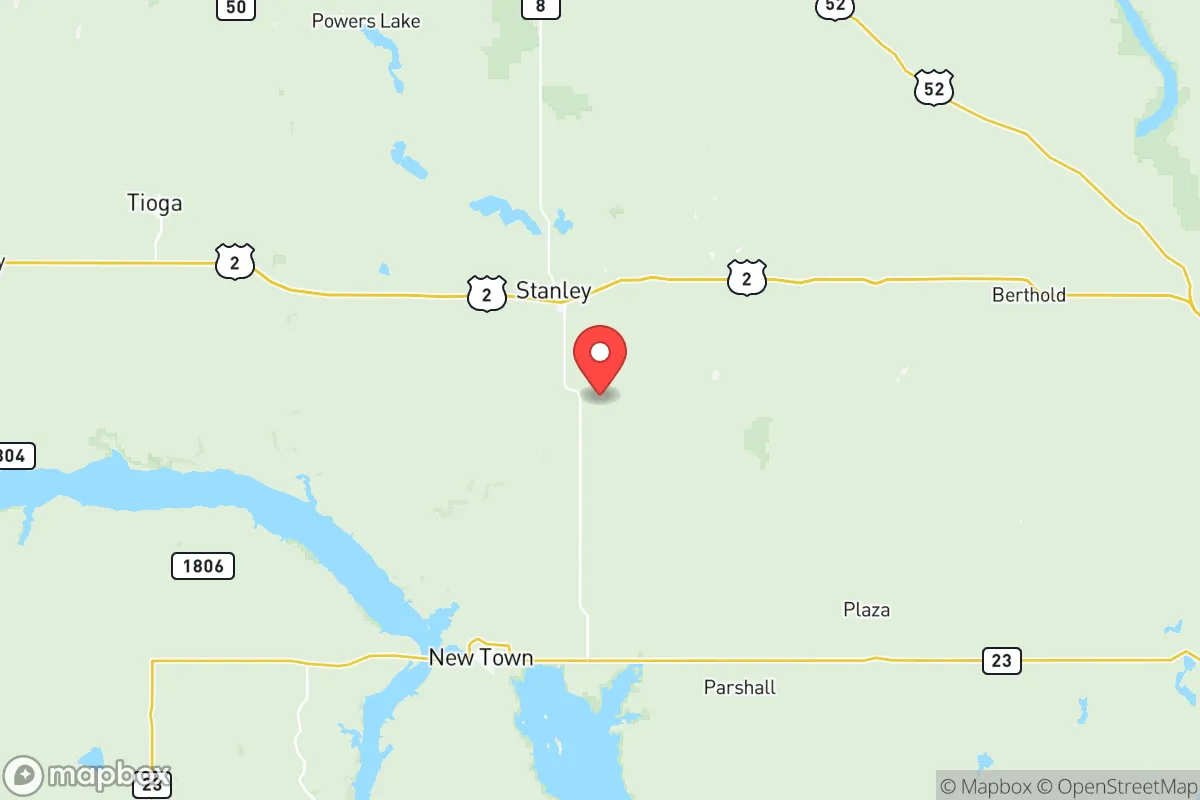
Long before European settlers arrived, the area that is now Mountrail County was home to the Mandan, Hidatsa, and Arikara people, who lived in earth-lodge villages along the Missouri River. The 1851 Treaty of Fort Laramie recognized their territory, but the creation of the Fort Berthold Reservation in 1870 confined these three tribes to a single land base, a forced consolidation that reshaped their way of life. The reservation's boundaries were later reduced, but the tribes' presence remained central to the county's identity, with communities like New Town and Parshall serving as hubs for the Native population.
European-American settlement began in earnest after the Northern Pacific Railway extended its line through the region in the 1880s. The railroad opened the prairie to homesteaders, primarily of Norwegian, German, and Russian German descent, who were drawn by the promise of 160-acre plots under the Homestead Act. Towns like Stanley, the county seat, and Ross sprang up as agricultural service centers, with wheat and cattle farming dominating the economy. The early 1900s saw a wave of Scandinavian immigrants, particularly Norwegians, who established tight-knit Lutheran communities in places like Palermo and White Earth. By 1920, the county's population had peaked at over 13,000, but the Dust Bowl and Great Depression of the 1930s drove many families off the land, leading to a steady decline that would last for decades.
The post-World War II era brought little change. Mechanization reduced the need for farm labor, and younger generations left for cities like Minot and Bismarck. By 1960, the population had fallen to roughly 8,000, a trend that continued through the 1990s. The county's economy remained tied to agriculture and the reservation, with oil exploration beginning in the 1950s but not yet transforming the region.
Modern era (post-1965)
The 1965 Hart-Cellar Act had minimal direct impact on Mountrail County, as the area did not attract the large-scale immigration seen in coastal cities. The foreign-born population today is just 1.5%, and the small Asian (0.5%) and Indian (0.3%) communities are largely professionals connected to the energy industry or healthcare. The most significant demographic shift of the modern era came not from immigration but from the Bakken oil boom, which began in earnest around 2008.
The discovery of oil in the Bakken shale formation brought a wave of domestic migrants from across the United States, particularly from the Rust Belt and other energy-producing states. Workers from Texas, Oklahoma, and Louisiana arrived to staff drilling rigs and support services, while others came from the Upper Midwest. This influx temporarily swelled the county's population, with Stanley and New Town seeing rapid growth in temporary housing and man camps. The Hispanic population rose to 8.2%, driven by workers from Texas and the Southwest, and the Black population reached 2.0%, reflecting a broader diversification of the labor force. However, the boom was volatile; when oil prices dropped in 2015 and again in 2020, many workers left, leaving the population relatively stable at around 9,500.
The Native American population, while not new, has seen a cultural and economic resurgence. The Mandan, Hidatsa, and Arikara Nation (MHA Nation) has leveraged oil revenue to invest in infrastructure, education, and healthcare on the reservation. Communities like Mandaree and Four Bears have grown as tribal members return for economic opportunities, reversing decades of out-migration. The county's racial makeup is now a unique blend: a White majority that is increasingly tied to the energy sector, a substantial Native minority with deep historical roots, and small but visible Hispanic and Black communities concentrated in the oil-field towns.
The future
Mountrail County's population is likely to remain stable or grow slowly, driven by the energy sector's long-term prospects. The Bakken formation still holds significant reserves, and advances in extraction technology could sustain production for decades. However, the boom-and-bust cycle means that the population will remain sensitive to global oil prices. The county is becoming slightly more diverse, with the Hispanic and Black shares expected to rise modestly as energy companies recruit from a broader labor pool. The Native American population is also projected to grow, as the MHA Nation continues to invest in housing and economic development on the reservation.
The cultural identity of the county is evolving. The old agricultural Scandinavian and German communities are aging, while younger residents are more likely to be connected to the oil industry or tribal government. Towns like Stanley and New Town are becoming more cosmopolitan, with a mix of long-time residents and transient workers. The county's political leanings remain conservative, reflecting its rural character and energy-industry ties, but the growing Native American population adds a distinct political voice. The next 10-20 years will likely see a continued blending of these communities, with the county becoming more economically integrated but retaining its small-town, frontier character.
For someone moving in now, Mountrail County offers a place where the past and future coexist. The land is still shaped by the Missouri River breaks and the prairie, but the economy is driven by oil and tribal enterprise. The population is small but diverse, with a strong sense of community in each town. It is a place of opportunity for those in the energy sector, and a place of deep cultural heritage for the Native American community. The county is not becoming a suburb or a boomtown; it is becoming a stable, working landscape where different histories meet.

* Values derived from national, state, county, city and local statistics and may differ in a specific area. Last updated: 2026-06-16T22:39:29.000Z
Narrative content on this page is AI-generated and may contain mistakes. Verify any details that matter before acting on them.
ReloMaps may earn a commission from affiliate links at no extra cost to you.

