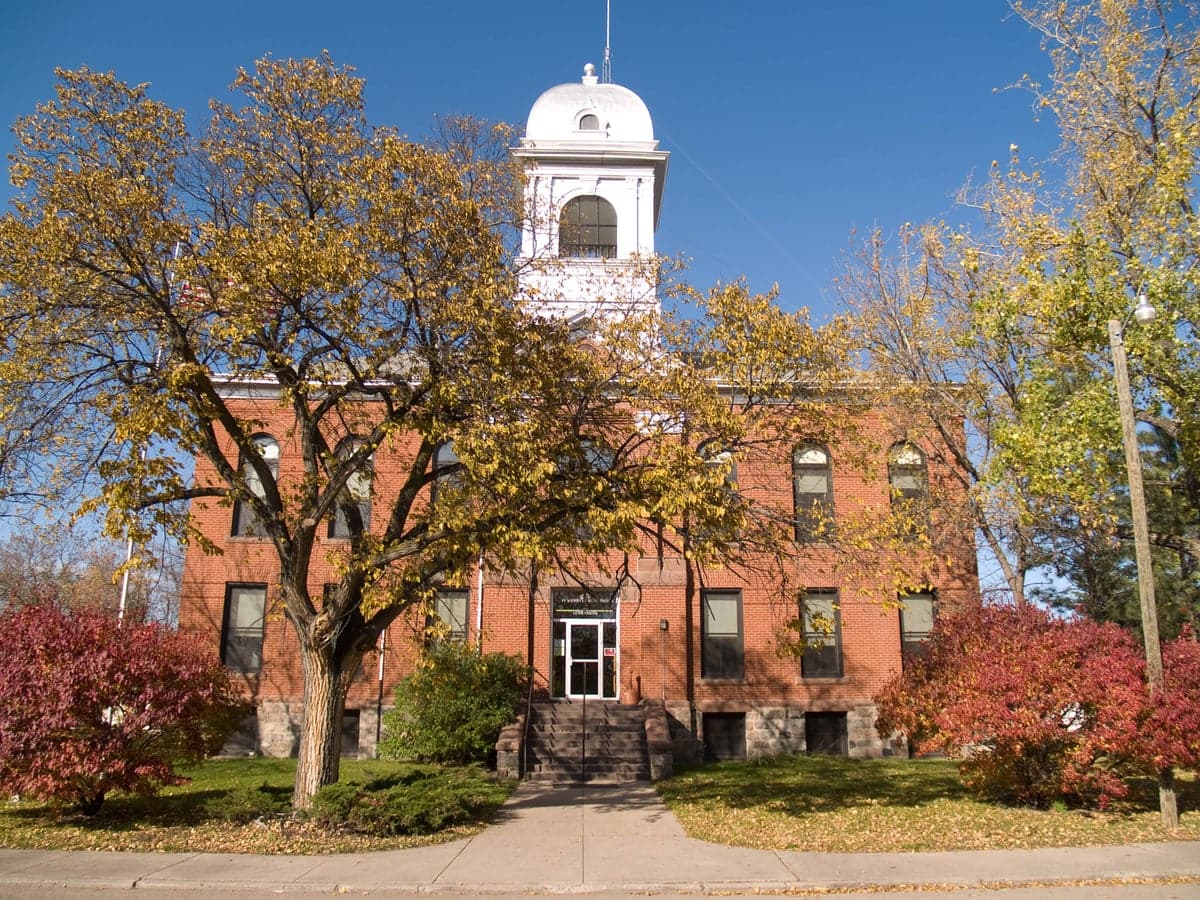
Photo: Wikipedia
Political ClimatePolitical Climate in Eddy County
Showing state-level results — no local-only data available.
Local Political AnalysisPolitical Analysis of Eddy County
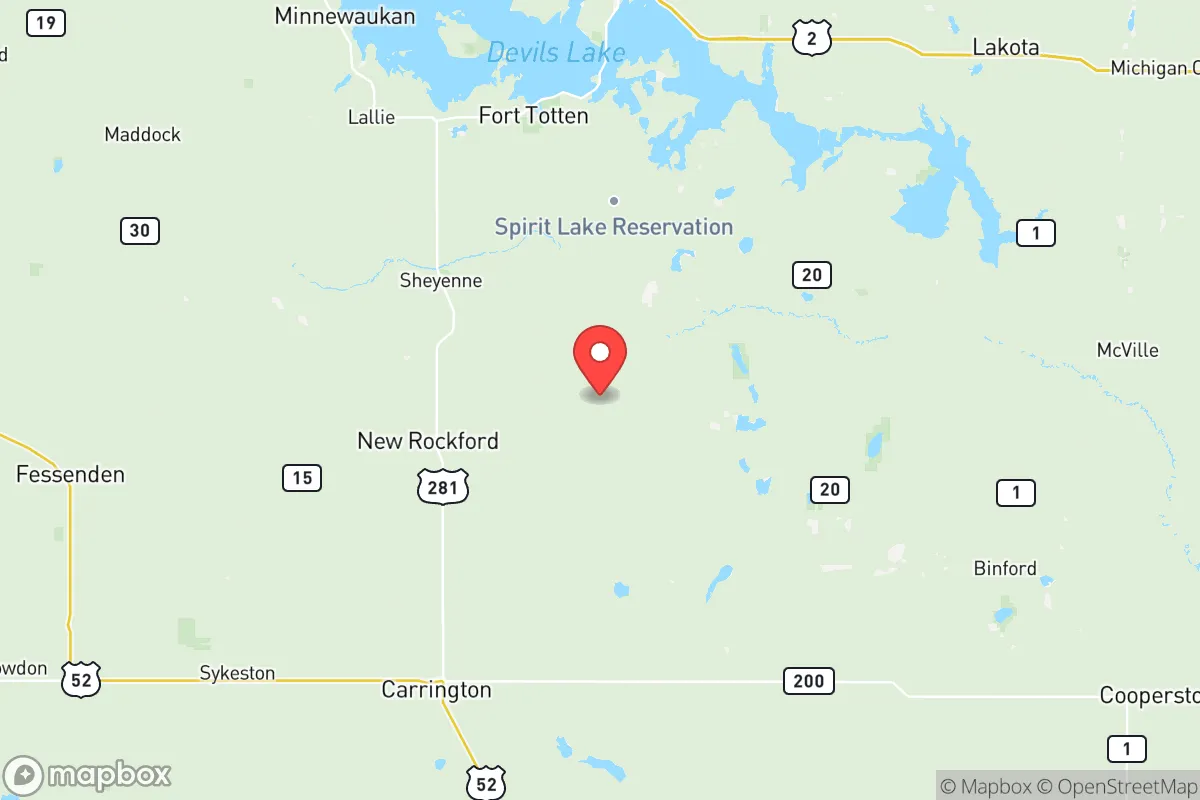
Eddy County, North Dakota, is a deeply conservative area with a Cook Partisan Voting Index of R+18, meaning it votes about 18 points more Republican than the national average. In practice, this translates to a near-total Republican lock on local offices and a political culture where Democratic candidates rarely break 35% of the county-wide vote. The trajectory has been steadily rightward over the past two decades, mirroring the broader rural shift in the Great Plains, though the pace has been slower here than in some neighboring counties due to a small but persistent Democratic holdout in the county seat of New Rockford.
How it compares
Compared to North Dakota as a whole, Eddy County is notably more conservative. While the state has a strong Republican lean—every statewide office is held by a Republican and the legislature is heavily GOP-dominated—Eddy County’s R+18 rating places it among the reddest rural counties in the state, alongside places like Hettinger and Grant counties. The state’s Cook PVI isn't officially calculated, but most estimates put North Dakota around R+16 to R+20, meaning Eddy County is right in the thick of the state’s conservative heartland. The key difference is that Eddy County lacks the moderate or swing precincts found in the state’s larger cities like Fargo or Bismarck. In New Rockford, the county’s largest town, you’ll find a few precincts that occasionally vote within 10 points of a Democrat—especially in local races where a popular independent or moderate Republican runs—but the surrounding townships, like those around Sheyenne and Hamar, are reliably +30 or more Republican. There are no blue-leaning towns in Eddy County; the closest thing to a swing area is the New Rockford city core, where a handful of precincts have voted for a Democrat in a state legislative race as recently as 2018.
What this means for residents
For conservative residents, Eddy County’s political climate means their values are deeply reflected in local policy. The county commission, school board, and city councils are uniformly Republican, and issues like gun rights, limited regulation, and agricultural subsidies are front and center. Taxes are low, and there’s little appetite for new spending outside of essential infrastructure like roads and the local hospital. For liberal residents, the reality is more isolating. There’s no organized Democratic party presence in the county, and progressive viewpoints are rarely voiced in public forums. Socially, it means that being openly liberal can be a social liability, especially in smaller towns like Sheyenne or Hamar where everyone knows everyone. However, the small population—around 2,300 people—means that personal relationships often trump political labels in day-to-day life. A liberal neighbor who helps with harvest or volunteers at the fire department is still a neighbor first.
Culturally, Eddy County stands apart from the state’s oil-boom regions in the west. There’s no Bakken money here, so the politics are more rooted in traditional agriculture and small-town survival. The county has a strong sense of self-reliance, and policy debates tend to focus on keeping the local school open, maintaining the hospital, and attracting any kind of economic development. Unlike in the state’s larger cities, there’s little discussion of urban issues like public transit or housing density. The biggest political flashpoint in recent years has been over wind energy development, with some residents welcoming the tax revenue and others opposing the visual impact on the prairie—a debate that cuts across party lines. In the long term, Eddy County will likely remain a Republican stronghold, but as the population ages and young people leave, the political energy may shift toward survival issues rather than ideological battles.

State Political ClimatePolitical Climate in North Dakota
State Political AnalysisPolitical Environment in the State
North Dakota has been a reliably Republican state for decades, with a partisan lean that has only deepened in recent years. In the 2024 presidential election, Donald Trump won the state by a margin of over 34 points, a slight increase from his 33-point victory in 2020. The state’s political identity is rooted in a strong rural conservative tradition, but it’s not a monolith—there are distinct regional and demographic splits that shape the landscape. Over the past 20 years, the state has shifted from a more pragmatic, farm-belt conservatism to a harder-edged, culturally conservative posture, driven largely by the oil boom in the western part of the state and the steady out-migration of younger, more liberal-leaning residents from the eastern cities.
Urban vs. rural divide
The political map of North Dakota is defined by a sharp contrast between the small, isolated cities and the vast rural expanse. The largest metro area, Fargo (Cass County), is the state’s most competitive region—Cass County voted for Trump by only 12 points in 2024, a far cry from the 50+ point margins seen in rural counties like McKenzie or Williams in the oil patch. Fargo’s growth, driven by a younger, more educated workforce tied to North Dakota State University and the healthcare sector, has created a small but persistent blue-leaning bloc. Bismarck (Burleigh County) and Minot (Ward County) are more reliably conservative, with Trump winning Burleigh by 30 points and Ward by 38 points in 2024. The real engine of the state’s Republican dominance, however, is the rural west—counties like Dunn, Divide, and Golden Valley routinely deliver 80-85% Republican votes. The only notable exception is the Native American-majority counties like Rolette and Sioux, which vote heavily Democratic, but their populations are too small to shift the statewide balance.
Policy environment
North Dakota’s policy environment is among the most conservative in the nation, with a focus on low taxes, limited regulation, and cultural conservatism. The state has no personal or corporate income tax, a position solidified by a 2023 law that accelerated the elimination of the state’s income tax brackets. Property taxes are relatively high compared to the region, but the state offers a homestead credit for homeowners. The regulatory posture is business-friendly, particularly for the energy sector, with streamlined permitting for oil and gas extraction. Education policy is dominated by school choice debates—the state has a limited private school voucher program, but it remains a contentious issue in the legislature. Healthcare is a mixed bag: the state expanded Medicaid under the Affordable Care Act in 2013, a decision that still rankles some conservatives, but it has not pursued a state-based exchange or other progressive reforms. Election laws are restrictive by national standards—voter ID requirements are strict, and same-day voter registration is not available. The state also has a unique nonpartisan legislative election system, but in practice, nearly all candidates run with a party label.
Recent policy direction
Over the past five years, North Dakota’s legislature has moved aggressively on cultural and liberty issues. In 2023, the state passed one of the nation’s most restrictive abortion bans, with exceptions only for rape, incest, and life of the mother, and no exceptions for fetal anomalies. Gun laws are among the most permissive in the country—the state allows permitless carry for both open and concealed firearms, and in 2021, it passed a “Second Amendment Preservation Act” that purports to nullify federal gun regulations. On education, the 2023 session saw the passage of a “Parents’ Bill of Rights” that requires schools to notify parents of any changes to a student’s health or well-being, including gender identity. Property rights are strongly protected, with the state having a robust eminent domain statute that favors landowners. On voting, the state has tightened ballot access, requiring a valid ID for all in-person voting and eliminating the use of student IDs from out-of-state colleges. The overall direction is toward a maximalist interpretation of individual liberty on guns and property, paired with a restrictive approach to bodily autonomy and voting access.
Civil unrest & political movements
North Dakota has seen its share of political flashpoints, most notably the Dakota Access Pipeline protests at the Standing Rock Reservation in 2016-2017. That event drew thousands of activists from across the country and resulted in a heavy law enforcement response, including the use of water cannons in freezing temperatures. The protests remain a touchstone for both environmental activists and conservative defenders of energy development. More recently, the state has seen organized opposition to mask and vaccine mandates, with a 2021 law banning vaccine passports and a 2023 law prohibiting any COVID-19-related mandates in schools. Immigration politics are relatively quiet, as the state has a very small foreign-born population, but there have been local debates over refugee resettlement in Fargo and Bismarck. Election integrity has been a recurring theme, with the state’s Republican secretary of state, Michael Howe, pushing for stricter voter ID laws and purging inactive voters from the rolls. There is no significant secession or nullification movement, but the “Second Amendment Preservation Act” reflects a strain of state sovereignty rhetoric that resonates in rural areas.
Projection
Over the next 5-10 years, North Dakota is likely to become even more conservative, driven by two key trends. First, the oil boom in the western part of the state continues to attract a predominantly male, working-age population that leans heavily Republican. Second, the state’s small urban centers—particularly Fargo—are growing, but they are not growing fast enough to offset the rural dominance. The state’s population is aging and slowly declining in many rural counties, which could lead to a more polarized political landscape as the remaining rural voters become even more conservative. In-migration from other states is modest, and most newcomers are drawn to the energy sector or to low-tax living, which reinforces the conservative tilt. The wild card is the Native American population, which is growing and becoming more politically organized, but it remains a small share of the electorate. For a new resident, the state will likely feel even more culturally and politically uniform in a decade, with little room for liberal or moderate voices outside of Fargo and a few college towns.
For someone moving to North Dakota, the political climate is straightforward: the state is deeply conservative, and that’s unlikely to change. If you align with that worldview, you’ll find a policy environment that supports your values on taxes, guns, and education. If you don’t, you’ll be in a distinct minority, and you may find the social and political atmosphere isolating, particularly in rural areas. The practical takeaway is that North Dakota is a place where your vote matters less in statewide elections—the outcome is almost predetermined—but local politics, especially in the legislature, can be surprisingly competitive and consequential. If you’re considering a move, pay attention to the county you choose: Cass County offers the most political diversity, while the western oil counties are the most uniformly conservative.
* Values derived from national, state, county, city and local statistics and may differ in a specific area. Last updated: 2026-06-16T04:23:00.000Z
Narrative content on this page is AI-generated and may contain mistakes. Verify any details that matter before acting on them.
ReloMaps may earn a commission from affiliate links at no extra cost to you.

