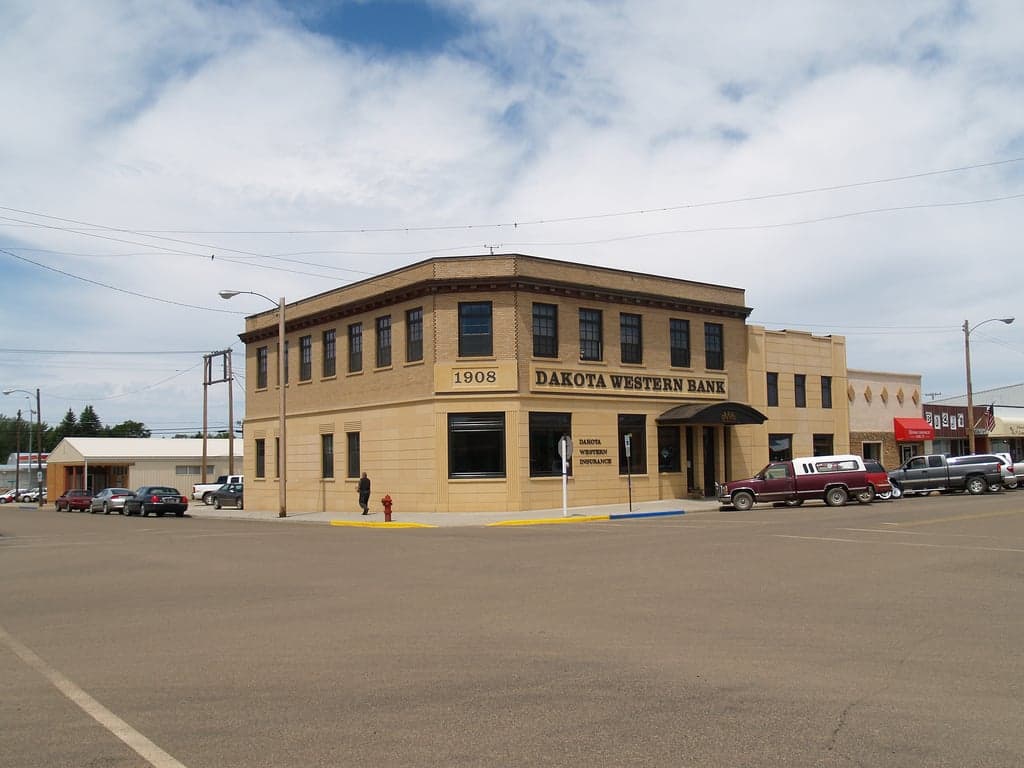
Photo: Wikipedia
Political ClimatePolitical Climate in Bowman County
Showing state-level results — no local-only data available.
Local Political AnalysisPolitical Analysis of Bowman County
Bowman County, North Dakota, is about as reliably Republican as any place in the state, with a Cook Partisan Voting Index (PVI) of R+18, meaning it votes roughly 18 points more Republican than the national average. That’s a deep red lean, and it’s been that way for decades—the county hasn’t backed a Democrat for president since Lyndon Johnson in 1964, and even then it was a squeaker. The trajectory here is steady, not shifting: the oil boom in the Bakken region, which touches the county’s western edge, has brought in new residents, but they’ve mostly reinforced the conservative tilt rather than diluting it. If you’re looking for a place where the political winds don’t change much, this is it.
How it compares
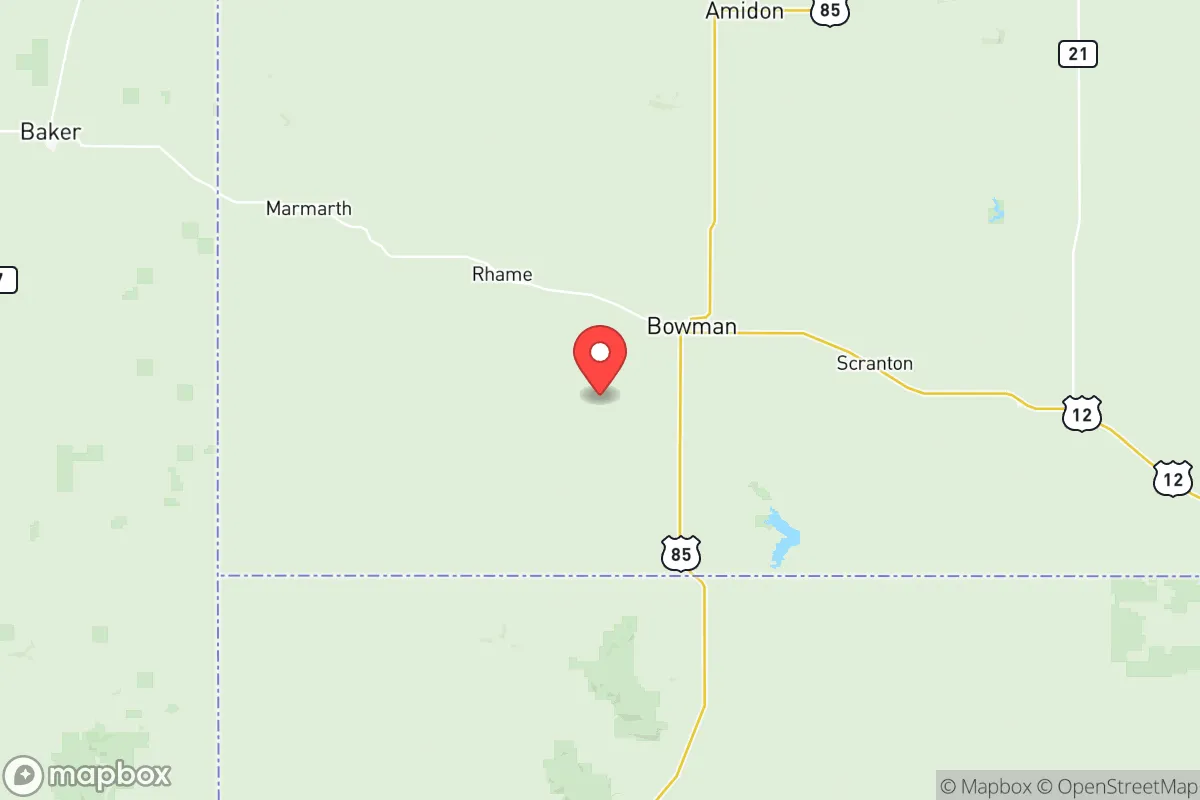
Bowman County’s R+18 PVI puts it well to the right of North Dakota as a whole, which is itself a reliably red state—though the state’s exact PVI isn’t published, it’s generally pegged around R+16 to R+20 depending on the cycle. So Bowman County is right in the ballpark of the state’s average, maybe a hair more conservative. Within the county, the political variation is subtle but real. The town of Bowman, the county seat and largest community, is the most reliably Republican precinct, often voting 80% or more for GOP candidates. Scranton, a smaller town to the east, leans similarly red but with a slightly higher independent vote—think 75-80% Republican. The only place you’ll find a hint of blue is in Rhame, a tiny community near the Montana border, where a handful of oil workers and younger families have nudged the Democratic vote up to about 15-20% in recent presidential elections. Still, that’s a far cry from competitive; the county’s swing precincts are really just between “very Republican” and “extremely Republican.” Compared to the state, Bowman County lacks the moderate pockets you see in places like Fargo or Grand Forks, where college towns and larger populations create a more mixed political landscape.
What this means for residents
For conservative residents, Bowman County’s political climate means their values are reflected in local governance without much friction. The county commission, school board, and city councils are uniformly Republican, so policies around taxes, land use, and energy development (especially oil and agriculture) tend to align with conservative priorities. For liberal residents, it’s a different story: they’re a distinct minority, and they often feel the weight of that in everyday life. There’s no active Democratic Party organization in the county, and progressive viewpoints on issues like renewable energy or social services can be met with polite dismissal rather than open debate. That said, the community is small enough—around 3,200 people—that political differences rarely get personal; neighbors help each other regardless of party. The practical effect is that local elections are often decided in the primary, and general elections are a formality. If you’re a conservative, you’ll find your voice amplified; if you’re a liberal, you’ll need to be comfortable being in the minority and focusing on common ground.
Culturally and policy-wise, Bowman County stands out for its strong emphasis on local control and self-reliance, which is typical of rural North Dakota but amplified here. The county has resisted some state-level mandates on land use and energy regulation, preferring to let the market and local landowners decide. There’s a palpable pride in the area’s agricultural and oil heritage, and that shapes everything from school curricula to public events. You won’t find much in the way of progressive policy experiments—no local carbon taxes or diversity initiatives—but you will find a community that pulls together for things like the Bowman County Fair or the annual pheasant hunt. For anyone moving here, the political climate is less about party labels and more about a shared ethos of hard work and independence, with the understanding that the county’s deep red lean is just part of the landscape, like the rolling plains and the Missouri River breaks.

State Political ClimatePolitical Climate in North Dakota
State Political AnalysisPolitical Environment in the State
North Dakota has been a reliably Republican state for decades, with a partisan lean that has only deepened in recent cycles. The state voted for Donald Trump by a margin of +34 points in 2024, a slight tightening from the +36-point margin in 2020 but still among the most Republican outcomes in the nation. The dominant coalition is a mix of rural agricultural voters, energy-sector workers in the Bakken region, and conservative-leaning small-business owners, with Democrats largely confined to a few tribal areas and the university towns of Grand Forks and Fargo. Over the past 10-20 years, the state has shifted rightward as the oil boom brought in new residents and as national polarization reshaped local politics, though the Democratic-NPL (Nonpartisan League) still holds a handful of legislative seats and occasionally wins local offices in the eastern part of the state.
Urban vs. rural divide
The political map of North Dakota is starkly divided between a handful of small urban centers and the vast rural expanse. Fargo, the largest city, is the state's most competitive area: Cass County voted for Trump by only +12 points in 2024, compared to the statewide +34, and the city itself has a visible Democratic presence, particularly among younger professionals and academics at North Dakota State University. Grand Forks, home to the University of North Dakota, is similarly moderate, with Grand Forks County voting +18 for Trump. In contrast, the rural counties in the western half of the state—like McKenzie, Williams, and Mountrail—routinely deliver margins of +50 to +70 points for Republicans, driven by the oil and gas industry and a strong libertarian-leaning culture. The Turtle Mountain and Standing Rock reservations are notable exceptions, consistently voting Democratic due to tribal sovereignty issues and federal funding concerns. The divide is less about suburbs versus cities and more about the handful of population centers versus the rest of the state.
Policy environment
North Dakota's policy environment is shaped by a deep-seated distrust of government and a preference for low taxes and limited regulation. The state has no state income tax (eliminated in phases starting in 2015), a low property tax rate (averaging about 0.98% of assessed value), and a sales tax of 5% that local governments can add to. The regulatory posture is business-friendly, particularly for energy extraction, agriculture, and manufacturing. Education policy is locally controlled, with school choice limited to charter schools and a small voucher program for special-needs students; there is no broad private school voucher system. Healthcare is a mixed bag: the state expanded Medicaid under the Affordable Care Act in 2013, but the legislature has resisted further expansion of government-run programs. Election laws are relatively permissive—same-day voter registration is allowed, and no-excuse absentee voting is available—though voter ID laws require a state-issued ID or tribal ID, which has been a point of contention for Native American voters. The state has a part-time legislature that meets for 80 days in odd-numbered years, which keeps lawmaking relatively slow and deliberate.
Recent policy direction
Recent legislation in North Dakota has moved decisively toward conservative priorities, particularly on cultural and economic issues. In 2023, the legislature passed a near-total abortion ban (HB 1250) with exceptions only for rape, incest, and medical emergencies, effectively ending abortion access in the state. Gun laws are among the most permissive in the nation: constitutional carry (permitless carry) was enacted in 2017, and there are no state-level restrictions on magazine capacity or assault weapons. Parental rights in education have been strengthened through laws requiring schools to notify parents of curriculum changes and allowing parents to opt their children out of certain materials. On property rights, the state has a strong tradition of mineral rights protection, with surface owner protections in the oil patch. Privacy and surveillance laws are minimal—there is no state-level data privacy law akin to California's, and law enforcement has broad leeway for warrantless searches in certain contexts. Voting access has been tightened slightly: a 2021 law (SB 2103) required voters to provide a residential address rather than a PO box, which disproportionately affected rural and tribal voters. The overall direction is toward more individual liberty on guns and taxes, but less on bodily autonomy and privacy.
Civil unrest & political movements
North Dakota has seen its share of political flashpoints, most notably the Standing Rock protests (2016-2017) against the Dakota Access Pipeline, which drew thousands of activists from across the country and resulted in mass arrests and a lasting tension between tribal sovereignty and energy development. Since then, the state has seen periodic protests over oil and gas development, particularly in the Bakken region, though these have diminished as production has stabilized. On the right, the state has a strong constitutional sheriff movement, with several sheriffs publicly refusing to enforce certain federal gun laws or vaccine mandates. There is no significant secession or nullification rhetoric, though some rural counties have passed symbolic resolutions opposing federal land management. Immigration politics are relatively quiet—the state has a small foreign-born population (about 4%), and there are no sanctuary city policies. Election integrity controversies have been minimal, though the 2020 election saw some local Republican officials question mail-in voting procedures. A new resident would notice that political activism is generally low-key compared to coastal states, with most people keeping their politics private in daily life.
Projection
Over the next 5-10 years, North Dakota is likely to remain solidly Republican, but with some subtle shifts. The Fargo-Moorhead metro area is growing faster than the rest of the state, attracting younger workers in tech, healthcare, and education who tend to be more moderate or even liberal. This could make Cass County a swing area in state legislative races, though it won't flip the state anytime soon. The rural population is aging and slowly declining, which may reduce the Republican margin in statewide races by a few points. The oil and gas industry is volatile—if prices stay high, the western counties will continue to drive the rightward tilt; if they crash, the state could see a temporary moderation as energy workers leave. In-migration from blue states is minimal compared to Texas or Florida, so the political culture will remain distinctly Northern Plains conservative. A new resident moving in now should expect the state to be reliably Republican for at least the next decade, with the main political action being internal GOP primaries rather than general elections.
For a new resident, the bottom line is that North Dakota offers a predictable, low-tax, low-regulation environment that aligns closely with conservative values on economics and gun rights, but with less cultural intensity than states like Texas or Florida. Liberal residents will find a small but active community in Fargo and Grand Forks, but should expect to be in the minority on most issues. The practical takeaway: if you value personal liberty on taxes and guns, and don't mind cold winters and a slow pace of life, North Dakota is a straightforward choice. If you're looking for a politically diverse or progressive environment, you'll need to stick to the university towns or look elsewhere.
* Values derived from national, state, county, city and local statistics and may differ in a specific area. Last updated: 2026-08-14T01:08:23.000Z
Narrative content on this page is AI-generated and may contain mistakes. Verify any details that matter before acting on them.
ReloMaps may earn a commission from affiliate links at no extra cost to you.

