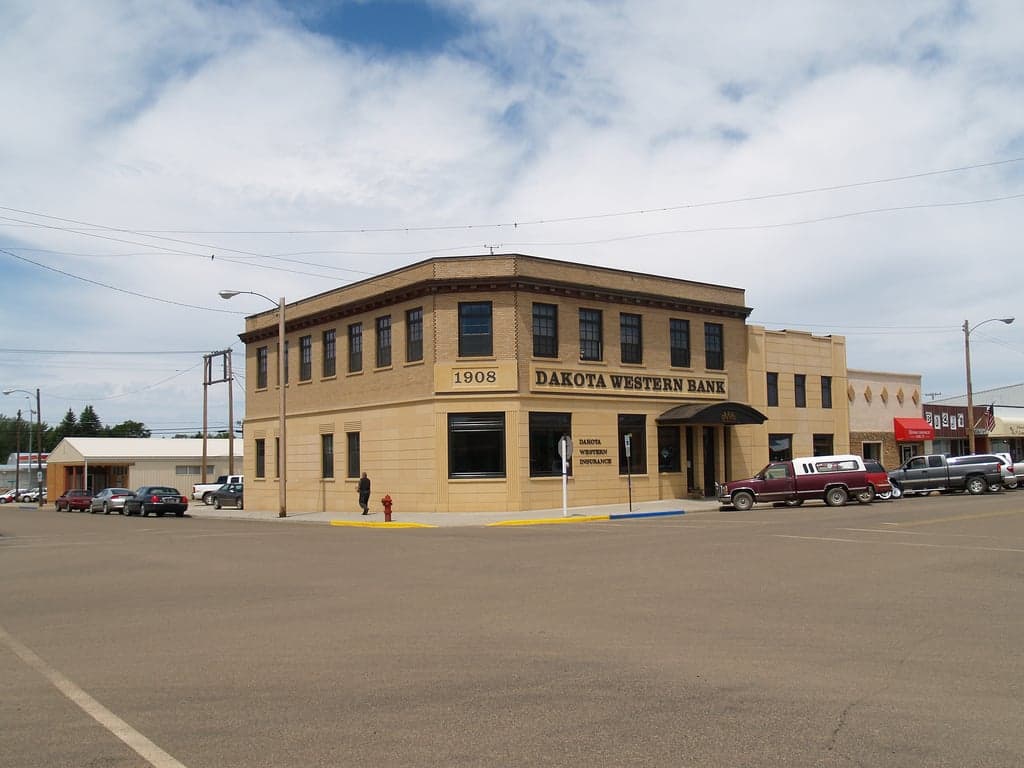
Photo: Wikipedia
Demographics of Bowman County
Affluence Level in Bowman County
A middle-class area roughly in line with national averages across income, home values, education, and employment.
People of Bowman County
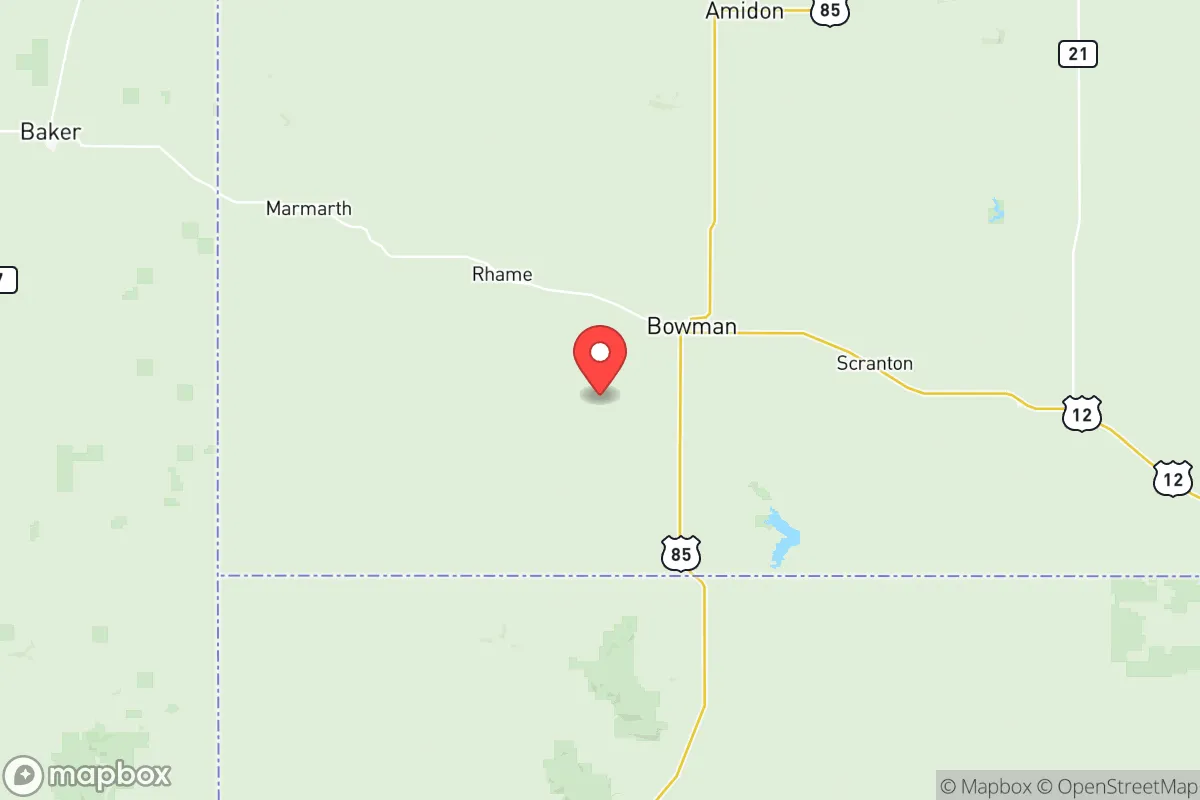
Bowman County, North Dakota, is home to approximately 2,935 residents, making it one of the state’s most sparsely populated counties, with a character defined by its agricultural roots, strong community ties, and a predominantly white population of 92.2%. The county’s people are concentrated in the city of Bowman, the county seat and only incorporated town, along with smaller unincorporated communities like Scranton, Gascoyne, and Rhame. Distinctive identity markers include a deep connection to ranching and farming, a politically conservative outlook, and a population that is notably older than the national median, with a foreign-born share of just 0.6% reflecting limited recent immigration.
Settlement & growth (pre-1960)
Before American settlement, the area now known as Bowman County was part of the traditional territory of the Sioux (Lakota) and Cheyenne nations, who followed bison herds across the Great Plains. The first non-Native presence came with the U.S. Army’s Fort Dilts in the 1860s, but permanent settlement did not begin until the arrival of the railroad in the early 1900s. The Milwaukee Road extended its line through the region in 1907, opening the land to homesteaders under the Enlarged Homestead Act of 1909, which offered 320 acres per claim.
The first major wave of settlers were Northern European immigrants, primarily Norwegians, Germans from Russia, and Swedes, who arrived between 1900 and 1920. These groups were drawn by the promise of cheap, fertile land for wheat farming and cattle ranching. The town of Bowman was platted in 1907 and quickly became the commercial hub, while Scranton (founded 1908) and Gascoyne (1910) grew as agricultural service centers. German-Russian immigrants, in particular, brought expertise in dryland farming techniques, allowing them to thrive in the semi-arid climate. The county’s population peaked at 4,596 in 1930, reflecting the homestead boom.
The Dust Bowl and Great Depression of the 1930s hit Bowman County hard, causing many families to abandon their farms. The population declined steadily through the 1940s and 1950s as agricultural mechanization reduced the need for labor, and younger residents left for cities like Bismarck or out of state. By 1960, the county’s population had fallen to 3,773, a trend that would continue for decades.
Modern era (post-1965)
The 1965 Hart-Cellar Act, which reshaped U.S. immigration, had virtually no impact on Bowman County. The county’s foreign-born population remains at 0.6%, and its racial composition has changed only marginally since 1965. The Hispanic share of 4.7% is the only notable minority presence, largely consisting of families who moved into the area for agricultural labor, particularly in the cattle and hay industries, starting in the 1990s. These Hispanic residents are dispersed across the county, with small concentrations in Bowman and Rhame, but no formal enclave has formed.
Domestic migration has been the dominant demographic force since 1965, but it has been a story of net out-migration rather than influx. The county’s population fell to 2,935 by 2020, a decline of over 35% from its 1960 level. Young adults continue to leave for college and employment in larger cities, while the remaining population ages: the median age is approximately 50, well above the national average. The oil boom in western North Dakota’s Bakken shale formation (2008–2014) briefly brought some new residents to the region, but Bowman County, located south of the main oil fields, saw only modest spillover effects. A small number of workers from Texas and Oklahoma moved to Bowman during the boom, but most left when oil prices fell.
The county’s Black population is 0.0%, and there are no recorded East/Southeast Asian or Indian-subcontinent residents, reflecting the area’s lack of urban job markets or ethnic community infrastructure. The college-educated share of 27.3% is below the national average, consistent with a rural, agricultural economy where many jobs do not require a four-year degree.
The future
Bowman County’s population is projected to continue its slow decline over the next 10–20 years, barring a major economic shift. The county’s birth rate is below replacement level, and out-migration of young adults is expected to persist. The Hispanic share may grow slightly as agricultural families have higher birth rates, but the overall population will likely remain overwhelmingly white and native-born. No new immigrant groups are anticipated to settle in significant numbers, as the county lacks the job diversity or housing stock to attract them.
The cultural identity of Bowman County is likely to remain rooted in its ranching and farming heritage, with a conservative social and political outlook. The county voted +68 for Donald Trump in 2020, reflecting its deep alignment with rural Republican values. For someone moving in now, the area offers a quiet, safe, and community-oriented lifestyle, but with limited economic opportunity and a shrinking population base. The county’s future hinges on whether it can attract remote workers or retirees seeking low-cost, rural living, but as of 2026, no significant demographic reversal is in sight.
Bowman County is becoming a quieter, older, and more homogeneous place, where the descendants of Norwegian and German-Russian homesteaders still form the backbone of the community. For a new resident, the appeal lies in the strong social fabric, low crime, and wide-open spaces, but the trade-off is a declining population and limited services. It is a place for those who value stability and tradition over growth and diversity.

* Values derived from national, state, county, city and local statistics and may differ in a specific area. Last updated: 2026-08-14T01:08:23.000Z
Narrative content on this page is AI-generated and may contain mistakes. Verify any details that matter before acting on them.
ReloMaps may earn a commission from affiliate links at no extra cost to you.

