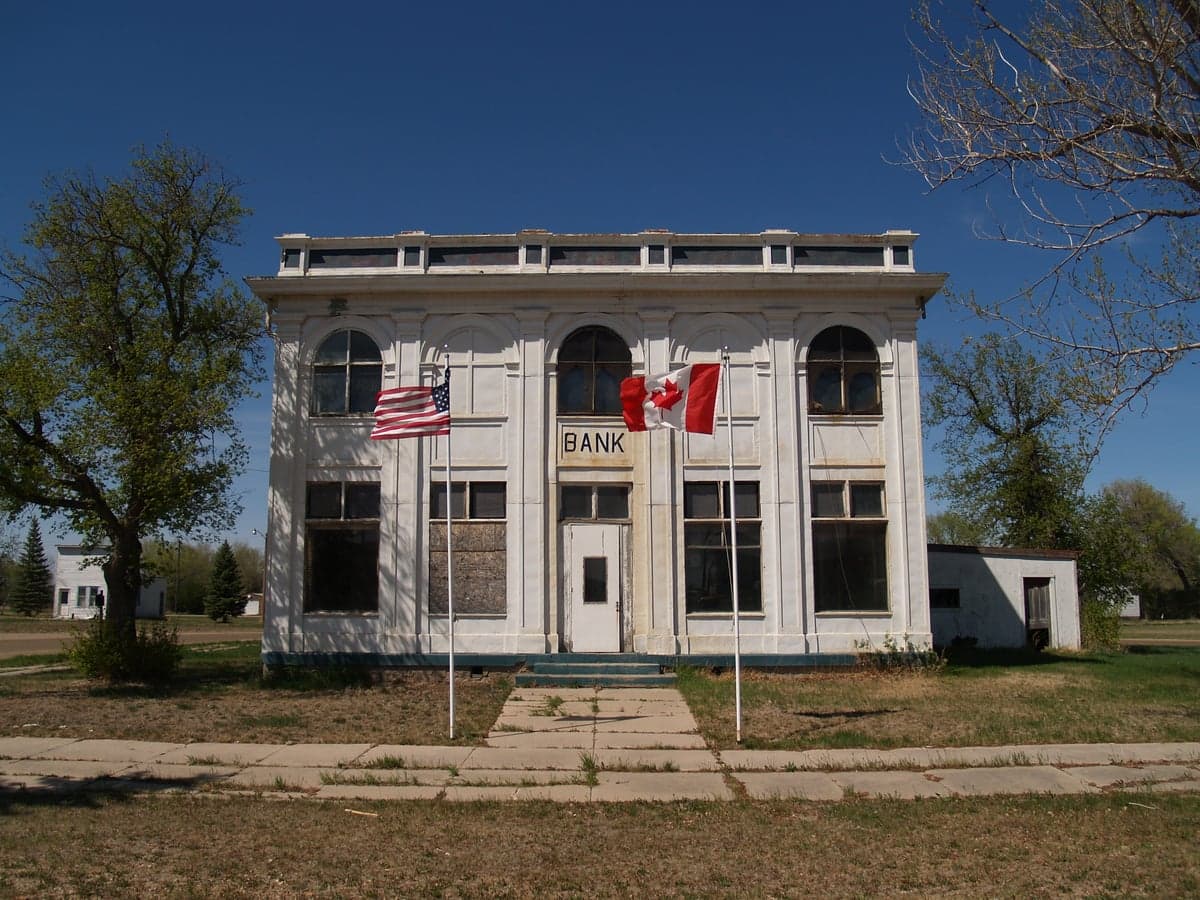
Photo: Wikipedia
Political ClimatePolitical Climate in Bottineau County
Showing county-level results — no local-only data available.
Lean and PVI are calculated from this county’s 2020 and 2024 presidential results, Cook-style.
Political rankings in North Dakota
- Most Conservative Cities in North Dakota
- Most Liberal Cities in North Dakota
- Best Liberal-Leaning Towns in the Midwest
- Safest Liberal-Leaning Towns in the Midwest
- Safest Conservative-Leaning Towns in the Midwest
- Affordable Small Towns for Conservatives
- Most Affordable Liberal-Leaning Small Towns in the U.S.
- Safest Conservative-Leaning Cities in the U.S.
- Most Conservative Counties in North Dakota
- Most Liberal Counties in North Dakota
Local Political AnalysisPolitical Analysis of Bottineau County
Bottineau County is one of the most reliably Republican counties in North Dakota, with a Cook Partisan Voting Index (PVI) of R+28, meaning it votes about 28 points more Republican than the national average. That’s a deep red lean, and it’s been that way for decades. The county has voted for the GOP presidential candidate by margins of 70% or more in every election since 2000, and in 2024, Donald Trump carried it with roughly 78% of the vote. There’s no real sign of that shifting — the county’s population is stable, mostly older, and heavily agricultural, which are all factors that reinforce conservative voting patterns. The only real variation is in the small towns: Bottineau, the county seat, tends to be slightly more moderate (still solidly red, but with a few more split-ticket voters), while rural precincts like those around Willow City and Westhope are among the most conservative in the state.
How it compares
Compared to North Dakota as a whole, Bottineau County is significantly more Republican. The state itself is reliably red — it hasn’t voted for a Democratic presidential candidate since Lyndon Johnson in 1964 — but its PVI is roughly R+20, meaning Bottineau is about 8 points more conservative than the statewide average. That gap shows up in local elections: Bottineau County often sends state legislators who are among the most conservative in the North Dakota House, while the state as a whole occasionally elects more moderate Republicans (like former Senator Heidi Heitkamp, a Democrat, in 2012). In practical terms, if you’re a conservative, you’ll find Bottineau County even more aligned with your views than most of the state. If you’re a liberal, you’ll find it tougher here than in, say, Grand Forks or Fargo — though there’s a small but persistent Democratic-leaning bloc in the city of Bottineau itself, mostly tied to the university (Dakota College at Bottineau) and a handful of local government workers.
What this means for residents
For conservatives, Bottineau County is a comfortable place to live politically. Local government, school boards, and the county commission are all Republican-dominated, and policy debates tend to focus on property taxes, agricultural regulations, and Second Amendment rights — issues where the majority view is already the law. For liberals, the reality is more about finding your niche. The city of Bottineau has a small but active Democratic-NPL (Nonpartisan League) group that meets monthly, and the college provides a slightly more diverse political environment. But you won’t find many progressive candidates on the ballot, and social issues like abortion or LGBTQ+ rights are rarely debated in public forums — the cultural consensus is conservative. That said, most residents, regardless of party, describe the county as civil and neighborly; political disagreements don’t usually spill into personal relationships the way they can in more polarized areas.
Culturally, Bottineau County stands out for its strong Norwegian and German heritage, which shapes everything from local festivals (like the Bottineau County Fair and the Norsk Høstfest in nearby Minot) to a general preference for small government and self-reliance. Policy-wise, the county is a stronghold for the state’s “right to farm” laws and has been a vocal supporter of the Bakken oil boom’s infrastructure, even though the county itself isn’t a major oil producer. There’s also a notable strain of libertarian-leaning independence — residents here are more likely to oppose federal land management policies (like those affecting the nearby Turtle Mountains) than to support new state-level regulations. In the long term, the county’s political trajectory is stable: it will remain deeply red, with the only real change being a slow, gradual aging of the electorate that could make it even more conservative over the next decade.

State Political ClimatePolitical Climate in North Dakota
State Political AnalysisPolitical Environment in the State
North Dakota has been a reliably Republican state for decades, but the nature of that conservatism has shifted noticeably since the early 2000s. The state’s overall partisan lean is deep red — Donald Trump won it by 33 points in 2020 and by 20 points in 2024 — but the coalition driving that majority has changed. The old agrarian populism that once produced figures like Senator Quentin Burdick has given way to a more culturally conservative, oil-and-gas-aligned Republicanism centered in the western half of the state. The 10-20 year arc shows a state that was already red becoming redder and more polarized along geographic and economic lines, with the Bakken oil boom accelerating a rightward shift that shows no sign of reversing.
Urban vs. rural divide
The political map of North Dakota is less an urban-rural split than a west-east divide with a small blue island. The state’s two largest cities, Fargo and Bismarck, both lean Republican, but Fargo is notably more moderate. In 2024, Cass County (Fargo) voted for Trump by 12 points, down from 18 in 2020 — a slight suburban drift toward the center. Bismarck’s Burleigh County went +28 for Trump. The only reliably Democratic-leaning area is the Grand Forks region, where the university population and unionized sugar beet workers in nearby East Grand Forks (technically Minnesota) create a small blue pocket; Grand Forks County itself voted +4 for Trump in 2024. The real engine of the state’s Republican dominance is the rural west and the oil patch. Williston, Watford City, and Dickinson routinely deliver margins of +50 to +70 points for Republicans, driven by a young, male, energy-sector workforce that is culturally and economically conservative. The state’s many small towns — Minot, Jamestown, Valley City — are uniformly red, with Trump winning Ward County (Minot) by 30 points in 2024. The only real political tension is between the old-school, low-tax, small-government conservatism of the eastern farming communities and the more libertarian, pro-energy, anti-regulation conservatism of the west.
Policy environment
North Dakota’s policy environment is shaped by a state government that has been under unified Republican control since 2011. The state has no income tax — it repealed its individual income tax in 2013 and has maintained that position. Property taxes are relatively low by national standards, though local levies vary; the average effective property tax rate is about 0.98%, below the national average. The regulatory posture is aggressively pro-business, especially in energy and agriculture. The state has a right-to-work law, no state-level minimum wage above the federal $7.25, and a regulatory framework for oil and gas that is among the most permissive in the country. Education policy is dominated by school choice: North Dakota has a robust open enrollment law, a growing charter school sector, and a 2023 law creating education savings accounts (ESAs) for special-needs students. Healthcare policy is limited; the state did not expand Medicaid under the Affordable Care Act until 2013, and then only after a federal court ruling forced the issue. Election laws are among the most restrictive in the nation: North Dakota requires a state-issued ID with a current residential address to vote, has no same-day registration, and in 2021 passed a law requiring absentee ballots to be notarized or witnessed by two adults. The state also has a voter ID law that was upheld by the Supreme Court in 2018.
Recent policy direction
The last five years have seen North Dakota’s legislature push aggressively on cultural and liberty-related issues. On gun and self-defense law, the state has constitutional carry (permitless carry for concealed weapons, passed in 2017) and a 2023 law that prohibits local governments from enacting gun restrictions stricter than state law. On parental and education rights, the 2021 “Parents’ Bill of Rights” (SB 2030) requires schools to notify parents of any curriculum changes and to obtain parental consent before students can access school library materials deemed “sexually explicit.” A 2023 law (HB 1205) bans transgender girls from participating in K-12 and college sports. On speech and privacy, the state has a 2023 law that prohibits social media platforms from “censoring” political speech, though it is currently tied up in litigation. On medical and bodily autonomy, North Dakota has a near-total abortion ban (HB 1466, 2023) that prohibits the procedure at fertilization, with exceptions only for rape, incest, and medical emergencies. The law is currently being challenged in state court. On property rights, the state has strong eminent domain protections for landowners, a legacy of the Dakota Access Pipeline protests. On taxation, the 2023 legislature passed a $515 million tax cut package that reduced individual income tax rates and expanded the homestead credit for seniors. On voting and ballot access, the state has not moved to expand mail-in voting; in fact, the 2021 law requiring notarized absentee ballots was a tightening measure.
Civil unrest & political movements
The most visible political flashpoint in recent North Dakota history was the Dakota Access Pipeline (DAPL) protests of 2016-2017 near the Standing Rock Reservation, which drew thousands of activists from across the country. The protests were a defining moment for the state’s political identity — they hardened the divide between the energy-driven western economy and the environmental and tribal interests of the eastern and central parts of the state. Since then, organized political movements have been quieter but persistent. On the right, the North Dakota Republican Party has seen internal battles between the establishment wing and a more populist, anti-establishment faction aligned with the state’s chapter of the Tea Party and later the MAGA movement. On the left, the North Dakota Democratic-NPL Party has shrunk to near-irrelevance, holding no statewide offices and only a handful of legislative seats. Immigration politics are not a major flashpoint — the state’s foreign-born population is only about 4%, mostly in Fargo and Grand Forks — but there have been local controversies over refugee resettlement, particularly in Fargo, where the city has a small but growing Somali and Bhutanese community. There is no serious secession or nullification movement in North Dakota, though the state has occasionally flirted with “state sovereignty” resolutions. Election integrity controversies have been minimal; the state’s voting system is widely trusted, and there were no major disputes after the 2020 or 2024 elections.
Projection
Over the next 5-10 years, North Dakota’s political trajectory is likely to remain deeply Republican, but the character of that Republicanism may shift. The state’s population is aging and slowly declining in rural areas, while Fargo and the oil patch continue to grow. Fargo’s growth — it added about 20,000 people between 2010 and 2020 — is bringing in a younger, more diverse, and slightly more moderate population, which could nudge Cass County toward swing territory over the next decade. But the western oil counties are growing even faster in terms of political weight, and they are pulling the state’s Republican Party further right on energy, regulation, and cultural issues. The state’s in-migration is overwhelmingly from other red states — Texas, Montana, and Minnesota — and is driven by energy jobs, which tends to reinforce the conservative tilt. The most likely scenario is that North Dakota remains a solidly red state, but with a growing internal tension between the moderate, business-friendly conservatism of the east and the populist, libertarian-leaning conservatism of the west. A new resident moving in now should expect a state where Republican primaries are the real elections, where the policy environment is stable and predictable for conservatives, and where liberals will find themselves in a permanent minority with limited political influence. The practical takeaway: if you are conservative, you will find a state that largely aligns with your values on taxes, guns, education, and regulation. If you are liberal, you will find a state where your vote matters little in statewide races but where local politics in Fargo or Grand Forks may offer some space for engagement.
* Values derived from national, state, county, city and local statistics and may differ in a specific area. Last updated: 2026-11-15T23:20:11.000Z
Narrative content on this page is AI-generated and may contain mistakes. Verify any details that matter before acting on them.
ReloMaps may earn a commission from affiliate links at no extra cost to you.

