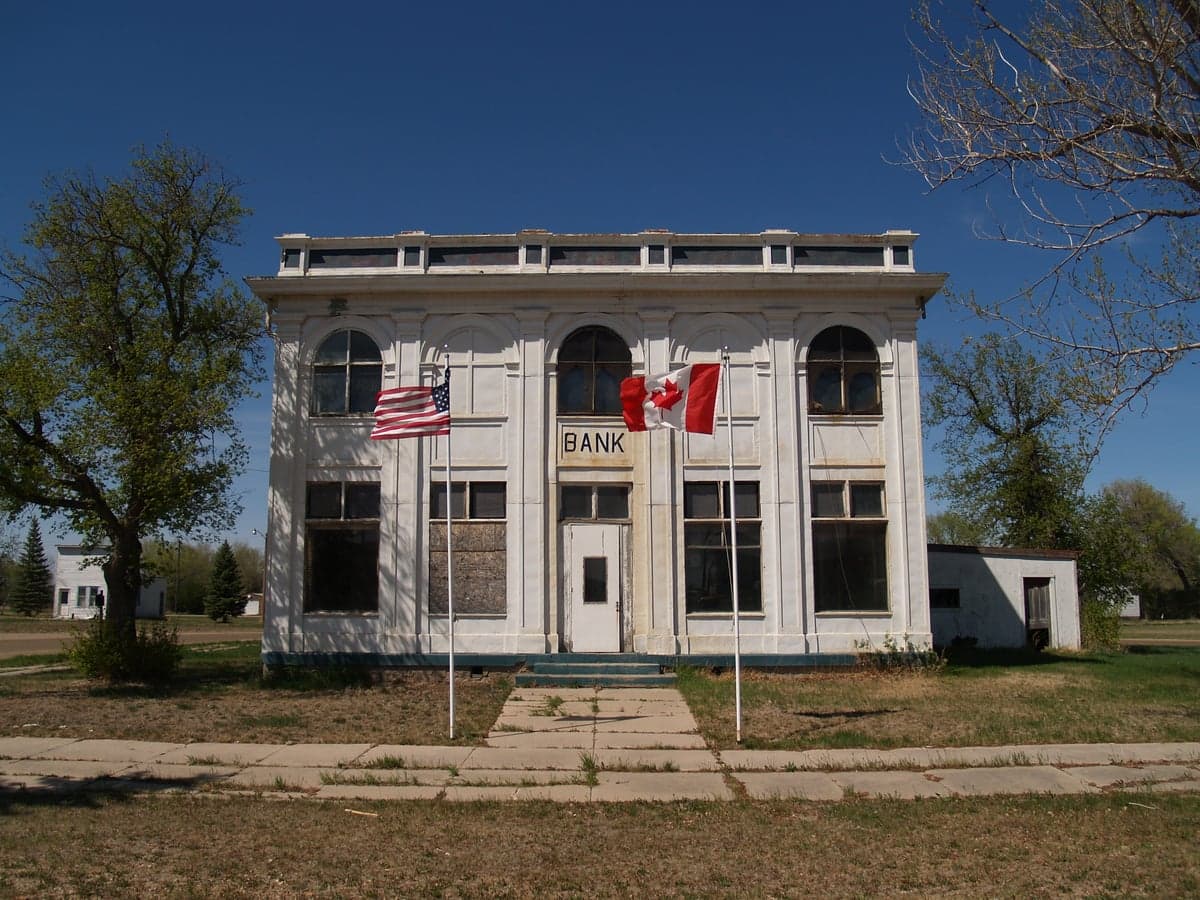
Photo: Wikipedia
Demographics of Bottineau County
Affluence Level in Bottineau County
A middle-class area roughly in line with national averages across income, home values, education, and employment.
People of Bottineau County
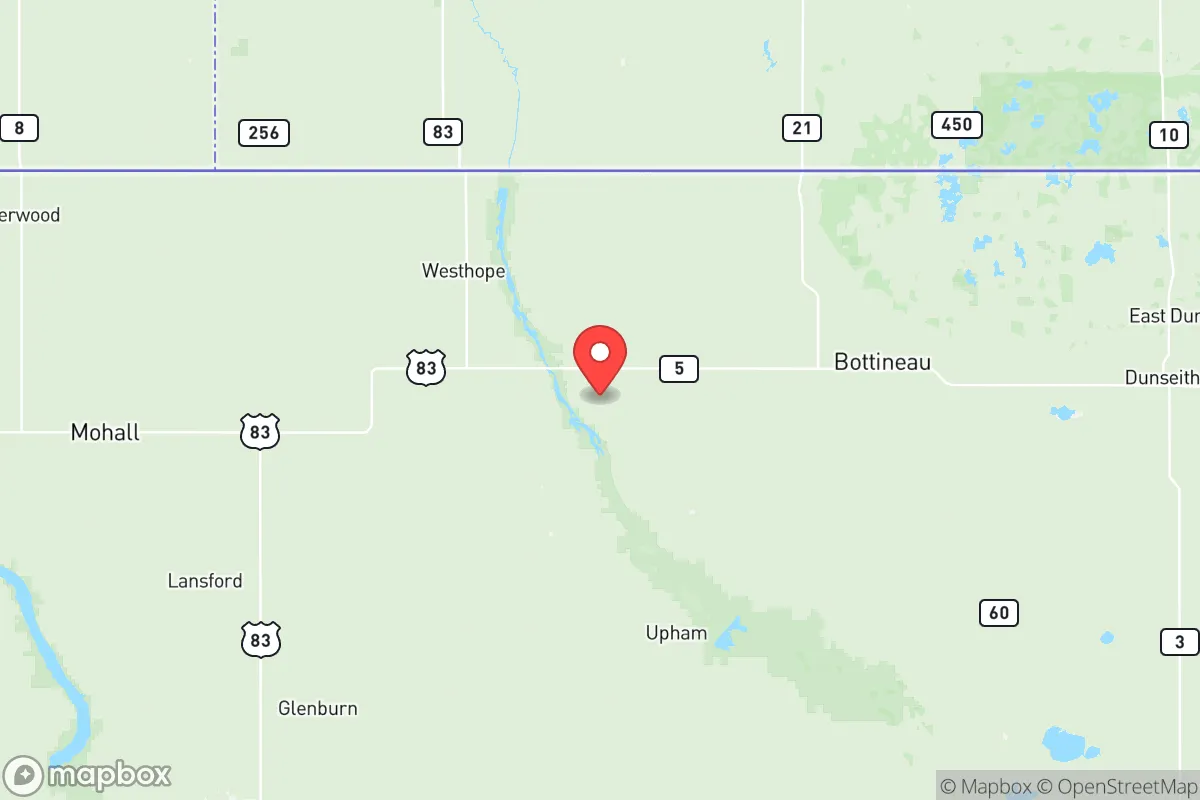
Today, Bottineau County, North Dakota, is home to roughly 6,390 residents, a population that is 89.7% white and notably homogenous even by regional standards. Its character is defined by a deep-rooted Scandinavian and German heritage, a quiet, rural pace of life, and a strong connection to the nearby Turtle Mountains and the international border with Canada. The county’s identity is less about a single bustling hub and more about a network of small, historically grounded communities where family names and local churches trace back generations.
Settlement & growth (pre-1960)
The land now known as Bottineau County was originally the domain of the Ojibwe (Chippewa) and, to a lesser extent, the Assiniboine and Plains Cree peoples. The Ojibwe, in particular, used the Turtle Mountains for hunting and gathering, and their presence shaped the region long before European settlement. The area was formally ceded by the Ojibwe in the 1892 Turtle Mountain Chippewa Agreement, opening the land to homesteaders. There was no significant Spanish, French, or British colonization of this specific area; instead, the primary European influence came from the fur trade, with French-Canadian and Métis trappers operating in the region throughout the 18th and early 19th centuries.
The major wave of settlement began in earnest with the arrival of the railroad in the 1880s and 1890s. The Great Northern Railway pushed a line through the area, and the promise of cheap, fertile land under the Homestead Act drew a flood of immigrants. The dominant groups were Norwegian and German immigrants, who arrived in large numbers between 1880 and 1910. These settlers were primarily farmers, drawn by the region's wheat-growing potential and the availability of 160-acre homesteads. They established the county's foundational communities. Bottineau, the county seat, was platted in 1883 and named after Pierre Bottineau, a Métis guide and frontiersman. It quickly became the commercial and social center for the surrounding agricultural area.
Other towns sprang up as service centers for the farming population. Westhope, founded in 1903, became a key grain-shipping point near the Canadian border. Willow City, established in 1887, grew around a mill and a railroad stop. Landa, founded in 1905, was a classic railroad town. Kramer, platted in 1905, was named after a railroad official. These towns were almost exclusively populated by descendants of the original Norwegian and German homesteaders, with a smaller but notable contingent of French-Canadian families, many of whom had roots in the earlier fur trade era. The population peaked around 1920 at over 12,000 residents, reflecting the peak of the homesteading era. The subsequent decades saw a slow, steady decline as agricultural consolidation and the Dust Bowl pushed younger generations off the land and toward larger cities.
Modern era (post-1965)
The post-1965 period, marked by the Hart-Cellar Act, had a minimal direct impact on Bottineau County. Unlike major urban centers or Sun Belt suburbs, the county did not experience significant immigration from new global sources. The foreign-born population today stands at just 2.3%, a figure that has remained consistently low. The demographic story of the modern era is one of continued out-migration and an aging population, rather than diversification through immigration.
The most significant demographic shift has been the gradual loss of young adults, who leave for educational and employment opportunities in larger cities like Minot, Grand Forks, or Fargo. This has led to a population that is older than the state average. The county's racial and ethnic composition has remained remarkably stable. The 89.7% white population is a direct continuation of the 19th-century settlement patterns. The small Hispanic population (2.4%) is largely composed of families who have moved into the area for work in agriculture or at the Lake Metigoshe State Park area, a popular tourist destination in the Turtle Mountains. The tiny East/Southeast Asian population (0.6%) is often connected to the presence of Dakota College at Bottineau, which attracts a small number of international students and faculty. The Black (0.4%) and Indian subcontinent (0.0%) populations are negligible.
Suburbanization, as understood in a metropolitan context, has not occurred. Instead, the pattern has been one of population concentration in the county seat. Bottineau city itself has held its population relatively steady, while the smaller towns like Westhope, Willow City, and Landa have seen more significant declines. The county's cultural identity remains firmly rooted in its Scandinavian and German heritage, celebrated through events like the Bottineau County Fair and the strong presence of Lutheran churches.
The future
The demographic trajectory for Bottineau County points toward a continuation of current trends: a slowly shrinking, aging, and overwhelmingly white population. The county's population of 6,390 is projected to remain flat or decline slightly over the next 10-20 years, barring a major economic shift. The primary driver of any future change will be economic opportunity. The expansion of the oil and gas industry in the western part of the state has had a limited spillover effect, but Bottineau County lacks the infrastructure and geological focus to attract a major energy workforce.
There is a small but notable potential for growth tied to tourism and recreation. The Turtle Mountains, with Lake Metigoshe and extensive trail systems, are a regional draw. If this sector expands, it could attract new residents, possibly including a slightly more diverse mix of service-industry workers and retirees. However, this is unlikely to fundamentally alter the county's demographic makeup. The county is not becoming more diverse in any meaningful way; the Hispanic and Asian populations are expected to remain very small percentages of the total.
The cultural identity will likely remain stable, with a strong emphasis on local history, outdoor life, and community self-reliance. The next generation of residents will likely be a mix of those who inherit family farms and those who choose the area for its low cost of living and quiet, safe environment.
For someone moving in now, Bottineau County offers a place where the past is still very present. It is a community built on a specific, deep-rooted heritage, and its future will be defined by how it balances the preservation of that heritage with the modest economic opportunities available. It is a place for those seeking a quiet, rural life in a close-knit, culturally homogenous setting, rather than a destination for demographic change or rapid growth.

* Values derived from national, state, county, city and local statistics and may differ in a specific area. Last updated: 2026-11-15T23:20:11.000Z
Narrative content on this page is AI-generated and may contain mistakes. Verify any details that matter before acting on them.
ReloMaps may earn a commission from affiliate links at no extra cost to you.

