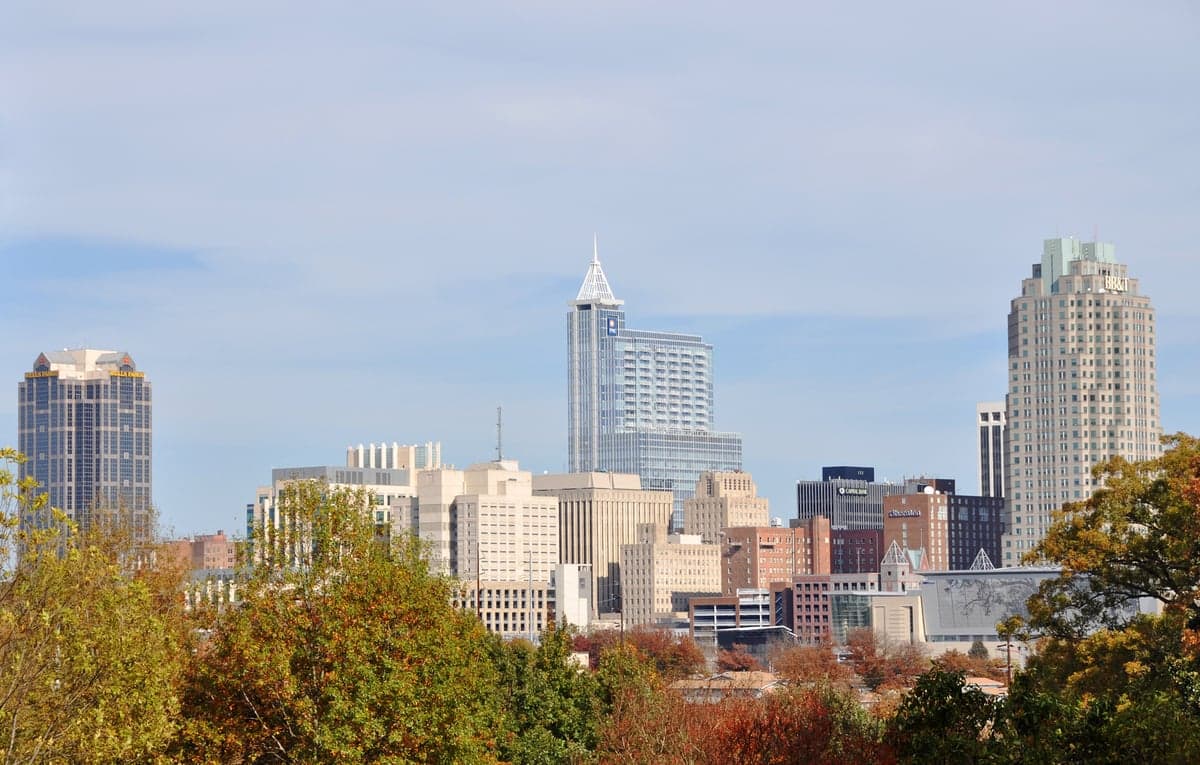
Photo: Wikipedia
Personal Sovereignty in Wake County
Viable for self-reliance. Generally workable, though some barriers may limit total independence.
What does Personal Sovereignty tell us?
Personal Sovereignty measures your capacity for self-reliance and independence with minimal government friction. Higher scores mean fewer barriers between you and the way you want to live... but it assumes you have the space you need and good neighbors.
What does this tell us?
Personal Sovereignty measures your capacity for self-reliance and independence with minimal government friction. Higher scores mean fewer barriers between you and the way you want to live... but it assumes you have the space you need and good neighbors.
State Policy
Energy independence: Importer (15% of energy produced in-state)
Personal Liberty
Homesteading

Personal Liberty Analysis
Wake County, North Carolina, presents a complex landscape for personal sovereignty that demands careful scrutiny from anyone prioritizing autonomy over government reach. While the county’s explosive growth and progressive urban centers like Raleigh and Cary exert significant pressure on individual freedoms through dense regulation and higher taxes, the broader state framework—including constitutional carry, a right-to-work law, and a preemption statute that limits local gun control—provides a meaningful floor of liberty that many Northeastern or West Coast jurisdictions lack. However, the gap between the county’s urban core and its rural fringe is stark, and a strategic relocation requires understanding where you can actually exercise self-reliance versus where you’ll be fighting city hall at every turn.
Tax burden and regulatory posture in Wake County vs. surrounding areas
Wake County’s tax burden is moderate by national standards but high for North Carolina, driven by rapid infrastructure demands and a robust public school system. The combined property tax rate in Raleigh hovers around 0.58% of assessed value, while Cary and Apex are slightly lower near 0.55%. That’s roughly $2,900 annually on a $500,000 home—not crushing, but notably higher than in neighboring Johnston County (around 0.48%) or Franklin County (0.52%). Income tax is a flat 4.75% state rate, with no local add-ons, and sales tax is 7.25% in Wake versus 6.75% in some rural counties. The regulatory posture is where sovereignty takes a hit: Wake County enforces strict stormwater management, tree preservation ordinances, and zoning codes that limit what you can do on your property. In Raleigh, for example, you cannot keep chickens on lots under 10,000 square feet without a special permit, and backyard beekeeping requires registration. Compare that to Zebulon or Wendell, where agricultural zoning is more permissive and code enforcement is far less aggressive. The county’s Unified Development Ordinance is a thick document that governs everything from fence heights to home-based businesses, and the permitting process for any structural change can take months. For a prepper mindset, this means Wake’s urban centers are actively hostile to self-sufficient modifications, while the eastern and northern towns—Rolesville, Knightdale, and the unincorporated areas near Holly Springs—offer more breathing room.
Self-defense and gun law specifics in Wake County
North Carolina is a constitutional carry state as of 2023, meaning law-abiding adults can carry a concealed handgun without a permit. This is a major win for personal sovereignty, and Wake County sheriffs have historically been pro-issuance for permits when they were required. However, the county is not a gun-friendly paradise. Raleigh, Cary, and Morrisville all have city ordinances that ban firearms in public parks and recreation centers, a direct violation of state preemption law that has been challenged but remains enforced. The state preemption statute (NCGS 14-409.40) prohibits local governments from regulating firearms, but these cities have carved out exceptions for “buildings and grounds” under their control. Practically, this means you cannot carry in a Cary park or Raleigh’s Pullen Park without risking a misdemeanor. The Wake County courthouse and all schools are off-limits, as are establishments that derive 51% or more of revenue from alcohol sales (unless you have a permit, which is now optional). For self-defense in the home, North Carolina’s Castle Doctrine is strong—no duty to retreat, and deadly force is presumed reasonable if an intruder has unlawfully entered. Stand Your Ground applies statewide. The real sovereignty issue is storage: Wake County has no safe-storage mandate, but the state does require firearms to be stored safely if a minor could access them. For a prepper, the key takeaway is that you can carry in most of Wake County outside of city parks, but you must know the exact boundaries of each municipality’s restrictions. Zebulon and Wendell have no park carry bans, making them safer bets for those who want to avoid legal gray areas.
Self-reliance and homesteading viability: lot sizes, zoning, and off-grid feasibility
Homesteading in Wake County is a tale of two landscapes. Inside the I-540 beltway, lot sizes average 0.25 to 0.5 acres, and zoning is overwhelmingly residential suburban (R-4, R-6, R-10 codes). Raising livestock is effectively impossible: chickens are limited to 6 hens (no roosters) on lots over 10,000 square feet in Raleigh, and goats, pigs, or cattle are prohibited in most subdivisions. Off-grid living is a non-starter in the urban core—the county requires connection to municipal water and sewer where available, and solar panels must comply with HOA covenants that often ban visible arrays. Even rainwater collection is regulated: North Carolina allows it, but Wake County requires a permit for systems over 1,000 gallons, and you must have a backup municipal connection. The picture changes dramatically as you move east toward Wendell, Zebulon, and the unincorporated areas near the Neuse River. Here, lot sizes of 1 to 5 acres are common, and agricultural zoning (RA-20) allows horses, cattle, and poultry without special permits. Off-grid feasibility improves: well and septic are standard, and the county’s building code is less aggressively enforced for accessory structures like barns or greenhouses. Rolesville and the northern fringe near the Franklin County line offer similar opportunities, with some parcels zoned for “rural residential” that permit limited commercial agriculture. For a prepper, the sweet spot is the eastern half of the county—anything east of US-401 or north of I-87—where you can realistically have a garden, a few animals, and a backup power system without constant code enforcement visits. The western towns like Apex and Holly Springs are rapidly suburbanizing and will only become more restrictive.
Personal liberties: parental rights, medical autonomy, speech, and property
North Carolina’s state-level legal framework provides a solid baseline for personal liberties, but Wake County’s local governance often pushes the envelope. On parental rights, the state has a Parents’ Bill of Rights (HB 755, 2023) that affirms parents’ authority over their children’s education, healthcare, and moral upbringing. Wake County Public Schools, however, has been a flashpoint: the district’s policy on gender-inclusive bathrooms and its refusal to notify parents of certain curriculum changes have drawn lawsuits and protests. For parents seeking to opt their children out of specific lessons or medical screenings, the process is cumbersome and often requires legal advocacy. Homeschooling is fully legal and lightly regulated—you simply file a notice with the state and administer a standardized test annually—and Wake County has a thriving homeschool co-op network, particularly in the eastern towns. Medical autonomy is mixed: North Carolina has not expanded Medicaid under the ACA, which limits options for low-income residents, but private healthcare is robust. Vaccine mandates are not enforced at the state level for adults, and Wake County’s health department does not require COVID-19 vaccines for public services. However, the county’s hospitals (UNC Rex, WakeMed) follow CDC guidelines closely, and some employers in the Research Triangle Park require vaccination. On speech and property, Wake County is generally respectful of First Amendment rights—protest permits are issued without hassle—but property rights are constrained by the aforementioned zoning and HOA regimes. In unincorporated areas near Fuquay-Varina and Zebulon, you can build a privacy fence up to 8 feet without a permit, and there are no noise ordinances that would prevent generator use or target practice on private land (within state firearm discharge laws). In Raleigh, by contrast, noise complaints can bring police to your door for a generator running after 10 PM.
Overall, Wake County offers a moderate-to-strong sovereignty environment compared to deep-blue states like California or New York, but it falls short of the libertarian-friendly counties in western North Carolina or the rural Deep South. The state’s constitutional carry law, right-to-work status, and parental rights legislation provide a meaningful buffer against local overreach. However, the county’s urban centers—Raleigh, Cary, Apex, Morrisville—are actively eroding those freedoms through park carry bans, restrictive zoning, and aggressive code enforcement. For a prepper or survivalist, the strategic play is to locate in the eastern or northern fringe: Zebulon, Wendell, Rolesville, or unincorporated areas near Fuquay-Varina. These towns offer the legal and physical space to live self-sufficiently while still accessing the economic opportunities of the Triangle. If you must be inside the beltway, be prepared to fight for every modification and accept that your autonomy will be constrained by HOA covenants and city ordinances. Wake County is not a sovereignty paradise, but with careful location selection, it can be a workable base for those who value freedom over convenience.

* Values derived from national, state, county, city and local statistics and may differ in a specific area. Last updated: 2026-05-08T06:59:30.000Z
Narrative content on this page is AI-generated and may contain mistakes. Verify any details that matter before acting on them.
ReloMaps may earn a commission from affiliate links at no extra cost to you.

