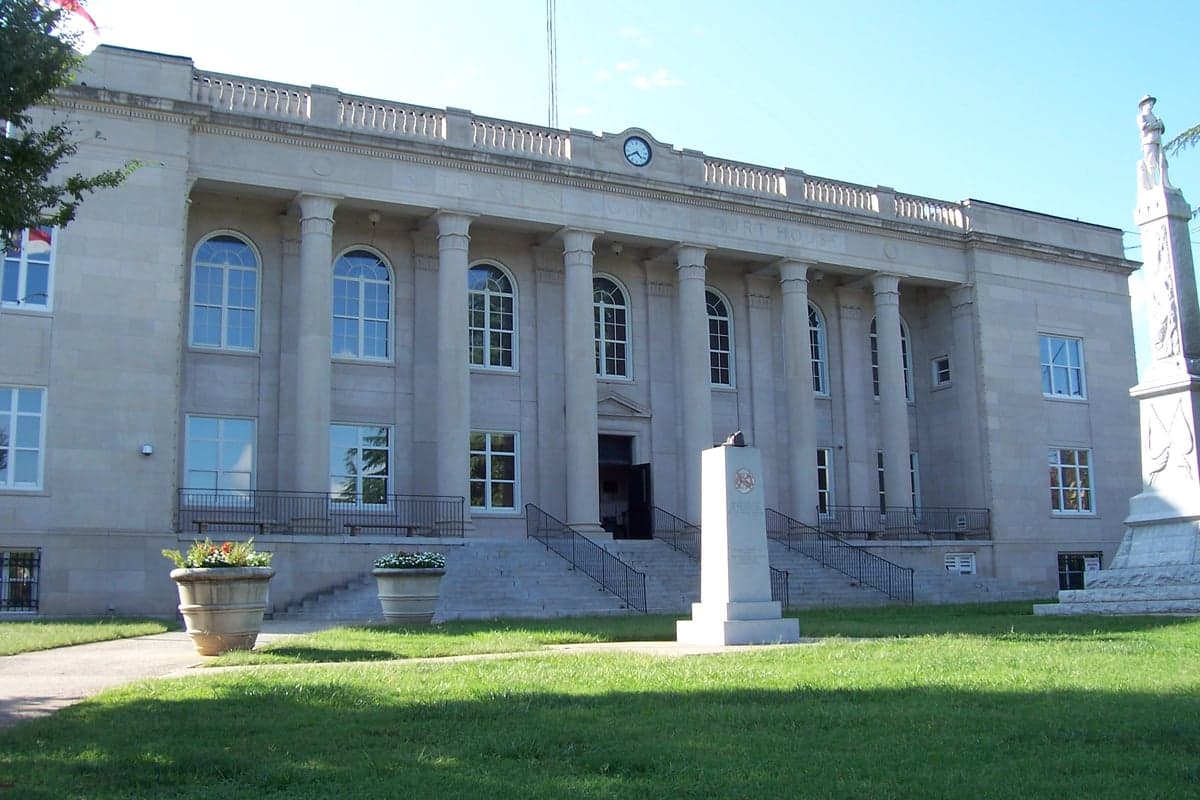
Photo: Wikipedia
Political ClimatePolitical Climate in Rutherford County
Showing district-level results — no local-only data available.
Local Political AnalysisPolitical Analysis of Rutherford County
Rutherford County is a solidly Republican corner of western North Carolina, with a Cook PVI of R+8 — meaning the county votes about eight points more Republican than the nation as a whole. That’s a stark contrast to the state’s overall R+1 rating, which reflects North Carolina’s status as a true battleground. The county has been drifting rightward for decades, and while the GOP’s margin has fluctuated with the national environment, the underlying trend is unmistakable: Rutherford is getting redder, not bluer.
How it compares
To put the numbers in perspective, Rutherford County’s R+8 puts it in the same league as neighboring Cleveland County (R+15) and McDowell County (R+17), but it’s noticeably more conservative than the state as a whole. In the 2024 presidential race, Donald Trump carried Rutherford by roughly 30 points, while he won North Carolina by just over 3 points. The gap between the county and the state has widened over the past two cycles — in 2016, Trump won Rutherford by about 25 points, and in 2020 by about 28. That’s not a fluke; it’s a pattern. The county’s rural character, manufacturing history, and older demographic profile all push it right, while the state’s growth in the Research Triangle and Charlotte suburbs pulls the statewide number toward the center.
What this means for residents
For conservatives, living in Rutherford means your vote carries real weight in local races — the county commission, sheriff, and school board are all reliably Republican, and primaries are often the real contest. For liberals, it means accepting that you’re in the minority, but not an invisible one. The county’s two population centers tell the story: Forest City and Spindale lean slightly more Democratic, thanks to a mix of older mill-town voters and a small but active progressive community, while Rutherfordton and the unincorporated areas around Lake Lure and Chimney Rock are deeply red. The swing precincts are mostly in the eastern part of the county, around the Bostic and Ellenboro areas, where a handful of votes can flip a local race. In practice, that means a Democrat can win a county commission seat if they run a strong local campaign and pick up those eastern precincts, but it’s an uphill climb.
What daily life is like for families
Politically, daily life in Rutherford is less polarized than the numbers suggest. People here tend to know their neighbors regardless of party, and the issues that dominate local conversation — jobs at the county’s remaining textile and manufacturing plants, the cost of living, and the condition of roads like US-74 and NC-108 — cut across partisan lines. The county’s politics are also shaped by its geography: the western half, toward the Blue Ridge escarpment, is more tourism-dependent and slightly more moderate, while the eastern half, anchored by Forest City, is more industrial and more conservative. That split means a county commissioner from the west often has to balance the interests of vacation-home owners with the concerns of year-round residents in the east.
One cultural distinction worth noting: Rutherford County has a strong tradition of gun ownership and evangelical Christianity, and that shows up in everything from the local sheriff’s office’s stance on Second Amendment rights to the prominence of churches in community life. But it’s also a county that has voted for Democratic governors in the past — Roy Cooper carried it in 2016 — and there’s a pragmatic streak that resists the national culture wars. Looking ahead, the county’s trajectory is likely to stay red, but the margin could narrow slightly as retirees and remote workers move into the Lake Lure area, bringing a more mixed political outlook with them. For now, though, Rutherford remains a place where the Republican primary is the election that matters most.

State Political ClimatePolitical Climate in North Carolina
State Political AnalysisPolitical Environment in the State
North Carolina is the closest thing the country has to a 50-50 state right now, with a Cook PVI of R+1 that undersells just how tight every statewide race has become. The state has swung back and forth over the last two decades — Barack Obama won it in 2008, Donald Trump took it in 2016 and 2020, and Republicans have held the governorship only once since 1993, while the GOP legislature has enjoyed veto-proof supermajorities for most of the last decade. What you’re really looking at is a state where the fast-growing urban crescent (Charlotte, Raleigh, Wilmington) pulls hard left, the rural east and mountain west pull hard right, and the suburbs in between decide everything.
Urban vs. rural divide
The political map of North Carolina is essentially a tale of two crescents. The urban corridor running from Charlotte through the Triad (Greensboro, Winston-Salem) up to Raleigh-Durham is the Democratic engine, powered by transplants, tech workers, and university communities. Mecklenburg County (Charlotte) and Wake County (Raleigh) alone account for nearly a quarter of the state’s votes, and they vote about 65-35 Democratic. The rural east — places like Robeson County, Pitt County, and the old textile towns along I-95 — is ancestrally Democratic but has shifted hard Republican over the past 15 years, driven by cultural conservatism and economic anxiety. The mountain counties in the west, like Henderson and Watauga, are a mixed bag: Watauga (Boone) is a liberal college enclave, while the surrounding rural counties are deep red. The real battleground is the suburban ring — Union County (southeast of Charlotte), Cabarrus County, and Johnston County (southeast of Raleigh) have all moved from solidly Republican to competitive, and they’re where statewide elections are actually decided.
Policy environment
North Carolina’s policy posture is a study in contrasts. The state has a flat income tax rate of 4.5% that’s scheduled to drop to 3.99% by 2027, and the corporate tax rate is already down to 2.5% — among the lowest in the country. There’s no state property tax (counties handle that), and the sales tax is around 6.75% in most areas. The regulatory climate is business-friendly, which is why Charlotte has become a major fintech hub and the Research Triangle continues to attract biotech and pharma companies. On education, the state funds a school voucher program (the Opportunity Scholarship Program) that’s been expanded to cover all families regardless of income, and charter schools are plentiful. Healthcare is where things get complicated: the state finally expanded Medicaid in 2023 under Democratic Governor Roy Cooper, but the legislature added work requirements for able-bodied adults. Election laws are moderately restrictive — voter ID is required, early voting is generous (17 days), and same-day registration is available during early voting. The state does not have a “stand your ground” law on the books, but it does have a Castle Doctrine and permitless carry for concealed handguns was passed in 2021.
Recent policy direction
The last five years have seen a clear rightward shift on cultural and social issues, even as the state’s economy stays centrist. The 2023 session produced a 12-week abortion ban (down from 20 weeks), a ban on gender-affirming care for minors, and a law requiring public schools to notify parents if a student requests a name or pronoun change. The legislature also overrode Governor Cooper’s vetoes on all three. On guns, the 2021 permitless carry law was a major win for Second Amendment advocates, and the state has preempted local governments from enacting their own gun ordinances. Property rights are strong — the state has a “right to farm” law that protects agricultural operations from nuisance lawsuits, and there’s no statewide zoning mandate, so counties have wide latitude. On voting, the 2023 election law overhaul shortened the mail-in ballot deadline, added stricter ID requirements, and made it harder for third parties to collect absentee ballots. The state Supreme Court flipped to a 5-2 Republican majority in 2022 and immediately reversed a previous ruling that had struck down the voter ID law.
Civil unrest & political movements
North Carolina has a visible but not chaotic activist scene. The Moral Monday movement, led by the NAACP, has staged regular protests at the state legislature in Raleigh since 2013, drawing thousands on peak days. The 2020 George Floyd protests in Charlotte and Raleigh were mostly peaceful but did see some property damage and curfews. On the right, the state has active Moms for Liberty chapters in Wake and Mecklenburg counties, and the “Parents’ Bill of Rights” law passed in 2023 was a direct response to their lobbying. Immigration is a live issue — the state has no sanctuary cities, and several counties (including Gaston and Iredell) have passed resolutions declaring themselves “Second Amendment sanctuaries” that refuse to enforce certain federal gun laws. Election integrity remains a flashpoint: the 2020 election saw lawsuits over absentee ballot rules, and the 2024 cycle has already produced litigation over the new voter ID requirements. The state’s secessionist rhetoric is minimal — this isn’t Texas — but there’s a persistent rural-urban cultural tension that shows up in fights over Confederate monuments (several were removed in 2020) and school curriculum.
Projection
Over the next decade, North Carolina is likely to get more competitive, not less. The state is adding about 100,000 new residents a year, and most of them are landing in the urban crescent — Charlotte, Raleigh, and the Wilmington area. Those newcomers skew younger, more educated, and more Democratic, which is why the state’s PVI has moved from R+3 in 2016 to R+1 today. But the rural areas are not shrinking — they’re just aging, and older voters are reliably Republican. The wildcard is the suburbs: places like Union County and Johnston County are filling up with families who moved for jobs and schools, and they’re voting more like the national suburbs — split on economics, conservative on crime, moderate on social issues. The 2024 governor’s race (Democrat Josh Stein vs. Republican Mark Robinson) will be a real test of whether the state is trending blue or just oscillating. Expect the legislature to stay Republican for the foreseeable future due to gerrymandering, but expect the statewide races to stay within 2-3 points either way.
For a new resident, the practical takeaway is this: North Carolina gives you a genuinely mixed experience. If you’re conservative, you’ll find a low-tax, business-friendly state with strong Second Amendment protections and a legislature that’s actively pushing parental rights and school choice. If you’re liberal, you’ll find growing urban centers with progressive local governments, a Medicaid expansion that’s helping rural hospitals, and a state that’s within striking distance of turning purple. The key is to pick your county carefully — the difference between living in Raleigh (Wake County) and living 20 minutes away in Clayton (Johnston County) is politically as wide as the difference between Massachusetts and Texas. That’s not a bug; it’s the nature of a state that’s genuinely split down the middle.
* Values derived from national, state, county, city and local statistics and may differ in a specific area. Last updated: 2026-10-09T03:10:58.000Z
Narrative content on this page is AI-generated and may contain mistakes. Verify any details that matter before acting on them.
ReloMaps may earn a commission from affiliate links at no extra cost to you.

