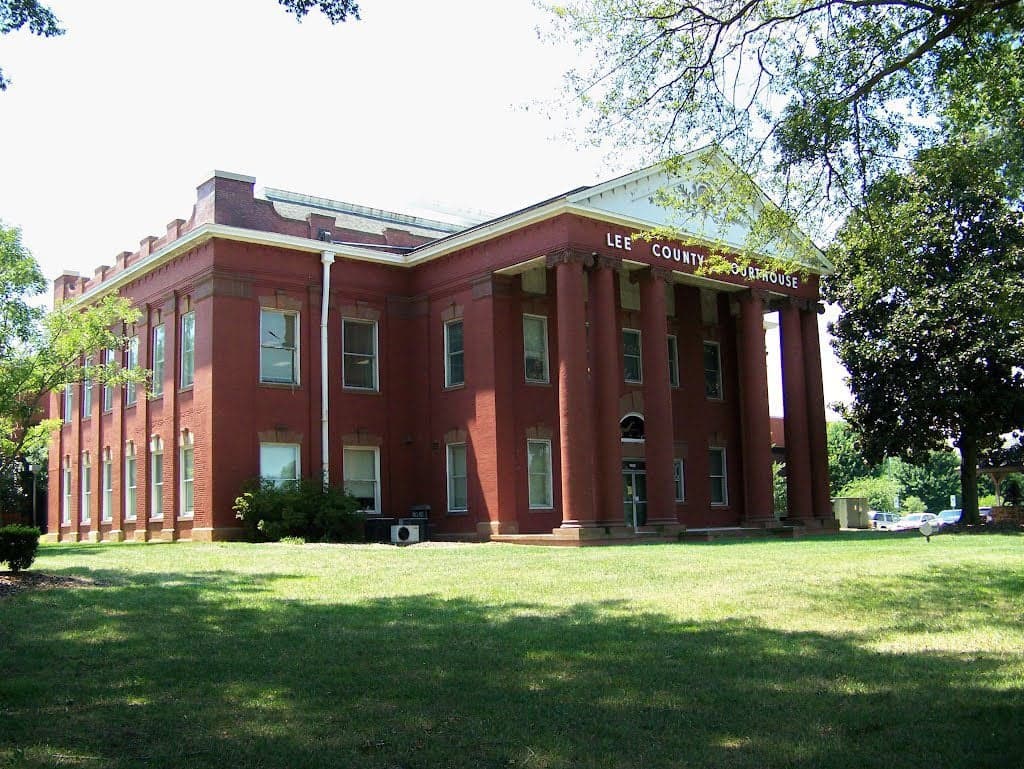
Photo: Wikipedia
Political ClimatePolitical Climate in Lee County
Showing district-level results — no local-only data available.
Local Political AnalysisPolitical Analysis of Lee County
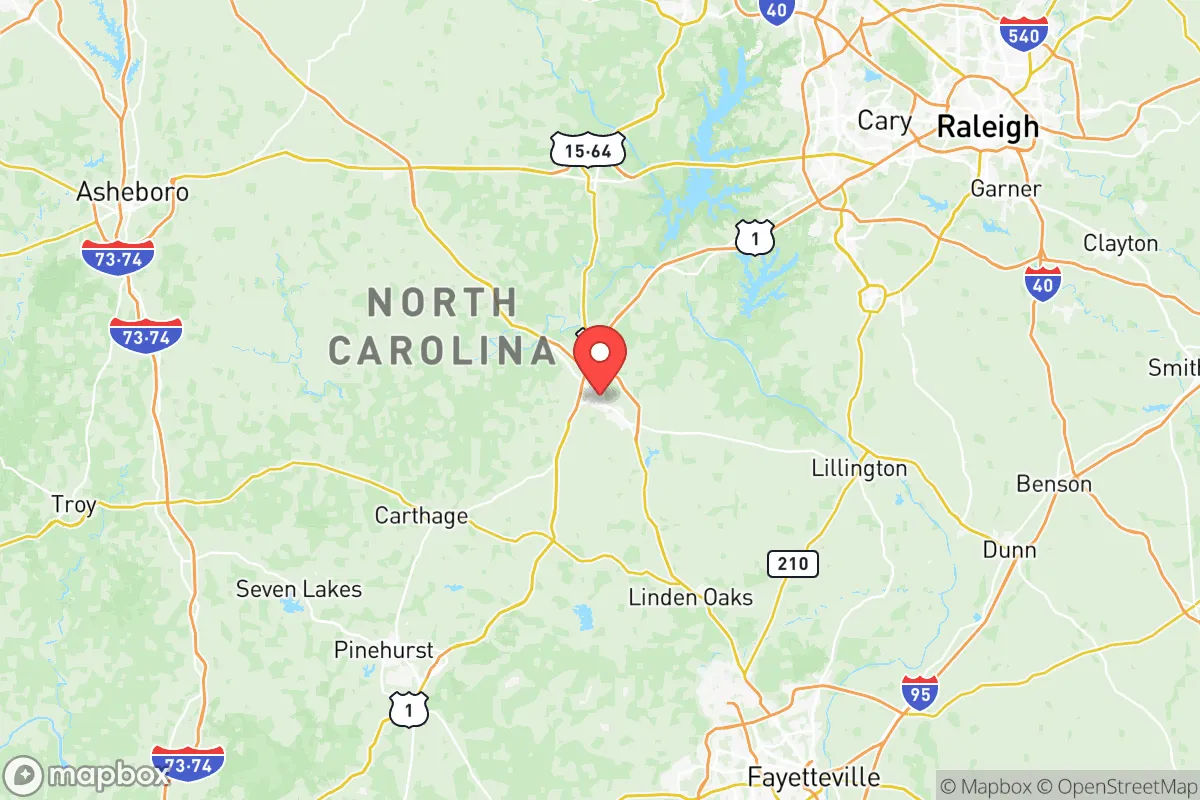
Lee County leans solidly Republican, with a Cook Partisan Voting Index of R+8, making it significantly more conservative than North Carolina as a whole, which sits at R+1. This isn't a new development—the county has voted for the GOP presidential candidate in every election since 2000, though the margins have tightened slightly in recent cycles as suburban areas around Sanford have become more competitive. The real story here is the internal divide: the city of Sanford, the county seat and largest municipality, contains precincts that lean Democratic, while the rural areas and smaller towns like Broadway and Cumnock vote overwhelmingly Republican.
How it compares
Compared to North Carolina's statewide R+1 rating, Lee County's R+8 is a meaningful shift to the right, but it's not an outlier in the Sandhills region. Neighboring Moore County is R+9, and Harnett County is R+11, so Lee fits a regional pattern of conservative-leaning rural and exurban communities. What sets Lee apart is the urban-rural split within its borders. In Sanford, precincts near downtown and around the historic district have trended blue in recent years, driven by a growing population of younger professionals and a modest but active Democratic base. Meanwhile, the unincorporated areas and towns like Tramway and Lemon Springs remain deeply red, with GOP turnout often exceeding 70% in presidential elections. The swing precincts are in the suburban fringe of Sanford—places like the areas around US-421 and the Chatham County line—where growth from the Research Triangle region is bringing more moderate voters who split tickets between local and national races.
What this means for residents
For conservative residents, Lee County's lean means local government is reliably Republican—the county commission and school board are GOP-majority, and tax policy tends to favor low rates and limited spending. The county's property tax rate is among the lowest in the region, which appeals to retirees and families looking for affordability. For liberal residents, the political reality is more mixed. While they are a minority, they have found influence in Sanford's city council, where Democrats hold a couple of seats and have pushed for downtown revitalization and affordable housing initiatives. The practical effect is that state-level issues like abortion access or gun laws are largely settled by Raleigh, not Sanford, so local debates focus more on zoning, school funding, and economic development. Both sides agree on one thing: the county's growth from the Triangle is the dominant issue, with new subdivisions and industrial parks reshaping the political landscape faster than either party can fully control.
Culturally, Lee County retains a distinct identity that sets it apart from the more transient Research Triangle. The annual Sanford Hog Day festival and the historic Temple Theatre are community anchors that draw residents across political lines. Policy-wise, the county has been slower than Wake or Durham counties to adopt progressive measures like plastic bag bans or inclusionary zoning, reflecting its more cautious, rural-influenced governance. But the influx of commuters from Cary and Apex is slowly shifting the conversation—expect the political center of gravity to move slightly left over the next decade, even if the county remains reliably red for the foreseeable future.

State Political ClimatePolitical Climate in North Carolina
State Political AnalysisPolitical Environment in the State
North Carolina is a classic swing state that has been trending rightward in recent cycles, with a Cook PVI of R+1, but it’s far from a lock for either party. The state’s political reality is a tug-of-war between fast-growing, diversifying metros and a deeply rooted, more conservative rural and suburban base. Over the last 10-20 years, the state has gone from a purple battleground that narrowly went for Obama in 2008 to a state that has voted Republican in every presidential election since 2012, while simultaneously electing Democratic governors and a split legislature. The dominant coalition is a mix of traditional business conservatives, rural voters, and a growing number of culturally conservative transplants, but the urban centers are becoming more reliably blue, creating a sharp geographic and cultural divide.
Urban vs. rural divide
The political map of North Carolina is a story of two worlds. The major metros—Charlotte (Mecklenburg County), the Raleigh-Durham-Chapel Hill triangle (Wake, Durham, Orange counties), and to a lesser extent Greensboro and Winston-Salem (Guilford and Forsyth counties)—are the Democratic strongholds. Mecklenburg County alone delivered over 300,000 votes for Biden in 2020, while Wake County added another 300,000. These areas are driven by a mix of tech, finance, and university populations, and they vote blue by margins of 20-40 points. In contrast, the vast rural and exurban areas—places like Gaston County (west of Charlotte), Johnston County (southeast of Raleigh), and the entire eastern and western thirds of the state—vote red by similar margins. The real battlegrounds are the fast-growing suburban counties like Cabarrus (Concord), Union (south of Charlotte), and Harnett (south of Raleigh), which have been trending red but are seeing demographic shifts as people move outward from the cities. The 2024 election saw Trump improve his margins in many of these exurban counties, while the urban cores held firm for Democrats.
Policy environment
North Carolina’s policy environment is a mix of conservative-leaning state laws and a more moderate, business-friendly posture. The state has a flat income tax rate of 4.5% (down from 7% a decade ago), with a scheduled phase-down to 3.99% by 2027, making it attractive for high earners. There is no state tax on Social Security benefits, and the standard deduction is generous. The regulatory posture is generally light, especially for manufacturing and agriculture, but the state has a complex patchwork of local zoning and land-use rules. On education, the state has a robust charter school system and a school voucher program (the Opportunity Scholarship Program) that has been expanded to all income levels, a major win for school choice advocates. Healthcare is a mixed bag: the state expanded Medicaid in 2023 under a bipartisan deal, but the private insurance market remains expensive. Election laws are a flashpoint: the state has voter ID requirements (photo ID required since 2023), strict absentee ballot rules, and a Republican-controlled legislature that has drawn congressional and state legislative maps that favor their party, though courts have occasionally intervened.
Recent policy direction
Over the last five years, the state has moved decisively in a conservative direction on several fronts. Gun and self-defense law: North Carolina is a “shall-issue” state for concealed carry, and in 2023, the legislature passed a law allowing permitless concealed carry (House Bill 189), effective immediately, making it one of the more permissive states in the Southeast. Parental and education rights: The state passed the “Parents’ Bill of Rights” (House Bill 755) in 2023, requiring schools to notify parents about curriculum changes and medical services, and prohibiting instruction on gender identity and sexuality in K-4 classrooms. Speech and privacy: There’s no broad state-level privacy law like California’s, but the state has a strong public records law. Medical and bodily autonomy: Abortion is currently legal up to 12 weeks (with exceptions for rape, incest, and fetal anomalies up to 20 weeks, and no limit for life of the mother), after a 2023 law (Senate Bill 20) tightened the previous 20-week limit. This was a major compromise that satisfied neither side fully. Property rights: The state has strong eminent domain protections, and property taxes are low (average effective rate around 0.7%), though local rates vary. Taxation: The flat tax is being phased down, and the state has no estate tax. Voting and ballot access: The voter ID law is in effect, and early voting is robust (17 days), but same-day registration is only available during early voting, not on Election Day. The overall direction is toward lower taxes, more school choice, and tighter election security, but with a pragmatic streak that avoids the most extreme positions.
Civil unrest & political movements
North Carolina has a history of visible political activism on both sides. The Moral Monday protests of 2013-2014, led by the NAACP, were a major left-wing movement against the Republican legislature’s policies on voting rights, education, and healthcare. More recently, the 2020 protests in Charlotte and Raleigh over George Floyd’s death saw some property damage and clashes, but were less intense than in Portland or Seattle. On the right, the state has a strong Second Amendment movement, with regular gun rights rallies at the state capitol. Immigration politics are a flashpoint: the state has a 2012 law (HB 318) that requires sheriffs to cooperate with ICE, and several counties (like Wake and Mecklenburg) have been sued for not fully complying. There is no statewide sanctuary policy, but some cities like Durham and Chapel Hill have declared themselves sanctuary cities, creating a patchwork. Election integrity has been a major issue since 2020, with the state legislature passing stricter voter ID laws and creating a new election board structure that gives Republicans more control. The 2024 election saw no major irregularities, but the rhetoric remains heated. A new resident would notice that political signs and bumper stickers are common, and local news is heavily politicized, but actual civil unrest is rare outside of organized rallies.
Projection
Over the next 5-10 years, North Carolina is likely to remain a competitive swing state, but the demographic trends favor a slow shift toward the center-right. The state is growing fast—adding about 100,000 new residents per year—and most of that growth is in the urban and suburban counties, which are becoming more diverse and more Democratic. However, the in-migration is also bringing many conservative retirees and remote workers from the Northeast and Midwest, who tend to vote Republican. The rural counties are losing population, which hurts the GOP’s raw vote totals, but the legislature’s gerrymandered maps will likely keep the state House and congressional delegation red for the foreseeable future. The wild card is the Charlotte and Raleigh suburbs: if they continue to trend blue like their counterparts in Virginia and Georgia, the state could flip back to purple by 2030. But for now, the state’s political trajectory is one of slow, grinding conservatism on policy, with a narrow but persistent Republican edge in statewide elections. A new resident moving in now should expect a state that is politically divided but functionally conservative on taxes, guns, and education, with a growing progressive counterweight in the cities.
For a new resident, the bottom line is that North Carolina offers a low-tax, business-friendly environment with a strong conservative tilt on cultural issues, but you’ll find a vibrant liberal community in the cities. If you’re a conservative, you’ll feel at home in the suburbs and rural areas, with a state government that generally aligns with your views. If you’re a liberal, you’ll find your people in Charlotte, Raleigh, Durham, and Chapel Hill, but you’ll need to accept that state-level policy will often be against you. The state is not a political monolith—it’s a place where your experience depends heavily on which county you live in. The key takeaway: choose your county carefully, because the political climate in Mecklenburg is a world away from Gaston, and the difference will shape your daily life more than the state’s overall lean.
* Values derived from national, state, county, city and local statistics and may differ in a specific area. Last updated: 2026-08-19T22:12:20.000Z
Narrative content on this page is AI-generated and may contain mistakes. Verify any details that matter before acting on them.
ReloMaps may earn a commission from affiliate links at no extra cost to you.

