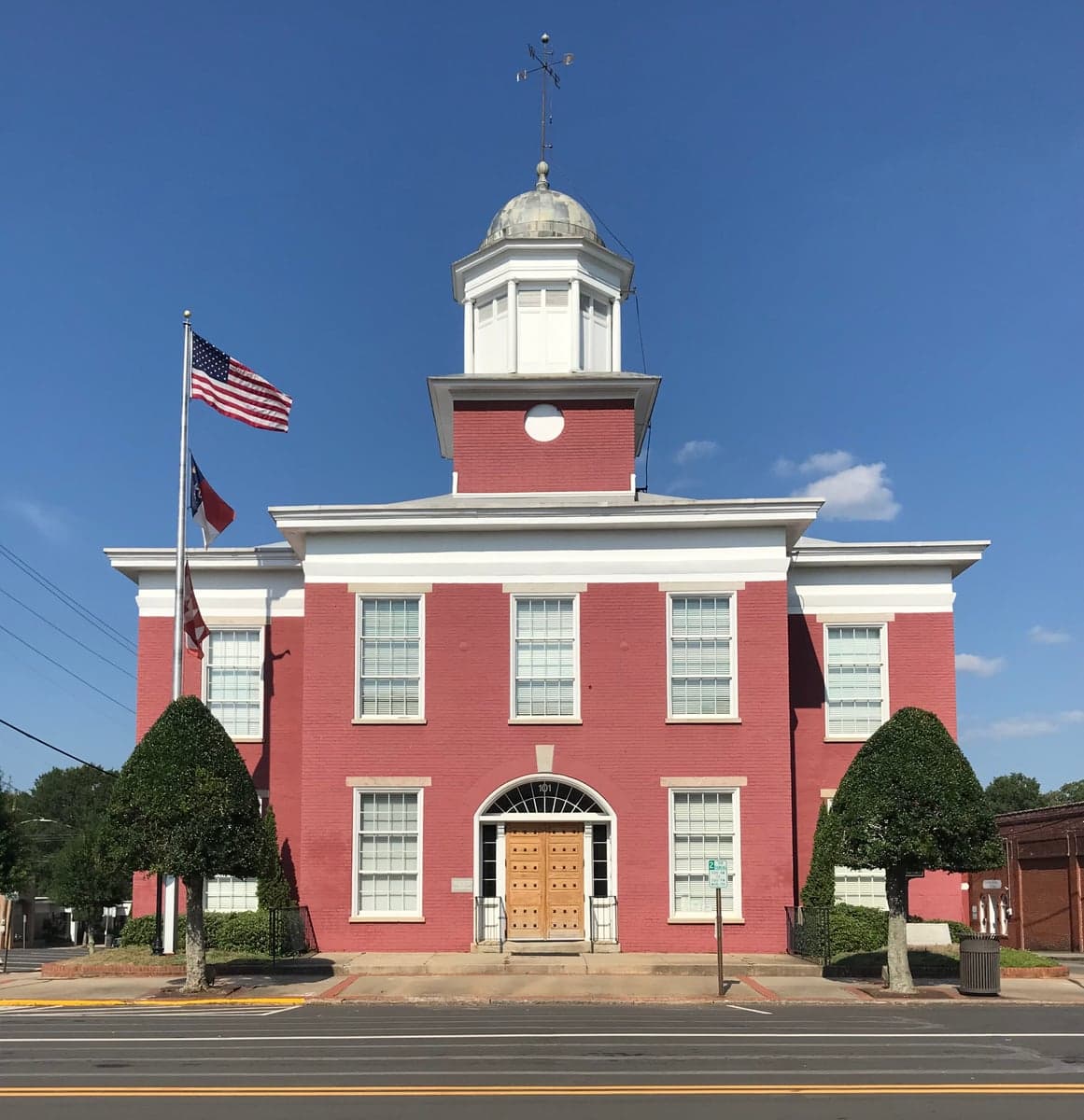
Photo: Wikipedia
Political ClimatePolitical Climate in Granville County
Showing district-level results — no local-only data available.
Local Political AnalysisPolitical Analysis of Granville County
Granville County sits firmly in the red column, carrying a Cook Partisan Voting Index (PVI) of R+8, which is a full seven points more conservative than the state of North Carolina as a whole (R+1). That gap isn't just a number on a map; it reflects a county that has been trending rightward for over a decade, even as the state’s urban centers pull the other direction. If you’re looking at the 2024 results, the county backed Donald Trump by a comfortable margin, and the real action isn’t in *whether* the county goes red, but *how red* it goes in any given cycle.
How it compares
The R+8 rating puts Granville in a different political universe than the state’s R+1 overall lean. North Carolina is a true battleground, decided by razor-thin margins in places like Mecklenburg and Wake counties. Granville, by contrast, is a reliable Republican stronghold, but it’s not a monolith. The county’s political geography is split between the rural, agricultural south and the exurban northern fringe that borders Virginia. The town of Oxford, the county seat, is the closest thing to a blue dot—its precincts around the historic downtown and the Granville County Schools administrative complex tend to vote Democratic, driven by a mix of Black voters, state employees, and a small but active college-adjacent population. Meanwhile, the towns of Creedmoor and Butner lean more Republican, with Butner’s precincts showing a notable shift to the right in recent cycles, likely tied to the growth of the Granville County Industrial Park and the influx of workers from the Research Triangle Park who commute south on I-85. The true swing precincts are in the unincorporated areas between Stovall and Stem, where a handful of votes can flip a local race. In the 2022 midterms, for example, the county’s Republican commissioner candidates swept every district, but the margins in those Stem-area precincts were under 5 points, a sign that the county’s red lean is not as unshakeable as the PVI suggests.
What this means for residents
For conservative residents, the R+8 lean means their votes carry real weight in local primaries, which are often decided in the Republican primary rather than the general election. The county commission and school board are effectively controlled by the GOP, and policy priorities—like the recent push to expand the county’s rural broadband infrastructure and the approval of a new industrial megasite near the Vance County line—reflect a pro-business, low-tax agenda. Property taxes here are among the lowest in the Triangle region, a direct result of that conservative majority. For liberal residents, the reality is more about finding your niche than winning elections. Oxford’s small but vocal Democratic precincts do elect a few county commissioners, and the city’s annual “Art on the Square” festival has become a gathering point for progressive activism. But statewide, Granville’s red lean means Democratic candidates often skip the county entirely, focusing their resources on Wake and Durham. That said, the county’s proximity to the Triangle means liberal residents can still work, shop, and socialize in blue-leaning cities like Durham, just a 30-minute drive south on I-85, without feeling politically isolated at home.
Culturally, Granville County is a place where the old and new South collide. The county’s identity is still rooted in tobacco farming and the historic plantations around Oxford, but the last decade has brought a wave of newcomers—many of them young families priced out of Durham and Raleigh—who are reshaping the political conversation. The local GOP has had to balance its traditional base of farmers and retirees with these new exurbanites, who often care more about school funding and traffic on Highway 15 than about national culture wars. The result is a county that votes red but governs pragmatically, a place where a Democratic commissioner can still get a standing ovation at a county meeting if she brings in a grant for rural water lines. Looking ahead, the trajectory is clear: as the Triangle’s growth spills further north, Granville’s R+8 lean will likely soften, but it won’t flip anytime soon. The county is a good example of how North Carolina’s political divide isn’t just urban versus rural—it’s about how fast the exurbs are changing the calculus.

State Political ClimatePolitical Climate in North Carolina
State Political AnalysisPolitical Environment in the State
North Carolina is a classic swing state with a Republican lean, carrying a Cook PVI of R+1, but the reality on the ground is far more nuanced than that single number suggests. Over the past 20 years, the state has shifted from a reliably red stronghold in presidential elections (voting for Bush in 2004) to a battleground that narrowly went for Trump in 2020 and 2024, while simultaneously electing Democratic governors and a Democratic attorney general. The dominant coalition is a rural, conservative base in the Piedmont and Coastal Plain, increasingly challenged by explosive growth in the Research Triangle, Charlotte, and the Asheville corridor, creating a political tug-of-war that defines every election cycle.
Urban vs. rural divide
The political map of North Carolina is a textbook case of the urban-rural split. The three major metros—Charlotte (Mecklenburg County), Raleigh-Durham-Chapel Hill (Wake, Durham, Orange Counties), and Asheville (Buncombe County)—are deep blue islands, collectively delivering hundreds of thousands of Democratic votes. Mecklenburg County alone gave Biden a 200,000-vote margin in 2020, while Wake County added another 150,000. In contrast, the vast rural expanse—from the Fayetteville region east to the coast, and from the Greensboro-Winston-Salem exurbs west to the mountains—votes overwhelmingly Republican. The real battlegrounds are the fast-growing suburban counties like Cabarrus (Concord), Johnston (south of Raleigh), and Union (southeast of Charlotte), which have shifted rightward as new residents arrive, while older suburbs like Cary and Apex have trended left. The result is a state where statewide races are decided by a few thousand votes in a handful of precincts, often in the exurban ring around Charlotte.
Policy environment
North Carolina’s policy environment reflects its divided government. The state has a flat income tax rate of 4.5% (down from 7% in 2013), with a scheduled phase-down to 3.99% by 2027, making it increasingly attractive for high-earners and businesses. The corporate tax rate is 2.5%, one of the lowest in the South. There is no state property tax, but local rates vary widely—Wake County levies around 0.75%, while rural counties like Jones County are under 0.5%. Education policy is a flashpoint: the state funds a private school voucher program (the Opportunity Scholarship Program) that has expanded to cover all income levels, while traditional public school funding per pupil remains below the national average. Healthcare is mixed—the state expanded Medicaid in 2023 under a bipartisan deal, adding 600,000 low-income adults, but abortion is banned after 12 weeks (with exceptions for rape, incest, and fetal anomalies), a law passed by the Republican supermajority over Governor Roy Cooper’s veto. Election laws are tight: voter ID is required, early voting is generous (17 days), but same-day registration is only available during early voting, not on Election Day. The state also has a strict photo ID requirement for voting, which was upheld by the courts in 2024.
Recent policy direction
The last five years have seen a clear conservative shift in state policy, driven by a Republican supermajority in the legislature (though the 2024 elections narrowed it to a simple majority). Key legislation includes the 12-week abortion ban (SB 20, 2023), which also tightened licensing requirements for abortion clinics. On gun rights, North Carolina is a permitless carry state (since 2023), allowing concealed carry without a permit, and it has a "stand your ground" law. Parental rights were strengthened with the Parents’ Bill of Rights (HB 755, 2023), which requires schools to notify parents about curriculum changes and prohibits instruction on gender identity and sexuality in K-4 classrooms. On property rights, the state has a strong right-to-farm law that limits nuisance lawsuits against agricultural operations. Tax policy has been consistently pro-growth: the flat income tax is being phased down, and the estate tax was repealed in 2013. On voting, the legislature passed a law in 2023 that shortened the mail-in ballot return window and banned private funding of election administration. Medical and bodily autonomy is limited: the 12-week abortion ban is among the strictest in the Southeast, and there is no state-level protection for gender-affirming care for minors (a ban was passed in 2023 but is currently blocked by court order). Privacy and surveillance are moderate—the state has no comprehensive data privacy law, but it does require a warrant for cell phone location data. Overall, a relocator should expect a state that is increasingly conservative on social issues, pro-business on taxes, and deeply contested on education and voting access.
Civil unrest & political movements
North Carolina has a history of visible political activism, from the Moral Monday protests of 2013 (against the Republican agenda on voting rights and education) to the 2020 Black Lives Matter demonstrations in Charlotte and Raleigh that saw property damage and curfews. The state has a strong organized left, particularly around the NAACP and the progressive advocacy group Democracy NC, which has challenged voter ID laws in court. On the right, the state has a robust gun rights movement (Grass Roots North Carolina) and a growing "election integrity" network that pushed for the 2023 voting law changes. Immigration politics are relatively quiet compared to border states—North Carolina has no sanctuary city policies, and Charlotte and Durham have "welcoming city" ordinances that limit cooperation with ICE, but these are largely symbolic. There is no serious secession or nullification movement, though some rural counties have passed "Second Amendment sanctuary" resolutions. Election integrity controversies flared after the 2020 election, with the state GOP challenging absentee ballot procedures, but no widespread fraud was found. A new resident would notice the political divide most acutely in the Raleigh-Durham area, where yard signs and bumper stickers are a constant, and in the rural counties, where Confederate monuments still stand on courthouse lawns.
Projection
Over the next 5-10 years, North Carolina is likely to remain a purple state with a slight Republican tilt, but the demographic trends are shifting. The state is growing by about 100,000 people per year, with most new arrivals coming from blue states (New York, New Jersey, California) and settling in the Charlotte and Raleigh metros. This in-migration is slowly making the suburbs more competitive—Wake County is trending bluer, while Mecklenburg is already deep blue. However, the rural counties are also growing (albeit slower) and are becoming more conservative as younger, liberal-leaning residents leave for the cities. The wild card is the Fayetteville region, home to Fort Liberty (formerly Fort Bragg), which has a large military and veteran population that tends to lean Republican but is also transient. The 2024 election results suggest the state is still a toss-up at the presidential level, but the legislature is likely to remain Republican-controlled due to aggressive gerrymandering. A new resident moving in now should expect a state that will continue to be a national battleground, with close elections, shifting policies on abortion and education, and a growing economy that attracts both conservatives and liberals. The political climate will remain heated, but the state’s culture of civility (relative to other swing states) means most people get along fine in daily life.
For a new resident, the bottom line is this: North Carolina offers a low-tax, business-friendly environment with a strong economy, but the social policies are increasingly conservative, especially on abortion and education. If you’re a conservative, you’ll find a state that generally aligns with your values on taxes, guns, and parental rights, but you’ll need to accept that the cities are blue and the state is still competitive. If you’re a liberal, you’ll find vibrant urban communities and a growing progressive movement, but you’ll face a legislature that is hostile to your priorities on abortion, voting access, and public education. The key is to choose your location carefully—Cary and Chapel Hill feel like blue islands, while Mooresville and Clayton are solidly red. Either way, you’re moving to a state that is politically engaged, economically dynamic, and unlikely to become a one-party lock anytime soon.
* Values derived from national, state, county, city and local statistics and may differ in a specific area. Last updated: 2026-09-08T07:06:10.000Z
Narrative content on this page is AI-generated and may contain mistakes. Verify any details that matter before acting on them.
ReloMaps may earn a commission from affiliate links at no extra cost to you.

