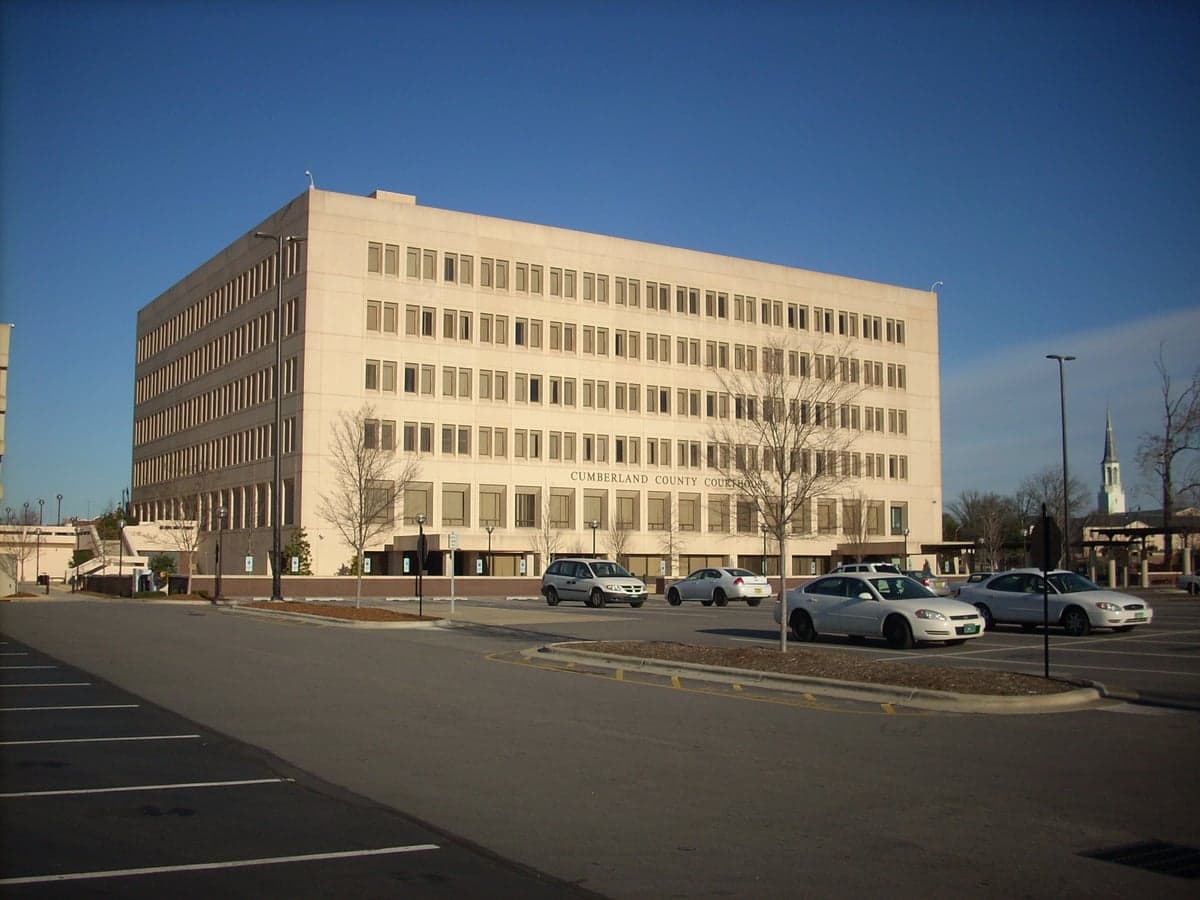
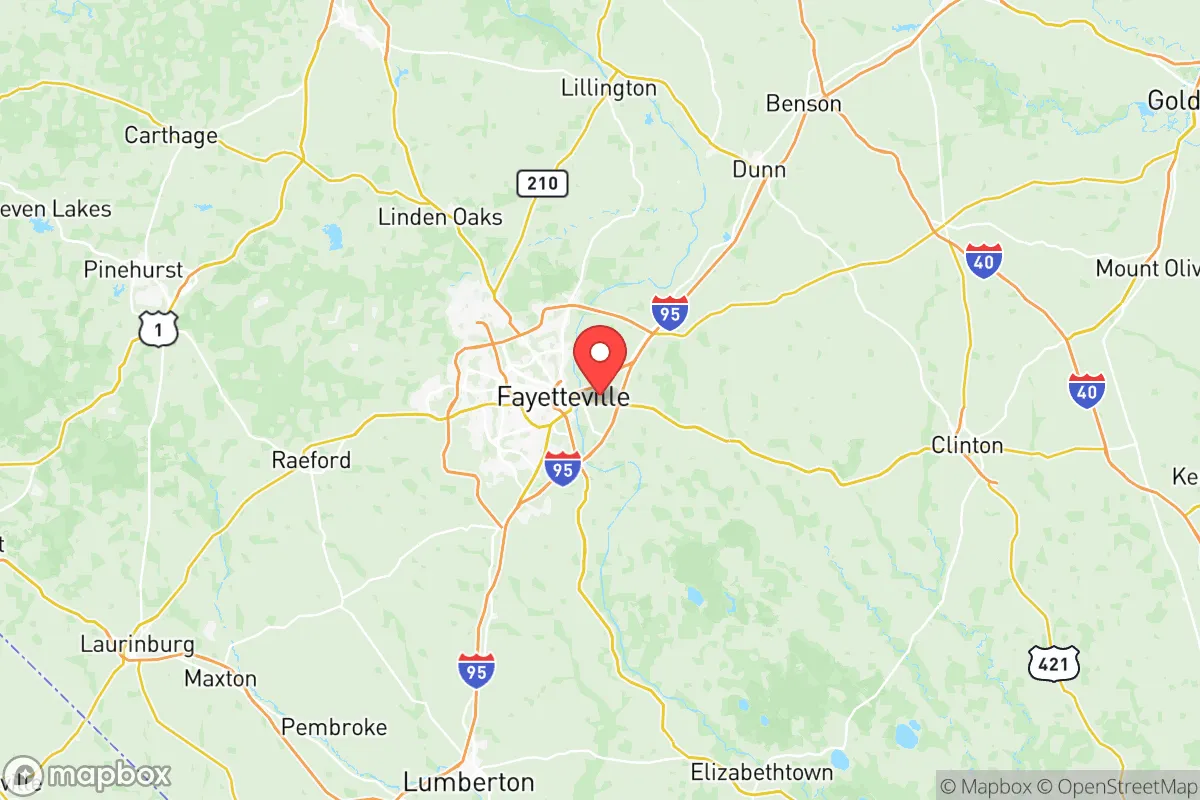
Photo: Wikipedia
Political ClimatePolitical Climate in Cumberland County
Showing district-level results — no local-only data available.
Local Political AnalysisPolitical Analysis of Cumberland County
Cumberland County, anchored by Fayetteville and home to Fort Liberty, is a politically complex place that leans Republican on paper but feels much more competitive on the ground. The county's Cook PVI of R+7 is a full six points more conservative than North Carolina's statewide R+1, but that number masks a deep urban-rural split and a significant military and minority population that keeps Democrats competitive in local races. In 2024, the county voted for Donald Trump by a narrower margin than the PVI suggests, and down-ballot races often flip depending on the candidate and turnout in Fayetteville's precincts.
How it compares to North Carolina's statewide politics
Cumberland County is more Republican than the state as a whole, but the gap is shrinking. North Carolina's R+1 PVI reflects a true swing state where both parties invest heavily, while Cumberland's R+7 has been drifting leftward over the past decade due to population growth in Fayetteville and the surrounding suburban areas. The county's political geography breaks into three distinct zones: Fayetteville's urban core and the areas near Fort Liberty lean Democratic, with precincts around Murchison Road and downtown regularly delivering 60-70% for Democrats. The western suburbs, including Hope Mills and parts of Spring Lake, are swing territory where candidates who can appeal to military families and veterans often win. The rural eastern and southern parts of the county, around Stedman and Wade, vote heavily Republican, sometimes by margins of 70% or more. This internal diversity means Cumberland often votes more like a microcosm of the state than its PVI suggests, with the Fayetteville-Fort Liberty axis providing a Democratic counterweight to the rural red precincts.
What this means for residents
For conservative residents, Cumberland County offers a comfortable environment where Republican candidates generally win countywide races, but not by blowout margins. The county commission and school board often have Republican majorities, but Democrats hold enough seats to force compromise on budgets and policy. For liberal residents, the political reality is that Fayetteville and the Fort Liberty area provide a blue stronghold where Democratic organizers are active and local candidates can win, but countywide elections remain an uphill battle. The military presence is the wild card — Fort Liberty's active-duty and veteran population tends to lean conservative on national security but is more moderate on social issues, which means candidates who focus on quality-of-life concerns like housing, schools, and infrastructure often outperform their party labels. Both sides find that local elections are highly competitive and turnout-driven, especially in midterm and municipal cycles.
Culturally, Cumberland County feels more Southern and military-oriented than the state's urban centers like Charlotte or Raleigh, but less rural and insular than counties further east. Fayetteville's downtown has seen a modest revitalization with new breweries, restaurants, and arts venues, but the city still grapples with a reputation for crime and underinvestment that shapes political debates. The county's policy distinctions are most visible in education and economic development: the Cumberland County Schools system is one of the largest in the state and a perennial flashpoint for funding debates, while the presence of Fort Liberty drives a constant conversation about military housing, veteran services, and base-community relations. Neither party has a permanent lock on the county, and the trajectory suggests it will remain a competitive, closely watched battleground as North Carolina's political center of gravity shifts.

State Political ClimatePolitical Climate in North Carolina
State Political AnalysisPolitical Environment in the State
North Carolina is the quintessential swing state, with a Cook PVI of R+1 that barely hints at the internal tension. Over the past 20 years, the state has shifted from a reliably Republican stronghold in presidential elections to a true battleground, driven by explosive growth in the Research Triangle (Raleigh-Durham-Chapel Hill) and Charlotte. While Republicans still hold the legislature and most statewide offices, the margins have tightened dramatically — Trump won the state by just 1.3 points in 2024, down from 3.7 in 2020. The dominant coalitions are a rural, conservative base concentrated in the Piedmont and coastal plains, versus a rapidly growing, diverse, and college-educated urban-suburban bloc that is pulling the state leftward.
Urban vs. rural divide
The political map of North Carolina is a study in contrasts. The major metros — Charlotte (Mecklenburg County), Raleigh (Wake County), Durham (Durham County), and Greensboro (Guilford County) — are solidly Democratic, with Wake and Mecklenburg alone delivering over 400,000 votes for Biden in 2020. These areas are powered by the finance, tech, and biotech sectors, and their growth is reshaping the state's politics. In contrast, the rural east and the Sandhills remain deeply Republican; counties like Robeson and Cumberland are competitive, but most of the coastal plain votes 60-70% Republican. A key battleground is the suburban ring around Charlotte and Raleigh — places like Union County (strongly red) and Cabarrus County (leaning red) are seeing in-migration that is slowly diversifying their politics. The Fayetteville area, home to Fort Liberty (formerly Fort Bragg), is a swing microcosm, with a large military and veteran population that leans conservative but is not monolithic.
Policy environment
North Carolina's policy environment reflects its divided government. The state has a flat income tax rate of 4.5%, down from 5.25% in 2021, with a scheduled phase-down to 3.99% by 2027. The corporate income tax is 2.5%, among the lowest in the Southeast. Sales tax is 4.75% state-level, with local add-ons up to 2.5%. Property taxes are relatively low, with a median effective rate of 0.78% of home value. The state is a "right-to-work" state with no public-sector collective bargaining. Education policy is a flashpoint: the state has a robust charter school system and a voucher program (Opportunity Scholarship Program) that now covers all income levels, but public school funding has been the subject of ongoing litigation (the Leandro case). Healthcare is mixed — the state expanded Medicaid in 2023 under a bipartisan deal, covering roughly 600,000 new enrollees, but the state has not legalized medical marijuana. Election laws are moderately restrictive: voter ID is required (with exceptions), early voting is generous (17 days), and same-day registration is available during early voting. The state has 14 electoral votes and is a perennial swing state.
Recent policy direction
Over the past five years, the Republican-controlled legislature has pushed a conservative agenda, often overriding Democratic Governor Roy Cooper's vetoes. Key legislation includes the 2023 abortion ban (HB 74), which prohibits abortion after 12 weeks with exceptions for rape, incest, and fetal anomalies (up to 20 weeks) and for the life of the mother (no limit). This replaced a previous 20-week ban. On guns, the state enacted permitless concealed carry (SB 41) in 2023, allowing any legal gun owner to carry a concealed handgun without a permit. The state also passed a parental rights bill (HB 755) in 2023, requiring schools to notify parents of any changes in a student's health or well-being, including gender identity. On education, the state expanded the voucher program to all families regardless of income. On voting, the legislature passed SB 747 in 2023, which made it harder to use same-day registration and absentee ballot drop boxes. On property rights, the state has strong eminent domain protections and no statewide rent control. On privacy, the state has no comprehensive data privacy law, but it does have a biometric privacy law. The overall direction is a steady conservative shift on social and cultural issues, paired with continued tax cuts and deregulation.
Civil unrest & political movements
North Carolina has a history of political activism on both sides. The Moral Monday protests (2013-2015) were a major progressive movement against the legislature's policies on voting rights, education, and healthcare. More recently, the 2020 protests in Charlotte, Raleigh, and Durham over police brutality were significant but largely peaceful. On the right, the LGBTQ+ issue has been a persistent flashpoint, particularly around transgender rights and bathroom access (the 2016 HB 2 "bathroom bill" controversy). Immigration politics are less heated than in border states, but there is a sanctuary city debate: Durham and Orange County have "limited cooperation" policies with ICE, while the state has a law (HB 10) requiring sheriffs to honor ICE detainers. Election integrity remains a live issue — the 2020 election was certified without major controversy, but the 2024 cycle saw increased scrutiny of mail-in voting. There is no serious secession or nullification movement, but rural counties occasionally pass "Second Amendment sanctuary" resolutions. A new resident would notice the political divide most acutely in the cultural landscape: the urban areas are visibly progressive, while rural areas are deeply traditional.
Projection
Over the next 5-10 years, North Carolina is likely to become more competitive, with a real chance of flipping to a lean-Democratic or toss-up status at the presidential level. The key driver is in-migration: the state is adding roughly 100,000 new residents per year, mostly from blue states like New York, California, and New Jersey, and they tend to settle in the urban and suburban areas that are already Democratic-leaning. The rural population is aging and shrinking. However, the legislature is gerrymandered to favor Republicans, and the state Supreme Court flipped back to a 5-2 Republican majority in 2024, so the policy direction may remain conservative even if the electorate shifts. The wild card is the Charlotte and Raleigh suburbs — places like Wake Forest and Concord — which are growing fast and could become swing areas. A new resident moving in now should expect a state that is politically divided but functional, with a conservative policy tilt that may moderate over time as the electorate changes.
For a new resident, the bottom line is this: North Carolina offers a low-tax, business-friendly environment with a high quality of life, but the political climate is a constant tug-of-war. If you lean conservative, you'll find a state that generally aligns with your values on taxes, guns, and education, but you'll need to accept that the urban areas are increasingly progressive. If you lean liberal, you'll find vibrant, welcoming cities and a growing political base, but you'll face a legislature that is often at odds with your priorities. The state is a true microcosm of America's political divide, and living here means engaging with that reality every day.
* Values derived from national, state, county, city and local statistics and may differ in a specific area. Last updated: 2026-08-08T12:36:14.000Z
Narrative content on this page is AI-generated and may contain mistakes. Verify any details that matter before acting on them.
ReloMaps may earn a commission from affiliate links at no extra cost to you.

