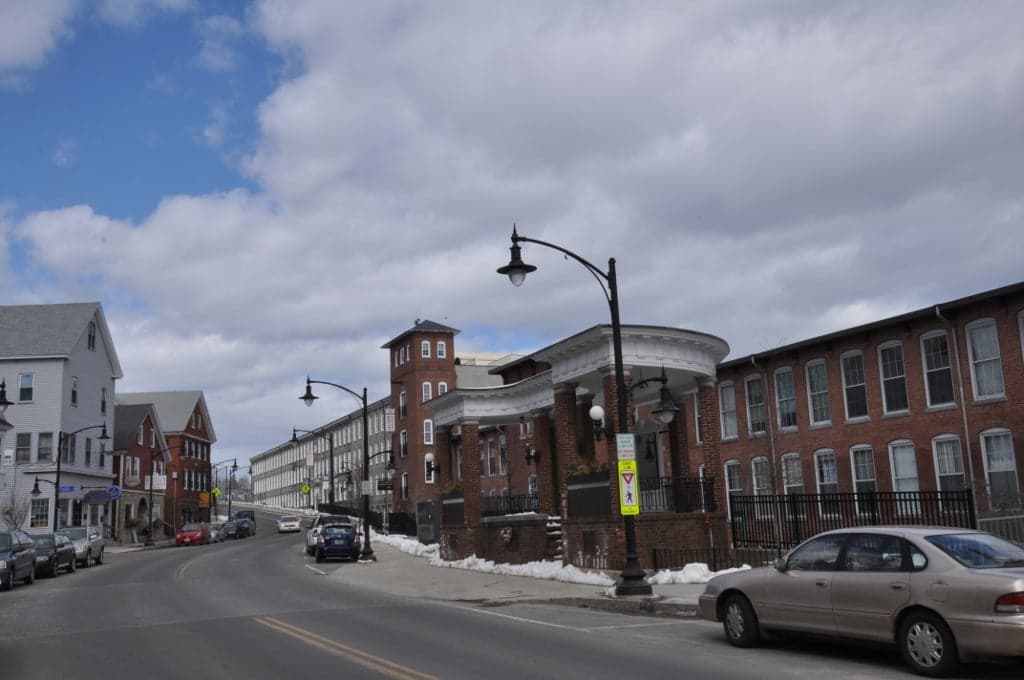
Photo: Wikipedia
Political ClimatePolitical Climate in Newmarket, NH
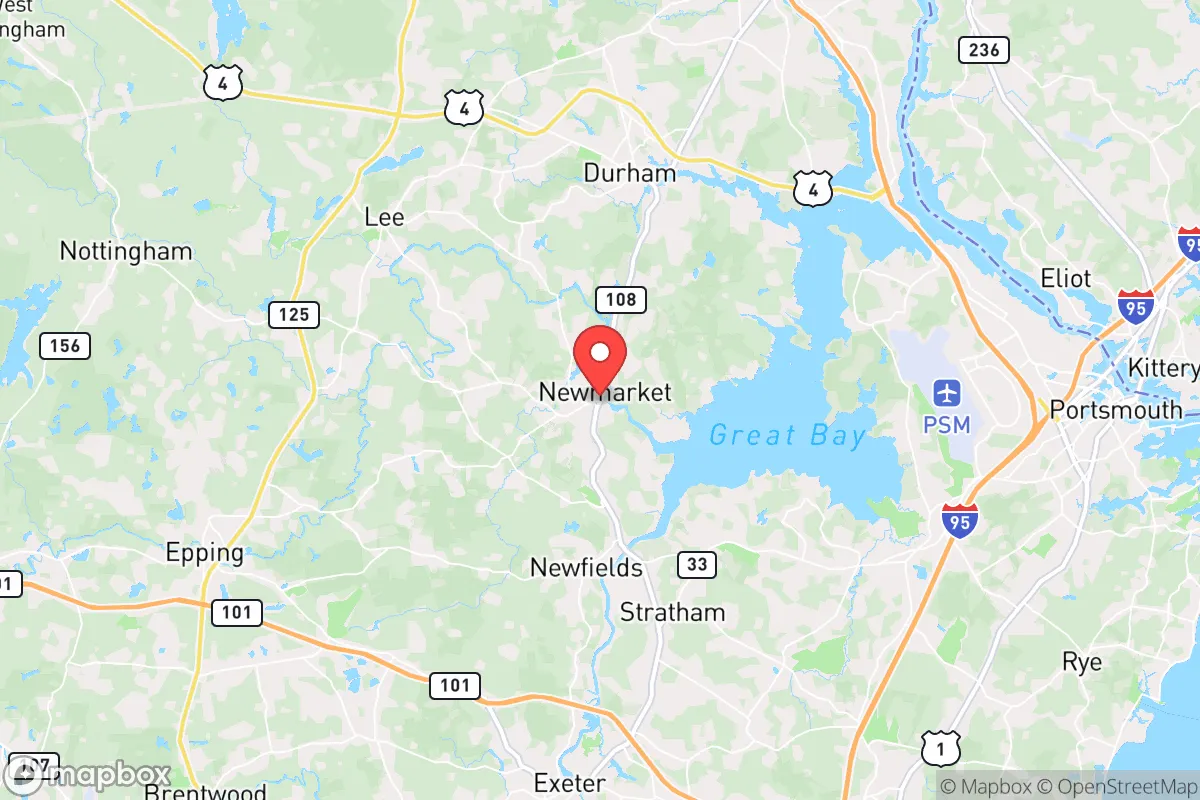
District shown is the primary district for this city’s centroid. Cities may span multiple districts.
Local Political AnalysisPolitical Analysis of Newmarket, NH
Newmarket, New Hampshire, leans solidly Democratic in a state that is famously purple, carrying a Cook Partisan Voting Index of D+2 that mirrors the state's overall D+2 rating. Over the past decade, the town has shifted noticeably leftward, driven by an influx of younger professionals and University of New Hampshire affiliates who have reshaped local elections and community priorities. While New Hampshire as a whole remains a battleground where both parties compete fiercely, Newmarket has become one of the more reliably blue dots in the Seacoast region, a trend that shows no signs of reversing.
How it compares
Newmarket's D+2 PVI puts it in the same partisan territory as the state overall, but that surface similarity hides real contrasts. Drive ten minutes east to Durham, home of UNH, and you'll find an even more liberal electorate, while a short trip west to Epping or north to Lee reveals towns that lean more conservative or are closely divided. In the 2024 presidential election, Newmarket voted for the Democratic candidate by a margin significantly wider than the statewide result, reflecting its status as a local Democratic stronghold. The town's politics align more closely with Portsmouth and Exeter than with the rest of Rockingham County, which has trended redder in recent cycles. What makes Newmarket distinct is its combination of a small-town New England feel with a reliably progressive voting record — a blend that is common in college-adjacent Seacoast communities but rare in the state's more rural interior.
What this means for residents
For liberal residents, Newmarket offers a comfortable environment where progressive candidates and causes typically find receptive audiences. Town council meetings and school board elections tend to reflect the community's left-leaning consensus, and local policies on issues like renewable energy, affordable housing, and public transit align with Democratic priorities. Conservative residents, while definitely present — especially among longer-established families and those working in trades or small business — often find themselves in the minority in local elections. That said, the state-level dynamic keeps things interesting: because New Hampshire's legislature and governor's office remain genuinely competitive, a conservative voter in Newmarket still has a meaningful say in statewide races and can find like-minded neighbors in nearby towns. The practical effect is a town where political conversations are more common and more civil than in deeply polarized areas, simply because the mix of viewpoints forces people to engage rather than retreat into echo chambers.
Culturally, Newmarket stands apart from much of New Hampshire by embracing a more urban, walkable, and community-oriented identity. The downtown revitalization along the Lamprey River, the presence of local breweries and arts spaces, and the town's investment in mixed-use development all reflect a governing philosophy that prioritizes density and public gathering over the rural, libertarian ethos that dominates much of the state. Policy-wise, Newmarket has been more aggressive than surrounding towns in pursuing zoning reforms for affordable housing and in supporting public transit connections to Portsmouth and Dover. For anyone moving to the area, the takeaway is straightforward: Newmarket offers a distinctly progressive small-town experience within a purple state, where your vote carries weight locally and your voice still matters in the broader New Hampshire political arena.

State Political ClimatePolitical Climate in New Hampshire
State Political AnalysisPolitical Environment in the State
New Hampshire is the ultimate swing state in New England, with a Cook PVI of D+2 that barely captures its volatile, independent-minded character. Over the past 20 years, the state has shifted from a reliably Republican stronghold in presidential races (voting for Bush in 2000) to a purple battleground that backed Clinton in 2016 and 2020, then swung back to give Trump a narrow win in 2024 by roughly 2 points. What makes New Hampshire unique is its Live Free or Die ethos — a libertarian streak that runs through both parties, producing a state where you can find a pro-choice Republican and a pro-gun Democrat living on the same street.
Urban vs. rural divide
The political map breaks down along a clear urban-rural axis, but with a twist. The southeastern corner — Manchester, Nashua, and the Seacoast region around Portsmouth — drives the Democratic vote, powered by Massachusetts transplants, tech workers, and younger professionals. Manchester, the largest city, has trended blue for a decade, while Nashua's southern suburbs are solidly Democratic. The Seacoast towns like Portsmouth and Durham (home to UNH) are among the most liberal in the state. In contrast, the northern and western regions — Berlin in Coös County, Littleton in Grafton County, and the entire Lakes Region around Laconia — lean heavily Republican, driven by older native-born residents, outdoor recreation workers, and a strong gun culture. The Dartmouth-Lake Sunapee area around Hanover is a blue island in a red sea, thanks to the university. The key swing counties are Hillsborough (home to Manchester) and Rockingham (the exurban corridor south of Manchester), which flip between parties and decide statewide races. In 2024, Rockingham County went for Trump by about 8 points, while Hillsborough County was nearly tied — a split that mirrors the state's overall divide.
Policy environment
New Hampshire's policy environment is defined by what it lacks: no state income tax and no state sales tax. This makes it a tax haven compared to neighboring Massachusetts, Vermont, and Maine. Property taxes are high — among the highest in the nation — to compensate, averaging around 2% of assessed value. The state's regulatory posture is light-touch: no seatbelt law for adults, no helmet law for motorcyclists, and a famously permissive alcohol and cannabis environment (medical marijuana is legal, decriminalized for small amounts, but recreational sales remain illegal as of 2026). Education policy is hyper-local, with no state-level curriculum mandates and a strong school choice movement — charter schools and homeschooling are common. Healthcare is a mixed bag: the state expanded Medicaid under the Affordable Care Act, but the insurance market is dominated by a single carrier (Anthem), leading to high premiums. Election laws are among the most open in the country: same-day voter registration, no voter ID requirement (though a photo ID law was passed in 2012 and then weakened), and a robust primary system that gives independents — who make up roughly 40% of registered voters — the ability to vote in either party's primary.
Recent policy direction
Over the past five years, New Hampshire has zigzagged on key issues. On gun rights, the state passed constitutional carry (permitless carry) in 2017 and has resisted red-flag laws, though a 2023 bill to ban firearms on school property was vetoed by Governor Chris Sununu. On parental rights and education, the state expanded school choice through Education Freedom Accounts in 2021, allowing public funds to follow students to private or homeschool settings — a major win for conservatives. On abortion, the state codified abortion rights up to 24 weeks in 2023, with no parental notification requirement for minors, making it one of the most permissive states in the region. On voting access, the state passed a law in 2024 requiring proof of domicile for same-day registration, a modest tightening that sparked debate but didn't fundamentally change access. On property rights, the state has resisted statewide zoning mandates, leaving land-use decisions to towns — a boon for rural property owners but a frustration for developers. On privacy and surveillance, the state passed a data privacy law in 2024 giving residents control over how companies use their personal data, a bipartisan effort. The overall direction is a patchwork: libertarian on taxes and guns, moderate on social issues, and increasingly polarized on education and abortion.
Civil unrest & political movements
New Hampshire is not a hotbed of civil unrest, but it has a long tradition of political activism. The Free State Project, a movement that relocated thousands of libertarians to the state starting in the early 2000s, has left a visible mark — particularly in the North Country towns like Groveton and Berlin, where libertarian-leaning candidates have won local offices. The movement has pushed for smaller government, gun rights, and school choice, and its members are active in local politics. On the left, the Seacoast area has seen protests over abortion rights and climate change, with Portsmouth hosting large rallies in 2022 after the Dobbs decision. Immigration politics are relatively quiet — the state has no sanctuary city policies, and the immigrant population is small (about 6% foreign-born). Election integrity controversies flared in 2020 and 2024, with Republican activists challenging ballot drop boxes and mail-in voting procedures, but no major fraud was found. The most visible flashpoint for a new resident might be the town meeting system — every March, residents gather in school gyms to vote on local budgets and ordinances, a direct democracy tradition that can get heated over school funding and property taxes.
Projection
Over the next 5-10 years, New Hampshire is likely to remain a purple state, but with a slight rightward drift. The in-migration pattern is key: Massachusetts transplants continue to move to the southern tier (Nashua, Salem, Derry) for lower taxes and more space, and they tend to bring moderate Democratic leanings. But the Free State Project and remote workers from other states are also moving in, often with libertarian or conservative views. The state's population is aging — the median age is 43, among the highest in the nation — and older voters lean Republican. The wild card is the Seacoast and Manchester growth: if these areas continue to attract young professionals and tech workers, the Democratic base will strengthen. But if the North Country and rural towns continue to depopulate, the Republican rural vote could shrink. The most likely outcome is a continued split: a Republican-leaning legislature (the state House and Senate have been Republican-controlled for most of the past decade) with a Democratic-leaning governor's office (Sununu, a Republican, was an outlier; his successor in 2024, Republican Kelly Ayotte, won narrowly). Expect more fights over school funding, property tax reform, and abortion access — the three issues that define New Hampshire politics.
For a new resident, the bottom line is this: New Hampshire offers a unique blend of low taxes, high property taxes, and fierce local control. If you're conservative, you'll find a welcoming environment for gun rights, school choice, and small government — but you'll also live alongside liberal neighbors in the cities and Seacoast. If you're liberal, you'll appreciate the abortion protections, open primaries, and environmental consciousness — but you'll pay some of the highest property taxes in the country. The state's political culture rewards independence and participation: show up to your town meeting, vote in the primary, and you'll have a voice. Just don't expect anyone to agree with you — that's the New Hampshire way.
* Values derived from national, state, county, city and local statistics and may differ in a specific area. Last updated: 2026-10-11T03:15:52.000Z
Narrative content on this page is AI-generated and may contain mistakes. Verify any details that matter before acting on them.
ReloMaps may earn a commission from affiliate links at no extra cost to you.

