
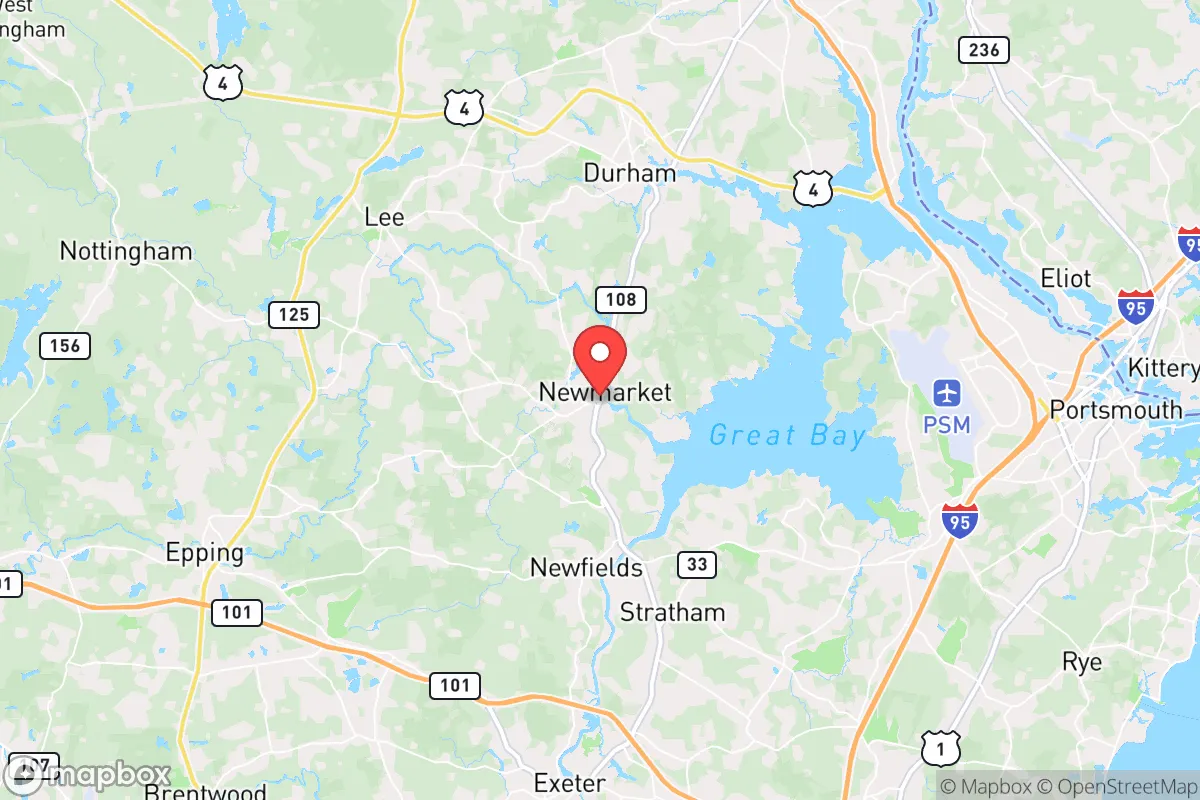
Photo: Wikipedia
Personal Sovereignty in Newmarket, NH
Viable for self-reliance. Generally workable, though some barriers may limit total independence.
What does Personal Sovereignty tell us?
Personal Sovereignty measures your capacity for self-reliance and independence with minimal government friction. Higher scores mean fewer barriers between you and the way you want to live... but it assumes you have the space you need and good neighbors.
What does this tell us?
Personal Sovereignty measures your capacity for self-reliance and independence with minimal government friction. Higher scores mean fewer barriers between you and the way you want to live... but it assumes you have the space you need and good neighbors.
State Policy
Energy independence: Importer (10% of energy produced in-state)
Personal Liberty
Homesteading

Personal Liberty Analysis
Newmarket, New Hampshire offers a notably high degree of personal sovereignty, grounded in the state’s longstanding "Live Free or Die" ethos and a legal framework that consistently prioritizes individual autonomy over government oversight. For a relocation audience valuing independence, the town presents a regulatory environment that is light-touch relative to most of New England, with no state income or sales tax, broad self-defense rights, and permissive land-use policies that enable self-reliant lifestyles. While Newmarket is a small, historic mill town with a denser village core than rural outposts like Wakefield or Ossipee, its zoning and state-level protections still afford residents significant latitude to live as they see fit, provided they respect local noise and nuisance ordinances. The following analysis breaks down the key pillars of personal sovereignty in Newmarket, covering tax burden, self-defense law, homesteading viability, and personal liberties.
Tax burden and regulatory posture: how New Hampshire’s structure affects Newmarket
Newmarket residents benefit from New Hampshire’s famously low-tax structure, which is a cornerstone of the state’s sovereignty appeal. There is no state income tax on wages or salaries, no state sales tax, and no capital gains tax, meaning the government takes a smaller cut of earnings and transactions than in virtually any other state. The trade-off is a reliance on local property taxes to fund services, and Newmarket’s property tax rate is moderate for the region. As of 2025, the town’s equalized tax rate hovers around $18.50 per $1,000 of assessed value, which is higher than in some rural towns but lower than in nearby Portsmouth or Durham. This rate funds a well-regarded school system, police and fire services, and municipal infrastructure. On the regulatory side, New Hampshire maintains a light-touch approach to business and occupational licensing, and Newmarket does not impose additional local business taxes or gross receipts fees. The state has no general building code for single-family homes in unincorporated areas, though Newmarket does enforce the state’s building code within its limits, which adds a modest layer of oversight for new construction. Overall, the tax and regulatory posture in Newmarket is among the most favorable in the Northeast for individuals seeking to keep more of their earnings and operate with fewer government mandates.
Self-defense and gun law specifics: what Newmarket residents can expect
New Hampshire is a "constitutional carry" state, and Newmarket fully reflects that legal environment. No permit is required to carry a concealed firearm for any law-abiding adult 18 or older, and there is no state-level handgun registry, waiting period, or magazine capacity restriction. The state also has a "stand your ground" law, meaning there is no duty to retreat before using deadly force in self-defense if a person is lawfully present and reasonably believes force is necessary to prevent imminent death or great bodily harm. Newmarket does not have any local ordinances that further restrict firearm possession or storage beyond state law, so residents can carry openly or concealed without additional permitting. The town does have a police department, but it does not engage in proactive firearms registration or confiscation. For those interested in shooting sports, the Pembroke Fish and Game Club is about 20 minutes away, and numerous public ranges exist throughout the state. Newmarket’s self-defense legal environment is as permissive as any in the country, placing it on par with states like Alaska, Arizona, and Kansas, and far more accommodating than neighboring Massachusetts or Maine.
Self-reliance and homesteading viability: lot sizes, zoning, and off-grid feasibility
Newmarket’s zoning and land-use policies offer moderate opportunities for self-reliance, though the town’s suburban character imposes some limits. The minimum lot size in the town’s residential zones is one acre, which is smaller than in rural towns but still sufficient for a substantial garden, small orchard, or keeping a few chickens. The town allows backyard chickens without a permit for up to six hens, though roosters are prohibited due to noise concerns. Goats and other small livestock are permitted on lots of two acres or more, and horses are allowed on parcels of three acres or more. For those seeking off-grid living, New Hampshire state law does not require connection to municipal water or sewer if a private well and septic system are installed and pass inspection. Newmarket does have municipal water and sewer in the village area, but properties on larger lots outside the core are typically on well and septic. Solar panels are permitted by right, and the state has a net metering policy that allows homeowners to sell excess power back to the grid. However, full off-grid living is more feasible in unincorporated townships like those in northern Coös County, where there are no building codes or zoning at all. In Newmarket, residents must still comply with local setback requirements, septic regulations, and the state’s building code for new structures. For a family wanting a modest homestead with a large garden, chickens, and solar power, Newmarket is viable; for those seeking complete autonomy from municipal systems, a more rural town would be a better fit.
Personal liberties: parental rights, medical autonomy, speech, and property
New Hampshire law provides strong protections for personal liberties that directly affect daily life in Newmarket. Parental rights are explicitly protected under state law, which affirms that parents have the fundamental right to direct the upbringing, education, and healthcare of their children. This includes the ability to opt children out of public school curricula or assignments without penalty, and to homeschool without excessive state oversight — New Hampshire requires only a simple notification and annual evaluation, with no mandated curriculum or testing. Medical autonomy is similarly robust: the state has no vaccine mandate for adults, and while school vaccine requirements exist, philosophical exemptions are permitted for all vaccines, giving parents broad latitude. The state also protects the right to refuse any medical treatment, and there are no laws forcing individuals to participate in health insurance plans. Free speech is protected under both the U.S. and New Hampshire constitutions, and the state has no hate speech laws that criminalize expression. Property rights are strong: New Hampshire has no statewide rent control, no forced inclusionary zoning, and no estate or inheritance tax. Newmarket does have a historic district commission that reviews exterior changes to properties in the village center, which can be a constraint for homeowners in that area, but outside the historic district, property owners have wide discretion over renovations and land use. Eminent domain is rarely used for private development, and the state’s "right to farm" law protects agricultural activities from nuisance lawsuits, which supports homesteaders. Overall, Newmarket’s legal environment is highly protective of individual choice in parenting, healthcare, speech, and property, with only the historic district overlay representing a notable local limitation.
In summary, Newmarket, NH offers a sovereignty profile that is strong for the Northeast but moderate by national standards. The absence of income and sales tax, constitutional carry, and robust parental rights create a foundation of personal freedom that is rare in the region. However, the town’s one-acre minimum lot size, building code enforcement, and historic district restrictions mean it is not the most permissive environment for those seeking maximum autonomy. For a family or individual who values low taxes, self-defense rights, and the ability to make independent choices about education and healthcare, Newmarket is an excellent choice within commuting distance of Portsmouth and the Seacoast. For those prioritizing off-grid living or complete freedom from local regulation, more rural towns in central or northern New Hampshire would offer even greater latitude. Newmarket strikes a balance between community amenities and personal sovereignty that appeals to many conservative-leaning relocators who want freedom without isolation.

* Values derived from national, state, county, city and local statistics and may differ in a specific area. Last updated: 2026-10-11T03:15:52.000Z
Narrative content on this page is AI-generated and may contain mistakes. Verify any details that matter before acting on them.
ReloMaps may earn a commission from affiliate links at no extra cost to you.

