Photo: Wikipedia
Demographics of Newmarket, NH
Affluence Level in Newmarket, NH
A middle-class area roughly in line with national averages across income, home values, education, and employment.
People of Newmarket, NH
The people of Newmarket, New Hampshire, today form a compact, historically rooted community of roughly 5,730 residents, characterized by a notably high education level—51.9% hold a college degree—and a population that remains predominantly white (88.9%). Despite its small size, the city carries a distinct identity as a former mill town that has reinvented itself as a bedroom community for the Portsmouth-Dover-Rochester corridor, blending old New England working-class stock with a newer wave of professionals and academics drawn by the nearby University of New Hampshire. The foreign-born share is low at 2.1%, and the racial makeup includes small but present Hispanic (1.9%), Black (1.0%), East/Southeast Asian (1.9%), and Indian subcontinent (0.8%) communities, reflecting modest diversification in recent decades.
How the city was settled and grew
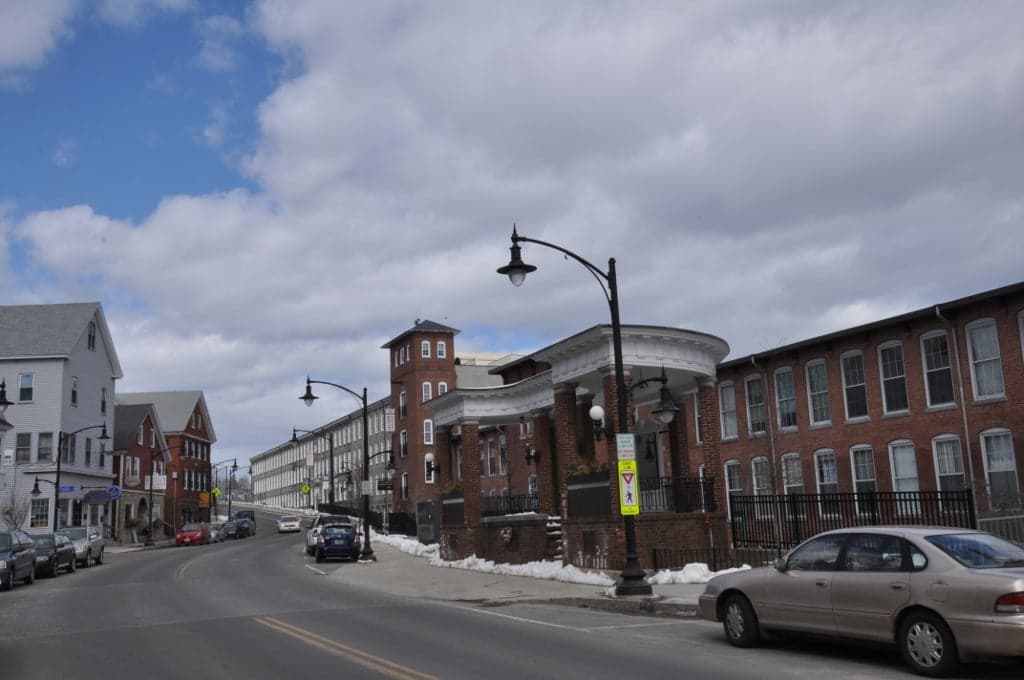
Newmarket's original population was built by European colonists, primarily of English and Scottish descent, who were drawn to the Lamprey River's water power in the early 18th century. The town was incorporated in 1727, and its early economy revolved around sawmills, gristmills, and shipbuilding. The defining population wave arrived with the Industrial Revolution: from the 1820s through the late 19th century, the Newmarket Manufacturing Company and other textile mills attracted waves of Irish immigrants fleeing the Great Famine, followed by French-Canadian families from Quebec seeking mill work. These groups settled in distinct neighborhoods that still carry their imprint. Irish laborers concentrated in the "Puddle Dock" area along the river, a dense working-class district of tenements and boarding houses. French-Canadian families clustered in "Canada Hill" (the area around upper Main Street and South Street), building St. Mary's Church as their cultural and religious anchor. A smaller wave of Polish and Italian immigrants arrived in the early 1900s, settling near the mill complex and along lower Main Street. By 1920, the population had swelled to over 3,000, with roughly half the town's workforce employed in the mills.
Modern era (post-1965)
The post-1965 era brought two major shifts. First, the collapse of the textile industry in the 1960s and 1970s triggered a population decline, as mill families left for jobs elsewhere. Second, the completion of the Spaulding Turnpike (NH Route 16) in the 1970s transformed Newmarket into a commuter suburb for Portsmouth, Dover, and the Seacoast's growing tech and healthcare sectors. The population bottomed out around 4,200 in 1980, then began climbing again as new residents—largely white, college-educated professionals—discovered the town's affordable historic housing stock. The "Downtown Historic District" (centered on Main Street and the mill complex) became a magnet for these newcomers, who renovated old mill-worker homes and converted mill buildings into condominiums. The racial and ethnic composition remained overwhelmingly white through the 1990s and 2000s, but the 2010s saw a slight uptick in diversity. The East/Southeast Asian population (1.9%) and Indian subcontinent population (0.8%) are largely concentrated among faculty and graduate students at the University of New Hampshire in nearby Durham, with some settling in the "South End" neighborhood (south of the Lamprey River, near the Durham line). The Hispanic and Black populations remain very small (1.9% and 1.0% respectively), scattered across the town without a distinct ethnic enclave.
The future
Newmarket's population is projected to grow slowly, reaching roughly 6,000-6,500 by 2040, driven by continued Seacoast regional growth and the town's appeal as a more affordable alternative to Portsmouth and Durham. The population is likely to become slightly more diverse, but the pace will be gradual. The East/Southeast Asian and Indian subcontinent shares may increase modestly as UNH expands its international graduate programs, with these new residents likely settling in "West Newmarket" (the area west of the downtown, near Route 152), where newer single-family subdivisions offer more space. The Hispanic and Black populations are expected to remain below 3% each, as Newmarket lacks the larger immigrant-service infrastructure and rental stock found in Manchester or Nashua. The town's cultural identity is evolving from a blue-collar mill town to a progressive-leaning, educated commuter suburb, though a significant conservative-leaning cohort remains among long-time families in "East Newmarket" (the area east of the downtown, toward the Great Bay). The biggest demographic wildcard is housing affordability: if the town approves more multi-family development near the downtown mill district, it could attract younger, more diverse residents; if not, the population will continue to skew older, whiter, and wealthier.
For someone moving in now, Newmarket offers a stable, safe, and highly educated community with a strong sense of place, but one that is demographically homogeneous and likely to remain so for the foreseeable future. The city is becoming a quieter, more professional version of its mill-town past, with the downtown's revitalization serving as the main engine of change. New residents will find a place that values its history while slowly adapting to a more diverse and commuter-oriented future.

* Values derived from national, state, county, city and local statistics and may differ in a specific area. Last updated: 2026-10-11T03:15:52.000Z
Narrative content on this page is AI-generated and may contain mistakes. Verify any details that matter before acting on them.
ReloMaps may earn a commission from affiliate links at no extra cost to you.

