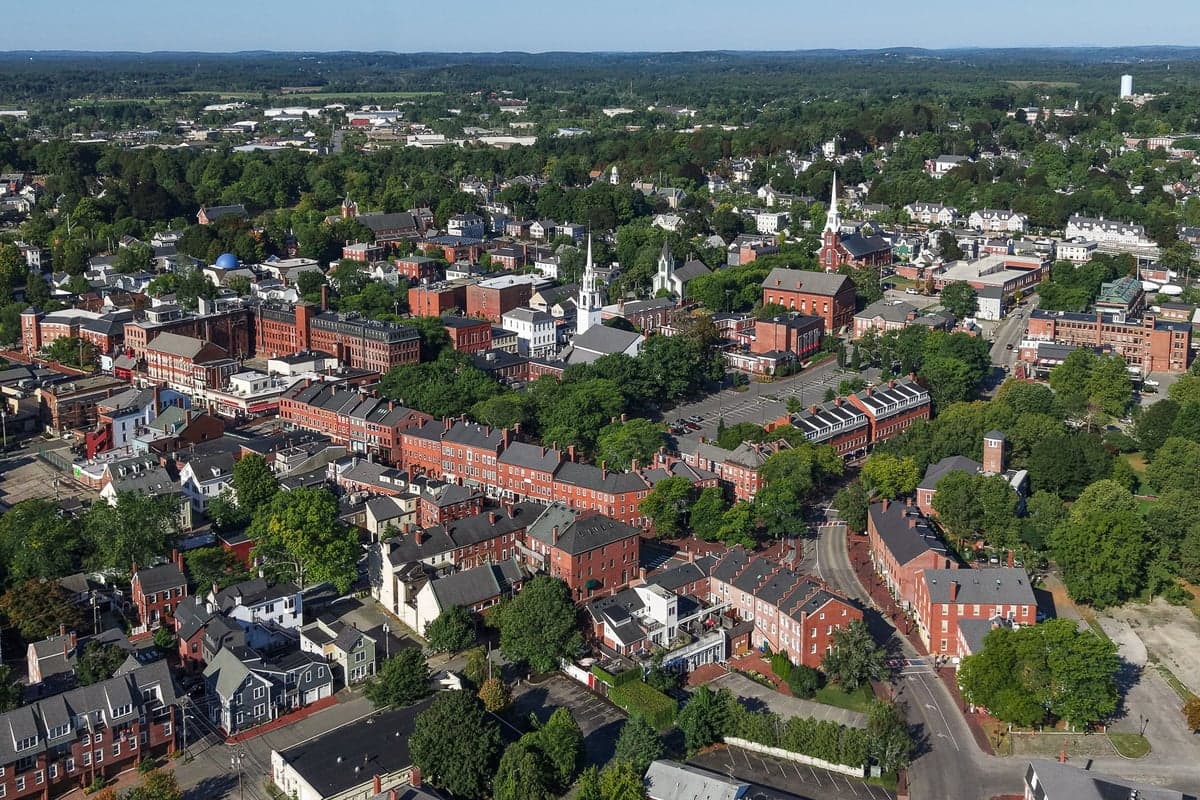
Photo: Wikipedia
Political ClimatePolitical Climate in Newburyport, MA
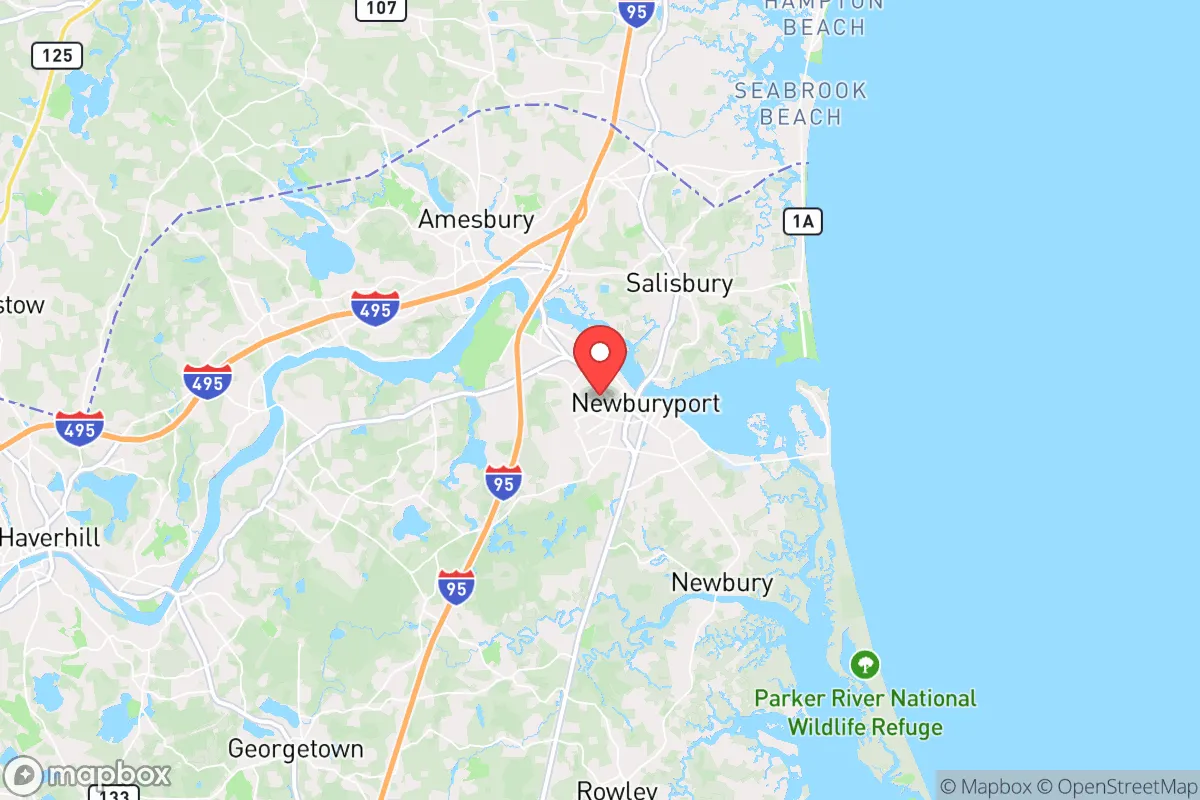
District shown is the primary district for this city’s centroid. Cities may span multiple districts.
Political rankings in Massachusetts
- Most Conservative Cities in Massachusetts
- Most Liberal Cities in Massachusetts
- Best Conservative-Leaning Towns in New England
- Best Conservative-Leaning Towns in the Northeast
- Safest Liberal-Leaning Towns on the East Coast
- Safest Conservative-Leaning Towns on the East Coast
- Most Affordable Liberal-Leaning Small Towns in the U.S.
- Safest Liberal-Leaning Cities in the U.S.
- Most Conservative Counties in Massachusetts
- Most Liberal Counties in Massachusetts
Local Political AnalysisPolitical Analysis of Newburyport, MA
Newburyport leans reliably Democratic, but it’s a bit more purple than the rest of Massachusetts. The city’s Cook Partisan Voting Index (PVI) is D+11, meaning it votes about 11 points more Democratic than the national average—but that’s four points less blue than the state’s overall D+15 rating. In practice, this means Newburyport is a place where you’ll see a fair number of Republican yard signs mixed in with the Harris-Walz ones, especially in the more rural pockets toward the town line with West Newbury or across the Merrimack in Salisbury. The trajectory has been slowly trending left over the past decade, but not as sharply as some Boston suburbs; the old Yankee Republican tradition still has a foothold here, particularly among older families who’ve been in town for generations.
How it compares
Compared to Massachusetts as a whole, Newburyport is a moderate outlier. The state’s D+15 PVI reflects deep-blue strongholds like Cambridge (D+38) and Boston (D+30), where Republican candidates rarely crack 20%. In Newburyport, by contrast, a Republican running for state rep or city council can pull 40-45% in a good year. The surrounding towns tell the story: head west to West Newbury or south to Rowley, and you’re in R+10 to R+15 territory—places where Trump won handily in 2020. Even neighboring Amesbury, just up the river, is closer to D+8, making Newburyport the leftmost anchor in the region. The real contrast is with the North Shore’s wealthier enclaves like Manchester-by-the-Sea (R+2) or the working-class mill towns like Haverhill (D+5), where the politics are more mixed. Newburyport sits right in the middle of this spectrum: liberal enough to feel comfortable for progressives, but with enough conservative holdouts that you’ll hear both sides at the coffee shop.
What this means for residents
For liberal residents, Newburyport is a comfortable place to live. The city council and school board are reliably progressive on issues like climate action, affordable housing, and public transit. You’ll find strong support for the MBTA Communities Act zoning changes, and the local Democratic committee is active. For conservative residents, it’s not hostile, but you’ll be in the minority. The local GOP chapter is small but vocal, and you can still find a few Republican selectmen or school committee members if you look. The practical effect is that taxes and regulations lean left—property taxes are high (around $6,000 on a median home), and the city has strict historic district rules that can frustrate homeowners wanting to renovate. But the trade-off is a well-funded school system and a downtown that’s been revitalized without losing its character. Most residents, regardless of party, agree that the city’s biggest challenge is managing growth without pricing out the middle class.
Culturally, Newburyport stands out for its blend of old-money reserve and new-economy activism. The waterfront and historic district give it a polished, preppy feel—think sailing clubs and farmers markets—while the influx of remote workers from Boston has pushed the politics a bit younger and more progressive. You won’t see the same level of street activism you’d get in Cambridge, but you will see strong local engagement on issues like the Plum Island beach erosion or the future of the Route 1 corridor. The policy distinction that matters most day-to-day is the city’s aggressive approach to housing: Newburyport was one of the first in the state to adopt a “housing production plan” that mandates a certain percentage of affordable units in new developments. That’s a very Massachusetts move, but the way it’s implemented here—with a lot of community input and a slow, deliberate pace—feels distinctly Newburyport. If you’re moving here, expect a place that votes blue but argues about it over oysters at the Grog.

State Political ClimatePolitical Climate in Massachusetts
State Political AnalysisPolitical Environment in the State
Massachusetts is one of the most reliably Democratic states in the country, with a Cook Partisan Voting Index of D+15, meaning it votes about 15 points more Democratic than the national average in presidential elections. The state hasn’t voted for a Republican presidential candidate since Ronald Reagan in 1984, and the Democratic hold on state government is near-total: every statewide office, both U.S. Senate seats, and a supermajority in both legislative chambers are held by Democrats. Over the past 20 years, the shift has been toward deeper blue, driven by the consolidation of the Boston metro area and the exodus of moderate Republicans from the legislature, though the state’s famous “Massachusetts Republican” tradition — fiscally conservative, socially moderate — has not entirely vanished in a few isolated pockets.
Urban vs. rural divide
The political map of Massachusetts is a classic urban-rural split, but with a twist: the urban core is so dominant that it overwhelms the rest of the state. Greater Boston, including Boston proper, Cambridge, Somerville, and Brookline, is the engine of the state’s Democratic lean, routinely delivering margins of 80% or more for Democratic candidates. The western part of the state, particularly Berkshire County (home to Pittsfield and North Adams), also leans heavily Democratic, driven by a mix of college towns and post-industrial communities. The true Republican strongholds are in the central and southeastern parts of the state, where towns like Wrentham, Norfolk, and Carver regularly vote Republican, but these are small, low-population areas. The most notable exception is Cape Cod and the Islands (Martha’s Vineyard and Nantucket), which are reliably Democratic due to a mix of wealthy retirees and seasonal residents. The 2020 presidential election saw Worcester County flip slightly toward Biden after going for Trump in 2016, but the margins are thin — it’s the only county that has been competitive in recent cycles. For a conservative relocator, the practical reality is that you will be a political minority almost everywhere, but the degree varies: you’ll find more like-minded neighbors in the rural towns of Plymouth County or the hill towns of Franklin County than in the Boston suburbs.
Policy environment
Massachusetts has one of the most progressive state-level policy environments in the country, which directly affects daily life. The state income tax is a flat 5% (recently reduced from 5.15% via a 2022 ballot question), and the sales tax is 6.25%. Property taxes are high, averaging about 1.1% of assessed value, but vary wildly by town — Boston has a relatively low rate (0.6%) while rural towns like Becket can exceed 1.5%. The state has a robust regulatory environment: strict environmental laws, a strong tenant-friendly landlord-tenant code, and a healthcare system built on near-universal coverage through MassHealth (Medicaid) and the Health Connector. Education policy is a point of pride: Massachusetts consistently ranks #1 in K-12 outcomes nationally, but the system is funded largely through local property taxes, creating a sharp divide between wealthy suburbs like Lexington and poorer cities like Fall River. Election laws are among the most accessible in the nation: no-excuse mail-in voting, same-day registration, and early voting are all permanent fixtures. For a conservative resident, the policy environment means higher taxes and more regulation than in most states, but also high-quality public services, especially in education and healthcare.
Recent policy direction
The last five years have seen Massachusetts move decisively left on several fronts, with legislation that a relocator should weigh carefully. On gun and self-defense law, the state passed the Massachusetts Gun Safety Act of 2024, which bans “ghost guns,” requires microstamping on new handguns, and expands the state’s already strict assault weapons ban. Massachusetts already had one of the nation’s most restrictive concealed carry regimes, with a “may issue” licensing system that gives local police chiefs broad discretion. On parental and education rights, the state has moved in the opposite direction from many red states: in 2023, the legislature passed a law requiring school districts to adopt policies that support LGBTQ+ students, including allowing students to use names and pronouns without parental consent in some circumstances. On medical and bodily autonomy, Massachusetts has become a safe haven: the ROE Act of 2020 codified abortion rights into state law, expanded access to later-term abortion, and removed parental consent requirements for minors. On property rights, the state has a strong “right to repair” law for vehicles, but also a controversial 2024 MBTA Communities Law that mandates multi-family zoning near transit stops, overriding local zoning control — a direct challenge to suburban property rights. On taxation, the 2022 “millionaire’s tax” (a 4% surtax on income over $1 million) was approved by voters, and the state has not shown any appetite for broad tax cuts. For a conservative, the direction is clear: the state is becoming more progressive on social issues, more regulatory on property, and more expensive on taxes.
Civil unrest & political movements
Massachusetts has a long history of organized political activism, but it’s overwhelmingly left-leaning in practice. The Boston-area Black Lives Matter protests in 2020 were among the largest per capita in the country, and the movement has maintained a visible presence, particularly around police reform and racial justice issues. On the right, the Massachusetts Republican Party is small but active, with a strong grassroots presence in the central and southeastern parts of the state; the 2020 election integrity movement had some traction in rural towns, but never reached the scale seen in swing states. Immigration politics are a flashpoint: Massachusetts is a sanctuary state (via a 2017 law limiting state and local police cooperation with ICE), and the arrival of migrant families in 2023-2024 — particularly in Boston, Worcester, and Springfield — has strained shelter systems and sparked local backlash in some communities. The 2024 state budget included $250 million for emergency shelter, a direct response to the crisis. For a new resident, the most visible political movements are likely to be left-leaning protests in Boston and Cambridge, but the right is present in quieter, more localized ways — town hall meetings, school board races, and local Republican committees in places like Plymouth and Bristol County.
Projection
Over the next 5-10 years, Massachusetts is likely to become even more Democratic, driven by two demographic trends. First, the Boston metro area continues to attract young, college-educated professionals from across the country and the world, who overwhelmingly vote Democratic. Second, the state’s rural and exurban areas — the remaining Republican strongholds — are aging and losing population. The 2020 census showed that Berkshire County lost 5% of its population, while Suffolk County (Boston) grew by 10%. This means the political center of gravity will continue to shift toward the urban core. On policy, expect further movement left: a potential push for rent control (currently banned by state law), a possible expansion of the millionaire’s tax to other income brackets, and continued tightening of gun laws. The MBTA Communities Law will likely be upheld and expanded, forcing more suburban towns to accept higher-density housing. For a conservative moving in now, the realistic expectation is that you will be in a state that is increasingly progressive, with a political culture that is more aligned with Cambridge than with the rest of the country. However, the state’s strong local governance tradition means that town-level politics can still offer some insulation — a Republican-leaning town like Norwell can maintain its character even as the state moves left.
Bottom line for a new resident: If you are a conservative, moving to Massachusetts means accepting that you will be a political minority at the state level, with higher taxes, stricter gun laws, and a progressive social agenda. The trade-off is access to world-class public schools, top-tier healthcare, and a stable, well-funded state government. Your best bet for finding a like-minded community is to target the rural towns of Plymouth, Bristol, or Worcester counties, or the hill towns of the Berkshires, where local politics can still lean right. For a liberal resident, the state offers a policy environment that aligns closely with your values, but be prepared for high housing costs and a competitive job market concentrated in the Boston area. Either way, the state’s political trajectory is clear: it’s not going to flip red, and it’s not going to moderate. Plan accordingly.
* Values derived from national, state, county, city and local statistics and may differ in a specific area. Last updated: 2026-11-28T00:04:02.000Z
Narrative content on this page is AI-generated and may contain mistakes. Verify any details that matter before acting on them.
ReloMaps may earn a commission from affiliate links at no extra cost to you.

