
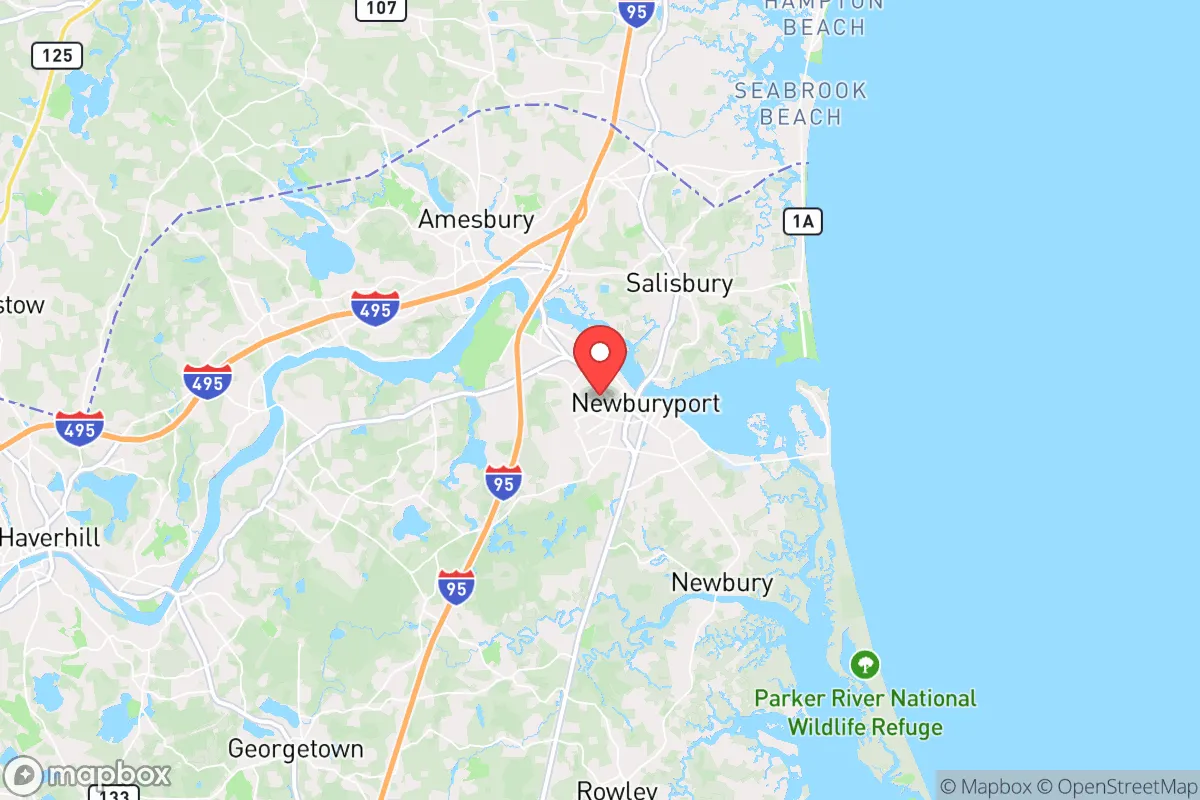
Photo: Wikipedia
Personal Sovereignty in Newburyport, MA
Viable for self-reliance. Generally workable, though some barriers may limit total independence.
What does Personal Sovereignty tell us?
Personal Sovereignty measures your capacity for self-reliance and independence with minimal government friction. Higher scores mean fewer barriers between you and the way you want to live... but it assumes you have the space you need and good neighbors.
What does this tell us?
Personal Sovereignty measures your capacity for self-reliance and independence with minimal government friction. Higher scores mean fewer barriers between you and the way you want to live... but it assumes you have the space you need and good neighbors.
State Policy
Energy independence: Importer (5% of energy produced in-state)
Personal Liberty
Homesteading

Personal Liberty Analysis
Newburyport, Massachusetts, presents a complex personal sovereignty environment where historic New England charm meets one of the nation's densest state-level regulatory frameworks. For the individual or family prioritizing autonomy, the city offers a walkable, amenity-rich coastal lifestyle, but the trade-offs are significant: a high tax burden, restrictive gun laws, limited off-grid feasibility, and a state government that actively preempts local decision-making on many personal liberty issues. Understanding these trade-offs is essential before relocating here, as the area's appeal lies more in community and convenience than in personal independence from government oversight.
Tax burden and regulatory posture in Essex County
Massachusetts is a high-tax state, and Newburyport residents feel this acutely. The state income tax is a flat 5.0% on all wages, with no standard deduction for most filers, meaning even part-time workers pay from the first dollar. Property taxes in Newburyport are moderate for the region, with a 2025 rate of approximately $10.50 per $1,000 of assessed value, but home values are high — the median single-family home exceeds $700,000 — so the effective annual bill often runs $7,000–$9,000. The state also imposes a 6.25% sales tax on most goods and a meals tax that pushes restaurant bills higher. Regulatory posture is heavy: Massachusetts has a statewide building code with strict energy-efficiency mandates (the "Stretch Code"), and Newburyport adds its own historic district commission oversight for exterior changes in much of the downtown. Permitting for new construction or major renovations can take months, and the city's Conservation Commission has authority over any work near wetlands, which cover significant portions of the area. For a reader accustomed to lighter-touch states like New Hampshire (just 30 minutes north), the regulatory density here will feel substantial.
Self-defense rights and Massachusetts gun law specifics
Massachusetts has some of the most restrictive firearm laws in the United States, and Newburyport residents must comply fully. The state requires a License to Carry (LTC) for both open and concealed carry, issued by the local police department — in this case, the Newburyport Police. The process includes a background check, fingerprinting, a state-approved firearms safety course, and a "suitability" interview where the licensing officer has discretion to deny based on subjective criteria. The state bans "assault weapons" by name and feature, limits magazine capacity to 10 rounds, and requires that all firearm transfers (including private sales) go through a licensed dealer with a background check. There is no "stand your ground" law; Massachusetts imposes a duty to retreat if safely possible before using deadly force in self-defense. Castle Doctrine applies only inside one's home, and even then, the burden of proof for justification rests heavily on the defender. For a reader who prioritizes self-defense autonomy, these constraints are a major consideration. The nearest jurisdictions with more permissive laws are New Hampshire and Maine, both roughly a 30–45 minute drive.
Self-reliance and homesteading viability in a coastal city
Newburyport is not a homesteading destination. The city is densely developed, with typical residential lot sizes ranging from 0.1 to 0.25 acres in the historic core and 0.25 to 0.5 acres in newer subdivisions. Zoning regulations prohibit keeping livestock (chickens, goats, pigs) on most residential lots under 1 acre, and even then, a special permit is required. The city's zoning bylaw restricts "accessory dwelling units" (ADUs) to owner-occupied properties and limits their size, making rental income or multi-generational living arrangements more difficult. Off-grid living is effectively impossible: the city requires connection to municipal water and sewer for any habitable structure, and solar panel installations must comply with historic district guidelines in many neighborhoods. Rainwater collection for potable use is not prohibited but is impractical given the small lot sizes and the availability of cheap municipal water. For a reader seeking self-sufficiency through gardening, small-scale food production, or energy independence, the regulatory environment and physical constraints of this coastal city are significant barriers. The rural towns of western Essex County (e.g., Georgetown, Rowley) offer larger lots and fewer restrictions, but even there, Massachusetts state law precludes many off-grid practices.
Personal liberties: parental rights, medical autonomy, speech, and property
Massachusetts generally takes an active role in personal liberty areas that other states leave to individuals. On parental rights, the state mandates comprehensive sex education in public schools (the "Healthy Youth Act"), and parents cannot opt their children out of specific lessons — only the entire curriculum. Vaccine mandates for school attendance are strict, with no philosophical exemption and a narrow medical exemption process. On medical autonomy, Massachusetts has some of the nation's strongest vaccine mandates for healthcare workers and schoolchildren, and during public health emergencies, the governor has broad authority to issue binding orders. The state also legalized assisted suicide (via the "End of Life Options Act") in 2025, which some readers may view as a liberty gain and others as a concern. Free speech is generally protected under the First Amendment, but Massachusetts has a "hate crimes" law that enhances penalties for speech or conduct deemed to target protected classes, and the state's anti-SLAPP statute is robust, protecting individuals from lawsuits meant to chill speech on public issues. Property rights are constrained by the state's strong "Chapter 40B" affordable housing law, which allows developers to bypass local zoning if a town has less than 10% affordable housing (Newburyport is at roughly 12%, so this pressure is moderate). The state also has a "right to farm" law, but it applies only to agricultural land, not residential lots. For a reader who values maximum personal discretion in medical, educational, and property decisions, Massachusetts' active regulatory posture will feel restrictive.
Overall, Newburyport offers a high quality of life for those who value community, walkability, and coastal access, but personal sovereignty is heavily circumscribed by state and local regulation. Compared to a freedom-oriented benchmark like New Hampshire or Texas, the trade-offs are stark: lower taxes, fewer gun restrictions, and greater homesteading feasibility exist just over the border, but with a different lifestyle and commute. For the reader who prioritizes autonomy above all else, Newburyport is likely not the right fit. For those who accept a higher regulatory burden in exchange for a historic, amenity-rich coastal environment, it can be a rewarding place to live — provided the constraints on personal independence are understood and accepted from the start.

* Values derived from national, state, county, city and local statistics and may differ in a specific area. Last updated: 2026-11-28T00:04:02.000Z
Narrative content on this page is AI-generated and may contain mistakes. Verify any details that matter before acting on them.
ReloMaps may earn a commission from affiliate links at no extra cost to you.

