Photo: Wikipedia
Demographics of Ulster County
Affluence Level in Ulster County
A middle-class area roughly in line with national averages across income, home values, education, and employment.
People of Ulster County
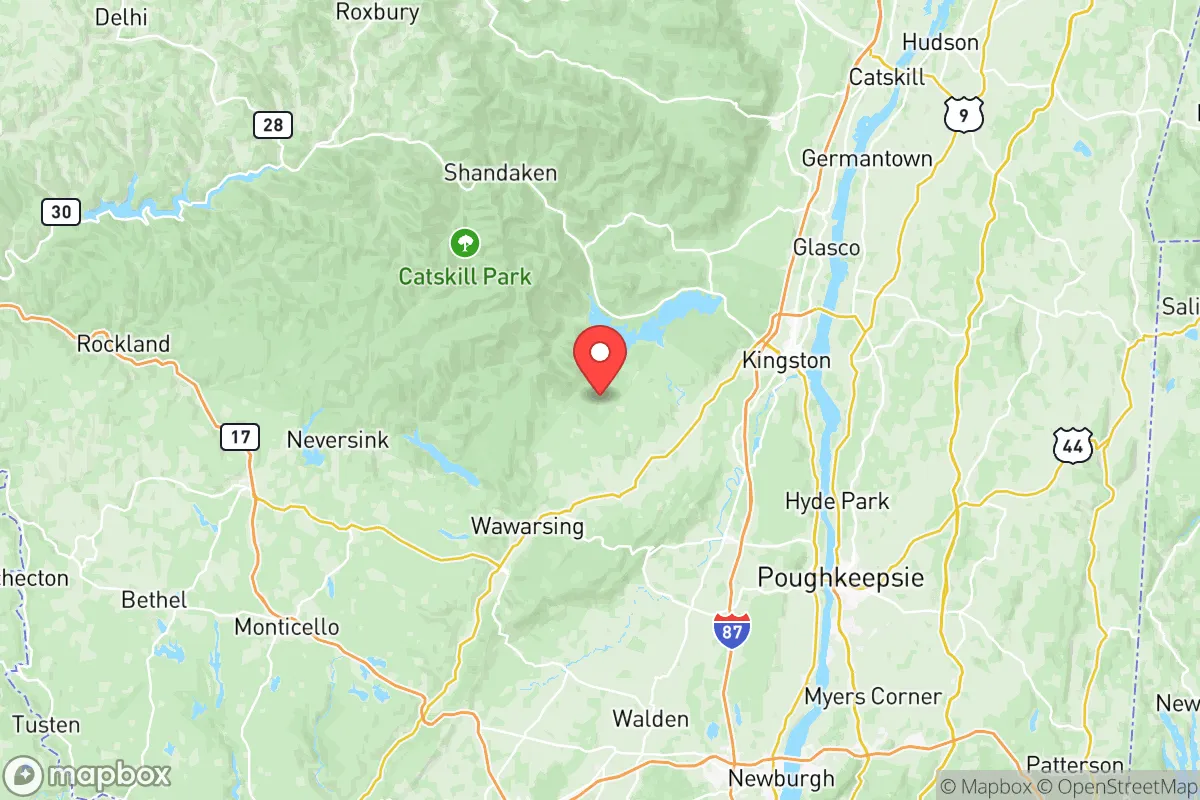
Today, the people of Ulster County, New York are a predominantly white (73.5%) and notably well-educated (37.1% college-educated) population of 182,109, characterized by a blend of historic small-town Yankee stock, descendants of 19th-century European immigrants, and a growing Hispanic community. The county's identity is shaped by its position as a Hudson Valley hub—less dense than the downstate suburbs but more connected than the rural North Country—with a distinct cultural marker in its long history of religious diversity and artistic retreat. The population is concentrated along the Hudson River corridor in cities like Kingston and the town of New Paltz, while the western and northern reaches remain more sparsely settled and heavily wooded.
Settlement & growth (pre-1960)
The first human history of Ulster County begins with the Lenape people, particularly the Esopus band, who inhabited the region along the Hudson River and its tributaries for centuries before European contact. Dutch colonists from the New Netherland colony established the first permanent European settlement at Kingston (then called Esopus) in 1653, making it one of the oldest continuously inhabited European settlements in New York. The Dutch influence remains visible today in Kingston's historic Stockade District and in family names that persist across the county.
After the English takeover of New Netherland in 1664, Ulster County was formally organized in 1683, and its early economy centered on farming, milling, and river trade. A significant wave of French Huguenot refugees arrived in the late 17th century, fleeing religious persecution in Catholic France. These Huguenots founded the town of New Paltz in 1678, where their stone houses still stand along Huguenot Street, now a National Historic Landmark district. The Huguenots brought with them a tradition of religious nonconformity and a work ethic that shaped the county's character for generations.
The 18th and early 19th centuries saw a steady influx of English and Scots-Irish settlers, who pushed inland from the Hudson River into the fertile valleys of the Wallkill River and Rondout Creek. These groups established farming communities in places like Gardiner, Rochester (now Accord), and Marbletown. The completion of the Delaware and Hudson Canal in 1828 transformed Kingston's Rondout district into a bustling port for transporting Pennsylvania coal to the Hudson River, drawing Irish immigrants who dug the canal and later worked the docks. By the 1850s, Irish laborers had established a strong presence in Kingston's Ponckhockie neighborhood, where St. Mary's Church became a cornerstone of the community.
German immigrants arrived in significant numbers during the mid-19th century, particularly after the failed revolutions of 1848. They settled in Kingston and the surrounding farmlands of Hurley and Woodstock, bringing skills in brewing, butchering, and cabinetmaking. The German influence is still evident in Kingston's German Methodist Church and in the popularity of local breweries that trace their roots to this era. Italian immigrants followed in the late 19th and early 20th centuries, drawn by work on the railroads and in the bluestone quarries that dotted the county. Italian enclaves formed in Kingston's East End and in the town of Saugerties, where quarrying was a major employer.
The early 20th century brought a smaller but culturally significant wave of Eastern European Jews, many of whom were drawn to the Catskill Mountains resorts that dotted the county's western edge. Towns like Woodstock and Shandaken became summer destinations for Jewish families from New York City, and the Borscht Belt hotels of the nearby Catskills created a seasonal economy that employed many local residents. This period also saw the arrival of African American families moving north during the Great Migration, though in smaller numbers than in industrial cities like Albany or Newburgh. Black communities formed in Kingston's Ponckhockie and Wilbur neighborhoods, where they worked in the brickyards and on the railroad.
Modern era (post-1965)
The 1965 Hart-Cellar Act opened immigration from Asia and Latin America, but Ulster County's foreign-born population remains low at just 3.2%—far below the national average and even below the New York state average. The county did not experience the large-scale immigration waves that transformed downstate suburbs or upstate cities like Utica. Instead, the most significant demographic shift since 1965 has been the growth of the Hispanic population, which now stands at 11.8% of the county's residents. This community is concentrated in Kingston, where Puerto Rican and Dominican families began arriving in the 1970s and 1980s, drawn by relatively affordable housing and service-sector jobs. The Hispanic population has since spread to Saugerties and New Paltz, where agricultural work in the region's orchards and farms has attracted Mexican and Central American immigrants.
The East/Southeast Asian population (1.6%) and Indian subcontinent population (0.4%) remain small but have grown modestly since the 1990s, primarily through professionals employed at the State University of New York at New Paltz and at healthcare facilities like HealthAlliance Hospital in Kingston. These communities are dispersed rather than concentrated in ethnic enclaves, reflecting the county's overall pattern of low-density diversity. The Black population (5.7%) has remained relatively stable, with the largest concentrations in Kingston and the town of Ulster, where historic neighborhoods like Ponckhockie continue to anchor the community.
Domestic migration has reshaped Ulster County more than international immigration. Beginning in the 1970s, the county attracted a wave of back-to-the-land homesteaders and counterculture refugees from New York City, drawn by the legacy of the 1969 Woodstock festival and the region's natural beauty. This influx transformed towns like Woodstock, Phoenicia, and New Paltz into centers of alternative culture, organic farming, and artistic production. More recently, the COVID-19 pandemic accelerated a trend of urban-to-rural migration, with remote workers from New York City and the Hudson Valley suburbs purchasing homes in Kingston, Saugerties, and the Rondout Valley. This has driven up housing prices and shifted the county's demographic profile toward higher-income, college-educated newcomers.
The future
Ulster County is becoming slightly more diverse but remains overwhelmingly white, and the pace of change is slow. The Hispanic population is projected to grow gradually, driven by both natural increase and continued migration for agricultural and service work, with Kingston and the Wallkill Valley likely to see the largest increases. The East/Southeast Asian and Indian populations will probably grow modestly as SUNY New Paltz and regional healthcare employers continue to attract professionals, but the county lacks the industrial base or ethnic infrastructure to draw large immigrant communities. The most consequential demographic trend is the continued influx of remote workers and retirees from downstate, which is reshaping the county's housing market and political character. Towns like New Paltz and Woodstock are becoming more expensive and more liberal, while the more rural western towns remain conservative and working-class. This internal divide is likely to deepen over the next decade.
For someone moving to Ulster County now, the region offers a mix of historic small-city life in Kingston, college-town energy in New Paltz, and rural quiet in the western towns. The population is stable but aging, and the county's future depends on whether it can attract younger families and workers to replace the retiring generation. The low foreign-born share means that newcomers who are not white may find limited co-ethnic community, though the county's long history of religious and cultural tolerance provides a generally welcoming environment. Ulster County is becoming a more expensive, more educated, and slightly more diverse place—but it remains, at its core, a historically white Hudson Valley community shaped more by domestic migration than by global immigration.

* Values derived from national, state, county, city and local statistics and may differ in a specific area. Last updated: 2026-06-18T14:14:35.000Z
Narrative content on this page is AI-generated and may contain mistakes. Verify any details that matter before acting on them.
ReloMaps may earn a commission from affiliate links at no extra cost to you.

