Photo: Wikipedia
Political ClimatePolitical Climate in Steuben County
Showing district-level results — no local-only data available.
Local Political AnalysisPolitical Analysis of Steuben County
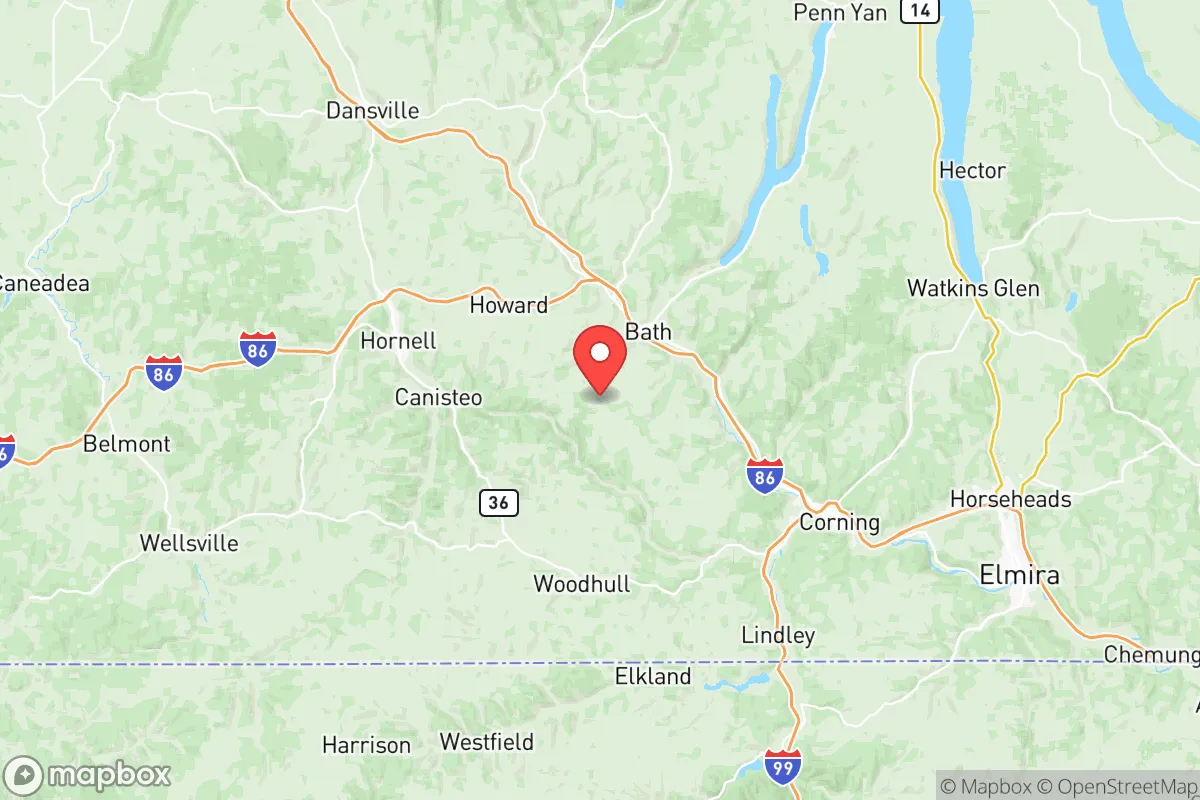
Steuben County, New York, is a reliably Republican stronghold in the Southern Tier, with a Cook Partisan Voting Index (PVI) of R+10, meaning it votes about 10 percentage points more Republican than the national average. This isn't a recent shift; the county has voted for the GOP presidential candidate in every election since 2000, often by margins of 15 to 25 points. The real story, though, is the growing divide between its rural, conservative towns and the small, more liberal pockets around Corning and Bath, a split that mirrors the state's urban-rural chasm but on a much smaller scale.
How it compares
Compared to New York City, Steuben County is a political mirror image. While NYC's five boroughs deliver massive Democratic margins — often 80% or more — Steuben's precincts in towns like Hornell, Canisteo, and Addison routinely go 65-75% Republican. The contrast is starkest in presidential years: in 2020, Steuben gave Donald Trump 64% of the vote, while New York City gave Joe Biden 76%. The county's R+10 PVI is a world away from NYC's likely D+30 or higher, making it one of the most conservative counties in the state outside of the Adirondacks. Even within Steuben, there's variation: the village of Corning (home to Corning Incorporated's headquarters) and the county seat of Bath (with its state prison and VA medical center) lean more moderate or even blue in local races, while Wayland, Arkport, and Prattsburgh are deep red. The swing precincts are often in the rural townships just outside Corning and Bath, where independent voters can tip a supervisor race by a few dozen votes.
What this means for residents
For conservative residents, Steuben County feels like a safe harbor in a blue state. Local government — from the county legislature to town boards — is overwhelmingly Republican, meaning tax policy, land-use regulations, and Second Amendment rights are generally aligned with conservative values. The county's Republican Party is well-organized, with active committees in all 32 towns. For liberal residents, the reality is more isolating. While Corning and Bath offer small enclaves of like-minded neighbors, Democratic candidates rarely win countywide office, and progressive policy proposals (like sanctuary city designations or renewable energy mandates) face steep uphill battles. That said, the county's nonpartisan local elections — for judges, highway superintendents, and school boards — often hinge on personality and competence rather than party label, giving moderates a real voice in day-to-day governance.
Culturally, Steuben County's political climate shapes daily life in tangible ways. The region's economy is anchored by Corning Incorporated, a Fortune 500 company that brings a more cosmopolitan, globally-minded workforce to the Corning area, while the rest of the county relies on agriculture, manufacturing, and state government jobs (the Bath VA and state prison system are major employers). This economic split creates a subtle cultural divide: Corning's Gaffer District feels more progressive, with farm-to-table restaurants and art galleries, while towns like Hornell and Canisteo hold tight to traditional values, with gun shops, hunting clubs, and a strong "live and let live" ethos. The county's trajectory is toward further polarization, as younger residents move to Corning or leave for cities, and the rural population ages and becomes more conservative. For newcomers, the key is understanding that Steuben County is not a monolith — your experience will vary dramatically depending on whether you settle in the Corning area or a small town like Jasper or Cohocton.

State Political ClimatePolitical Climate in New York
State Political AnalysisPolitical Environment in the State
New York State is a solidly Democratic stronghold, with a partisan lean of roughly D+10 to D+12 in statewide elections over the past decade, driven overwhelmingly by New York City and its inner suburbs. The state has moved leftward since the 1990s, when it was a competitive swing state that went for Bill Clinton and then flipped to Republican George Pataki for three terms as governor. Today, the Democratic trifecta in Albany has been in place since 2019, and the state’s political trajectory is defined by a growing urban-rural chasm, with upstate regions like the Southern Tier and North Country becoming deeply Republican while the five boroughs and Long Island anchor the Democratic majority.
Urban vs. rural divide
The political map of New York is a tale of two states. New York City alone accounts for roughly 40% of the state’s vote, and it delivers margins of 75-85% Democratic in presidential elections. Manhattan, Brooklyn, and the Bronx are among the most liberal jurisdictions in the country, while Staten Island is a notable outlier, often voting Republican by narrow margins. The immediate suburbs—Westchester, Nassau, and Suffolk counties on Long Island—have trended Democratic since 2016, though they remain more moderate than the city. In contrast, the vast upstate region—from Buffalo and Rochester to the Adirondacks—is a patchwork. Erie County (Buffalo) and Monroe County (Rochester) are Democratic-leaning due to their urban cores, but the surrounding rural counties—like Wyoming, Orleans, and Livingston—vote Republican by 20-30 points. The Capital District around Albany is a swing area, with Albany County itself Democratic and neighboring Rensselaer and Saratoga counties trending red. The Southern Tier, including places like Binghamton and Elmira, has shifted hard right over the past two decades, mirroring the national realignment of white working-class voters away from the Democratic Party.
Policy environment
New York’s policy environment is among the most progressive in the nation, with a high-tax, high-regulation posture that directly impacts relocators. The state has a progressive income tax with rates from 4% to 10.9% for top earners, and property taxes are among the highest in the U.S.—averaging 1.7% of home value statewide, with Long Island and Westchester often exceeding 2%. Sales tax varies by county, typically 8-8.875%. The regulatory climate is business-friendly in name only for many industries, with strict environmental rules, a $15 minimum wage (indexed to inflation), and a strong union presence in construction, education, and public services. Education policy is centralized: the state sets curriculum standards, mandates universal pre-K, and funds schools heavily through property taxes, leading to wide disparities between wealthy suburbs and poorer rural districts. Healthcare is dominated by large hospital systems like Northwell Health and NYU Langone, and the state runs its own health insurance exchange, NY State of Health, with generous subsidies. Election laws are among the most accessible: no-excuse absentee voting, early voting (10 days), same-day registration during early voting, and automatic voter registration via DMV. However, the state’s campaign finance system is notoriously opaque, with unlimited “independent expenditures” from unions and corporations.
Recent policy direction
Since 2019, Albany has passed a wave of legislation that signals a clear leftward direction. On gun policy, the state enacted the SAFE Act in 2013 (expanded in 2022 after the Supreme Court’s Bruen decision), requiring universal background checks, a ban on “assault weapons,” and a permit-to-purchase system for handguns. The 2022 law also restricts concealed carry in “sensitive locations” like Times Square and subways, which is currently being litigated. On parental and education rights, New York has no parental bill of rights; school boards have broad autonomy, but the state mandates LGBTQ-inclusive curriculum and prohibits discrimination based on gender identity, which has sparked clashes in conservative districts like Shenendehowa (Saratoga County). Speech and privacy are protected under the state constitution, but a 2023 law criminalizes “doxxing” of public officials, and the state has a strong anti-SLAPP statute. On medical and bodily autonomy, New York is a safe haven for abortion, with a 2019 law codifying Roe v. Wade protections and a 2022 amendment to the state constitution enshrining reproductive rights. Gender-affirming care for minors is legal and protected. Property rights are constrained by rent stabilization in NYC and some suburbs, and the state’s 2019 Housing Stability and Tenant Protection Act limits rent increases and evictions. Taxation has seen no major cuts; the top rate was actually increased in 2021 for high earners. Voting and ballot access expanded with the 2019 Early Voting Act and 2021’s automatic voter registration, though a 2021 law allowing non-citizens to vote in local elections was struck down by courts.
Civil unrest & political movements
New York has a long history of political activism, and recent years have seen intense polarization. The 2020 Black Lives Matter protests in NYC were among the largest in the country, with widespread property damage and a subsequent debate over police funding that led to a $1 billion cut to the NYPD budget, later partially restored. On the right, the “Second Amendment Sanctuary” movement has gained traction in upstate counties like Allegany and Chenango, where local sheriffs have refused to enforce parts of the SAFE Act. Immigration is a flashpoint: New York is a sanctuary state under the 2017 “New York is a Sanctuary State” executive order and subsequent laws, limiting cooperation with ICE. This has led to tensions in upstate cities like Utica and Buffalo, where refugee resettlement has been significant. Election integrity controversies flared after 2020, with Republican-led lawsuits challenging the state’s mail-in voting rules, though no widespread fraud was found. The “New York State of Mind” secession movement, which proposes splitting NYC from the rest of the state, has periodic online support but no serious legislative traction. Visible flashpoints include the annual “March for Our Lives” in NYC and the “Rally for Life” in Albany, as well as frequent protests outside the state capitol over everything from fracking bans to school mask mandates.
Projection
Over the next 5-10 years, New York’s political trajectory points further left, but with growing friction. Demographic trends favor Democrats: NYC continues to attract young, diverse, and college-educated residents, while upstate’s population stagnates or declines. However, the 2020 Census cost the state a congressional seat, and out-migration to Florida, Texas, and the Carolinas is disproportionately high among higher-income and conservative-leaning households. This could deepen the urban-rural divide, making upstate even more Republican and NYC even more Democratic. The state’s fiscal health is a wild card: high taxes and a $200+ billion state budget are increasingly strained by pension obligations and Medicaid costs, which could force future tax hikes or service cuts. A relocator moving in now should expect a state where Democratic control is entrenched, but where local politics vary enormously—a conservative family in the Adirondacks will experience a very different New York than a liberal professional in Brooklyn. The practical takeaway: if you align with progressive policies on social issues, healthcare, and labor, New York offers a supportive environment; if you prioritize low taxes, gun rights, or school choice, you’ll find yourself in a constant defensive posture against Albany.
For a new resident, the bottom line is that New York is a state of stark political contrasts. Your daily experience will depend almost entirely on which county you choose. A conservative moving to a red upstate county like Steuben or Chautauqua will find like-minded neighbors and local officials who push back against state mandates, but they’ll still pay high property taxes and abide by state gun laws. A liberal moving to NYC or its suburbs will find their values reflected in state policy, but they’ll also face the highest cost of living in the nation. The state’s political climate is not monolithic, and the smartest move is to research the specific town or county you’re considering—because in New York, the zip code matters as much as the state itself.
* Values derived from national, state, county, city and local statistics and may differ in a specific area. Last updated: 2026-11-07T08:08:43.000Z
Narrative content on this page is AI-generated and may contain mistakes. Verify any details that matter before acting on them.
ReloMaps may earn a commission from affiliate links at no extra cost to you.

