
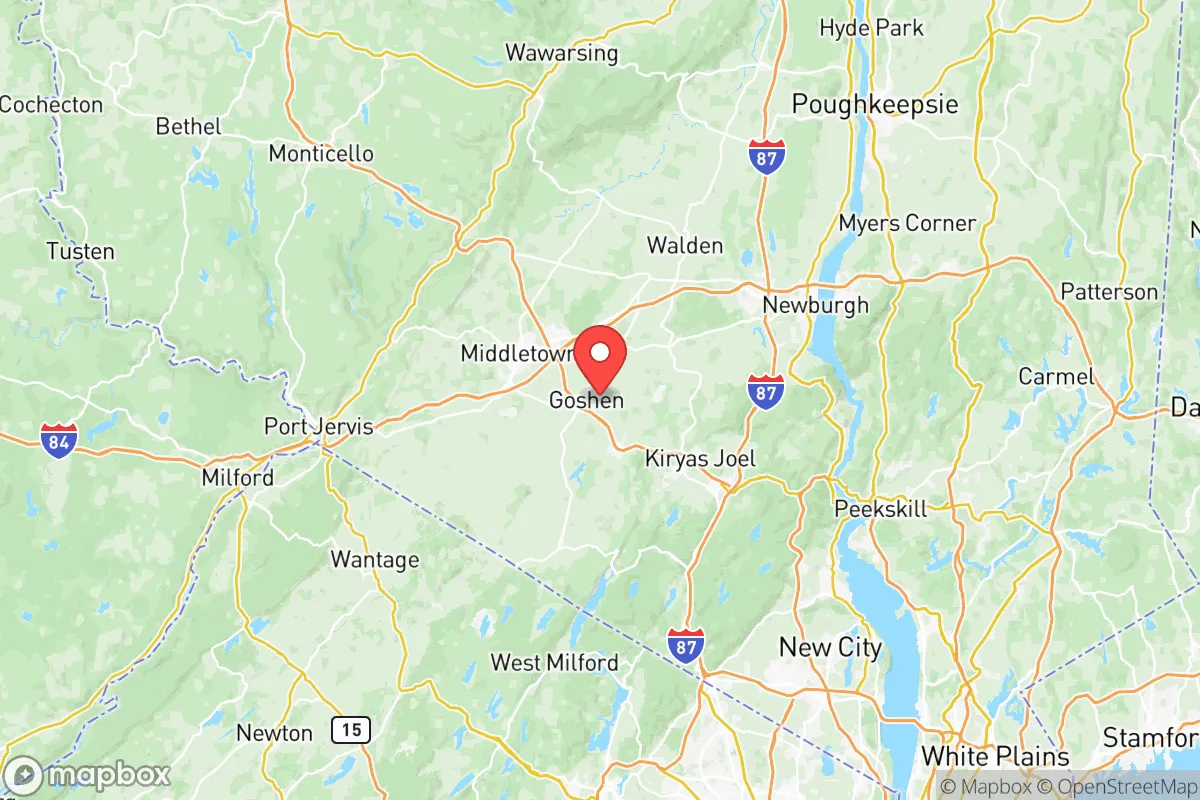
Photo: Wikipedia
Political ClimatePolitical Climate in Orange County
Showing district-level results — no local-only data available.
Local Political AnalysisPolitical Analysis of Orange County
Orange County, New York, is a classic swing county in a deep blue state, carrying a Cook Partisan Voting Index of D+2 that masks a deeply divided local electorate. The county has been trending leftward over the past decade, but it remains a patchwork of conservative strongholds and growing liberal enclaves, making it one of the most politically competitive areas in the Hudson Valley. In 2020, Joe Biden carried the county by about 10,000 votes, a shift from 2016 when Hillary Clinton won it by just 2,000, and from 2012 when Mitt Romney actually won the county by a slim margin. This trajectory mirrors the suburbanization of the region, as New York City commuters and ex-urbanites reshape the political landscape.
How it compares
Compared to New York City, Orange County is a political outlier. New York, NY is overwhelmingly Democratic, with a Cook PVI likely in the D+30 range or higher, and Republicans are virtually non-existent in citywide elections. In Orange County, the political reality is far more granular. The towns of Newburgh and Beacon are reliably blue, driven by younger, more diverse populations and a strong arts-and-commuter presence. Meanwhile, Monroe, Warwick, and Goshen lean red, anchored by longer-term residents, agricultural communities, and a strong law-enforcement and small-business base. The swing precincts are in the sprawling suburban towns of Wallkill and Blooming Grove, where housing developments and new families are slowly tipping the balance leftward. In New York City, you can safely assume a Democratic vote in most neighborhoods; in Orange County, you never know which way a town will go until the returns come in.
What this means for residents
For conservative residents, Orange County offers a rare pocket of political viability in New York State. Local offices—county legislature, town boards, and the district attorney’s seat—are genuinely competitive, and Republicans still hold a majority on the county legislature as of 2025. You can attend a GOP town hall in Goshen and feel your vote matters, unlike in Manhattan where a Republican primary is often uncontested. For liberal residents, the county’s leftward drift means their influence is growing, especially on issues like zoning reform, environmental policy, and school funding. However, they still face an uphill battle on statewide ballot measures and county-level tax debates, where conservative fiscal instincts often prevail. The practical upshot: both sides need to organize, canvass, and show up, because no one’s vote is taken for granted here.
Culturally, Orange County feels more like a Midwestern swing state than a New York City suburb. Gun rights are a live issue—you’ll see “Come and Take It” decals alongside “Coexist” bumper stickers in the same parking lot. The county’s policy debates often center on land use and development, with conservatives pushing for property rights and lower taxes, while liberals advocate for affordable housing and environmental protections. Unlike the city, where politics is a constant, high-decibel backdrop, Orange County’s political climate is quieter but no less intense—it’s the kind of place where a school board meeting can draw 300 people and decide the fate of a library budget. For anyone moving from New York City, the adjustment is real: your vote carries more weight here, but so does your neighbor’s, and you’ll have to earn your political wins the old-fashioned way.

State Political ClimatePolitical Climate in New York
State Political AnalysisPolitical Environment in the State
New York State has been a solidly Democratic stronghold for decades, with no Republican presidential candidate winning its electoral votes since 1984. However, this blue veneer masks a deep and growing urban-rural chasm. The state’s overall partisan lean is driven overwhelmingly by New York City and its inner suburbs, which deliver massive Democratic margins. Outside the five boroughs and a handful of downstate counties, much of the state is competitive or outright Republican. Over the last 10-20 years, the trajectory has been one of accelerating polarization: the city and its closest suburbs have moved further left, while vast swaths of Upstate New York have shifted right, creating a political map that looks like a blue island in a red sea.
Urban vs. rural divide
The political geography of New York is stark. New York City (Manhattan, Brooklyn, Queens, the Bronx, and Staten Island) casts roughly 40% of the state’s vote and consistently delivers 75-85% Democratic margins. The inner-ring suburbs of Westchester, Nassau, and Suffolk counties on Long Island are now reliably blue, though they were swing areas as recently as the 1990s. Albany, the capital, and Buffalo (Erie County) are also Democratic strongholds, driven by public-sector unions and urban constituencies. In contrast, the vast rural stretches of the Southern Tier, the North Country, and the Finger Lakes region vote heavily Republican. Oneida County (Utica) and Steuben County (Corning) routinely deliver 60%+ GOP margins. The suburban counties of Rockland and Orange, just north of the city, have become key battlegrounds, with Rockland trending rightward due to its large Orthodox Jewish population and Orange County flipping red in recent presidential cycles. This divide means that state policy is set by downstate urban and suburban interests, while upstate rural residents often feel politically marginalized.
Policy environment
New York’s policy environment is among the most progressive in the nation. The state has a progressive income tax with rates up to 10.9% on top earners, and property taxes are among the highest in the country, particularly in the downstate suburbs. The regulatory posture is heavy, with strict rent control laws in New York City, a statewide ban on natural gas hookups in new construction (effective 2026), and some of the nation’s toughest environmental regulations. Education policy is dominated by the teachers’ unions, with per-pupil spending among the highest in the nation, though outcomes vary wildly. Healthcare is heavily regulated, with a state-run health insurance exchange and strong Medicaid expansion. Election laws are among the most liberal: no-excuse absentee voting, early voting, and same-day registration are all in place. The state also has a sanctuary city policy that limits cooperation between local law enforcement and federal immigration authorities.
Recent policy direction
Recent legislation points in a clear direction. On gun and self-defense law, New York passed the SAFE Act in 2013 (universal background checks, assault weapons ban) and the CCIA in 2022 (restrictive concealed carry rules) after the Supreme Court’s Bruen decision. The state has also enacted a red flag law allowing courts to temporarily seize firearms from individuals deemed a risk. On parental and education rights, New York has moved toward expanding LGBTQ+ curriculum in schools and passed the “Billionaire Boy’s Club” law limiting charter school expansion. Speech and privacy are protected under the state constitution, but a 2023 law criminalized “doxxing” of reproductive health providers. On medical and bodily autonomy, New York has codified abortion rights up to viability and expanded access for out-of-state patients. Property rights are constrained by rent control and a 2019 law that weakened landlord eviction protections. Taxation has seen a slight shift: the 2023-24 budget included a modest middle-class tax cut, but the overall burden remains high. Voting and ballot access have been expanded, with automatic voter registration and no-excuse absentee voting now law.
Civil unrest & political movements
New York has been a flashpoint for political movements on both sides. The Black Lives Matter protests in summer 2020 were massive, particularly in New York City and Buffalo, and led to police reform legislation (the “Repeal 50-a” law that ended secrecy of police disciplinary records). On the right, the Second Amendment sanctuary movement has seen over 30 upstate counties pass resolutions declaring they will not enforce certain gun laws, though these are symbolic. Immigration politics are a constant tension: New York City’s sanctuary policy has led to a surge of asylum seekers since 2022, straining shelters and sparking backlash in working-class neighborhoods. Election integrity controversies have been relatively muted compared to swing states, but the 2020 and 2022 cycles saw GOP lawsuits over mail-in ballot rules. A notable flashpoint is the congestion pricing plan for Manhattan (set to begin in 2024), which has drawn lawsuits from New Jersey and suburban commuters. A new resident would notice the visible presence of activist groups, from the progressive Working Families Party to the conservative upstate group “New Yorkers for Constitutional Freedoms.”
Projection
Over the next 5-10 years, New York’s political trajectory points toward continued Democratic dominance at the state level, but with a shrinking margin. The downstate population is aging and, in some areas, declining, while the upstate population is stable or slowly growing. In-migration from other states has been net negative for years, with many leaving for Florida, Texas, and the Carolinas—a trend that disproportionately affects higher-income and conservative-leaning households. However, the state’s Democratic supermajority in the legislature is likely to persist due to gerrymandered districts and the concentration of Democratic voters in the city. The most realistic scenario is a slow rightward drift in the suburbs (Orange, Rockland, and parts of Long Island) that could make statewide races closer, but not flip the state. A new resident moving in now should expect to see continued progressive policy expansion—higher taxes, stricter gun laws, and expanded social services—along with persistent cultural tension between the city and the rest of the state.
For a conservative-leaning relocator, the bottom line is this: New York offers world-class amenities, strong property rights protections in the state constitution, and a vibrant economy in the city and its suburbs, but you will pay a premium in taxes and live under a regulatory regime that is actively expanding. For a liberal relocator, the state provides a policy environment that aligns with your values, with strong social safety nets and protections for marginalized groups. The practical takeaway is that your experience will be dramatically different depending on where you settle: a conservative can find a comfortable life in the Southern Tier or North Country, while a liberal will feel at home in the city or the Hudson Valley. The state’s political climate is not monolithic, and your choice of county matters more than your choice of state.
* Values derived from national, state, county, city and local statistics and may differ in a specific area. Last updated: 2026-06-17T01:57:27.000Z
Narrative content on this page is AI-generated and may contain mistakes. Verify any details that matter before acting on them.
ReloMaps may earn a commission from affiliate links at no extra cost to you.

