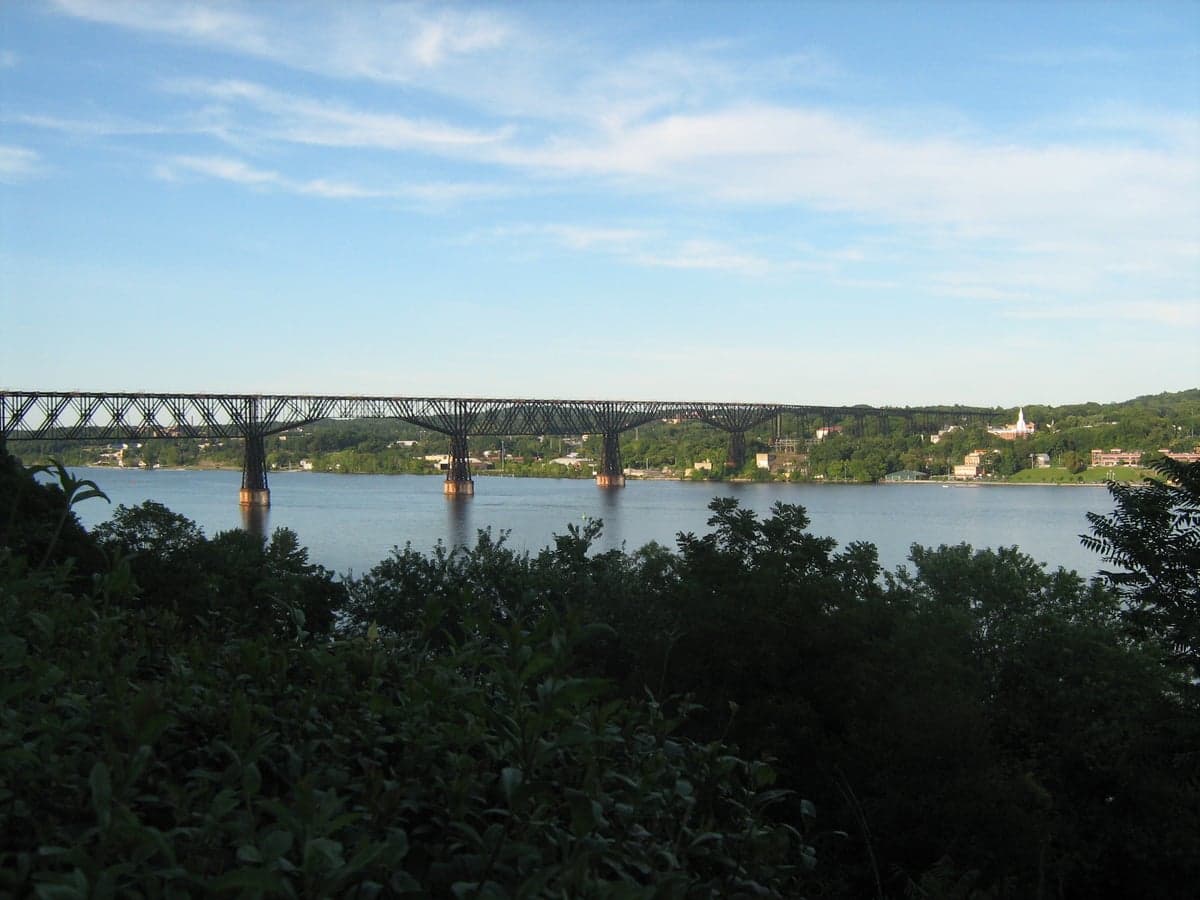
Photo: Wikipedia
Demographics of Dutchess County
Affluence Level in Dutchess County
A middle-class area roughly in line with national averages across income, home values, education, and employment.
People of Dutchess County
Dutchess County’s 297,144 residents today form a population that is predominantly white (67.2%) but increasingly diverse, with a Hispanic share of 14.9%, a Black population of 9.4%, and growing East/Southeast Asian (2.1%) and Indian-subcontinent (1.2%) communities. The county’s identity is shaped by its historic role as a Hudson Valley agricultural and industrial hub, its transformation into a commuter-shed for New York City, and its status as home to the Culinary Institute of America, Vassar College, and IBM’s former headquarters. With 39.7% of adults holding a college degree, Dutchess is more educated than the national average, yet its foreign-born share of 4.9% remains well below the U.S. figure of 13.7%, reflecting a population that has been shaped more by domestic migration than international immigration.
Settlement & growth (pre-1960)
Before European contact, the region was inhabited by the Wappinger people, an Algonquian-speaking confederation of tribes who lived in villages along the Hudson River and its tributaries. The Wappinger fished, farmed corn and beans, and traded with neighboring tribes, but their population was devastated by European diseases and warfare in the 17th century. By the 1680s, Dutch and English colonists had begun purchasing land from the remaining Wappinger, establishing the first permanent European settlements in what is now Dutchess County.
The county was formally created in 1683 as one of New York’s original twelve counties, named for Mary of Modena, Duchess of York. Early settlement was dominated by Dutch and English farmers, who established communities along the Hudson River at Poughkeepsie (the county seat since 1717), Rhinebeck, and Red Hook. These settlers were largely tenant farmers on large patroonships, such as the Livingston Manor, which stretched across much of the county’s eastern half. The region’s fertile soil and access to river trade attracted a steady stream of English, Dutch, and German settlers through the 18th century.
After the American Revolution, Dutchess County’s population grew rapidly as New Englanders—primarily from Connecticut and Massachusetts—moved west into the county’s interior. These Yankees established towns like Millbrook, Dover Plains, and Pawling, bringing with them Congregationalist and Presbyterian traditions that shaped the county’s cultural character. By 1820, the county’s population had reached roughly 46,000, with a mix of Yankee farmers, Dutch-descended landowners, and a small but growing number of Irish laborers working on the Erie Canal and later the Hudson River Railroad.
The 19th century brought two major immigrant waves. Irish immigrants arrived in large numbers during the Great Famine of the 1840s, settling in Poughkeepsie and Beacon (then called Matteawan and Fishkill Landing) to work in the county’s growing manufacturing sector—hat factories, iron foundries, and textile mills. German immigrants followed in the 1850s and 1860s, establishing farming communities in the county’s central and eastern townships, including Hyde Park and LaGrange. By 1900, Dutchess County’s population had reached 81,000, with Irish and German Catholics forming a significant minority alongside the Protestant Yankee majority.
The early 20th century saw the arrival of Italian and Eastern European immigrants, who found work in the county’s brickworks, quarries, and railroad yards. Beacon became a particular hub for Italian immigrants, who worked in the city’s hat factories and later in the construction of the New York City aqueducts. Meanwhile, African Americans had been present in Dutchess County since the colonial period, primarily as enslaved laborers on the Livingston Manor and other large estates. After emancipation, small Black communities formed in Poughkeepsie and Beacon, but the county’s Black population remained below 5% through the 1950s.
World War II and the postwar era brought dramatic change. IBM, founded in 1911, established its headquarters and major manufacturing facilities in Poughkeepsie and East Fishkill in the 1940s and 1950s, attracting a wave of white-collar engineers and managers from across the Northeast. The IBM boom transformed Dutchess County from a rural-agricultural economy into a technology and manufacturing hub, and the county’s population surged from 136,000 in 1950 to 222,000 by 1970. Suburban development spread across the towns of Wappinger, Fishkill, and East Fishkill, as new housing tracts replaced farmland.
Modern era (post-1965)
The 1965 Hart-Cellar Act had a modest direct impact on Dutchess County compared to urban areas, but its effects arrived indirectly through domestic migration. As New York City’s population diversified after 1965, some of that diversity spread northward into the Hudson Valley. The county’s Hispanic population, which was negligible in 1970, grew to 5% by 2000 and reached 14.9% by 2024. This growth has been driven primarily by Puerto Rican and Dominican families moving from New York City, as well as Mexican immigrants working in the county’s landscaping, construction, and food-service industries. Hispanic residents are concentrated in Poughkeepsie and Beacon, where they form roughly 25% and 20% of the population respectively.
The Black population grew from 5% in 1970 to 9.4% today, with the largest concentrations in Poughkeepsie (where Black residents make up about 20% of the city’s population) and Beacon. This growth reflects both domestic migration from New York City and natural increase among established families. The East/Southeast Asian community, at 2.1%, is a more recent phenomenon, growing since the 1990s as Chinese and Korean professionals moved to the county for jobs in technology, healthcare, and education. They are concentrated in Wappinger and Fishkill, near the IBM facilities and the Route 9 corridor. The Indian-subcontinent community, at 1.2%, has grown similarly, with many working as engineers, doctors, and IT professionals in the county’s tech and healthcare sectors.
The most significant demographic shift since 1965, however, has been domestic: the decline of IBM. After peaking at roughly 40,000 employees in Dutchess County in the 1980s, IBM’s local workforce shrank to under 5,000 by 2020. This collapse triggered an exodus of white-collar families, particularly from the towns of East Fishkill and LaGrange, and contributed to the county’s population stagnation (297,144 in 2024, down from a peak of 298,000 in 2010). At the same time, the county has attracted new residents from New York City and the lower Hudson Valley, drawn by lower housing costs and the scenic beauty of the Hudson Valley. These newcomers are disproportionately white, college-educated, and liberal-leaning, creating a cultural divide between the older, more conservative rural towns and the newer, more progressive commuter suburbs.
The future
Dutchess County’s population is projected to remain roughly stable over the next decade, with modest growth in the Hispanic and Asian communities offset by an aging white population and continued out-migration of young adults. The county’s foreign-born share, currently 4.9%, is likely to rise slowly as immigrant families from New York City continue to move north, but it will remain well below the national average. The most dynamic growth area is Beacon, which has become a destination for artists, remote workers, and second-home buyers from New York City, driving up housing prices and shifting the city’s demographic profile toward younger, wealthier, and more diverse residents.
The county’s cultural identity is becoming more polarized. The rural eastern towns—Millbrook, Dover Plains, Pawling—remain predominantly white, older, and more conservative, while the Hudson River corridor from Poughkeepsie to Beacon is becoming younger, more diverse, and more liberal. This divide is likely to deepen as the county’s economy shifts from manufacturing and technology toward healthcare, education, and tourism. The closure of IBM’s remaining facilities and the growth of the Culinary Institute of America, Vassar College, and Marist College are reshaping the county’s employment base and attracting a different kind of resident.
For someone moving to Dutchess County now, the choice is increasingly between two distinct lifestyles: the walkable, diverse, transit-connected river cities of Poughkeepsie and Beacon, or the quiet, car-dependent, predominantly white towns of the county’s interior and eastern hills. The county as a whole is becoming more diverse, but that diversity is concentrated in a few specific places, while large swaths of the county remain demographically unchanged from the 1990s. The next 10-20 years will likely see continued slow diversification, driven by Hispanic and Asian growth, but Dutchess County will remain a predominantly white, moderately educated, and politically divided corner of the Hudson Valley.

* Values derived from national, state, county, city and local statistics and may differ in a specific area. Last updated: 2026-07-08T09:22:25.000Z
Narrative content on this page is AI-generated and may contain mistakes. Verify any details that matter before acting on them.
ReloMaps may earn a commission from affiliate links at no extra cost to you.

