Photo: Wikipedia
Quality of Life in Burlington County
A livable area that tracks near national norms for affordability, walkability, and neighborhood health.
What does Quality of Life tell us?
Quality of Life measures an area by evaluating factors like cost of living, nearby amenities, country club access, airport proximity, socioeconomic signals and neighborhood character. For large states, this is a general average — quality of life can vary dramatically between metro areas, suburbs, and rural communities within the same state.
What does this tell us?
Quality of Life measures an area by evaluating factors like cost of living, nearby amenities, country club access, airport proximity, socioeconomic signals and neighborhood character. For large states, this is a general average — quality of life can vary dramatically between metro areas, suburbs, and rural communities within the same state.
Cost of Living
32% above national average
113%
The Real Cost of Living in Burlington County for 2026
| Tier | Individual | Family (4) |
|---|---|---|
| Survival | $27k | $50k |
| Comfortable | $63k | $93k |
| Luxury | $177k+ | $275k+ |
| Elite (Top 5%) | $209k+ | $323k+ |
Quality-of-Life Analysis
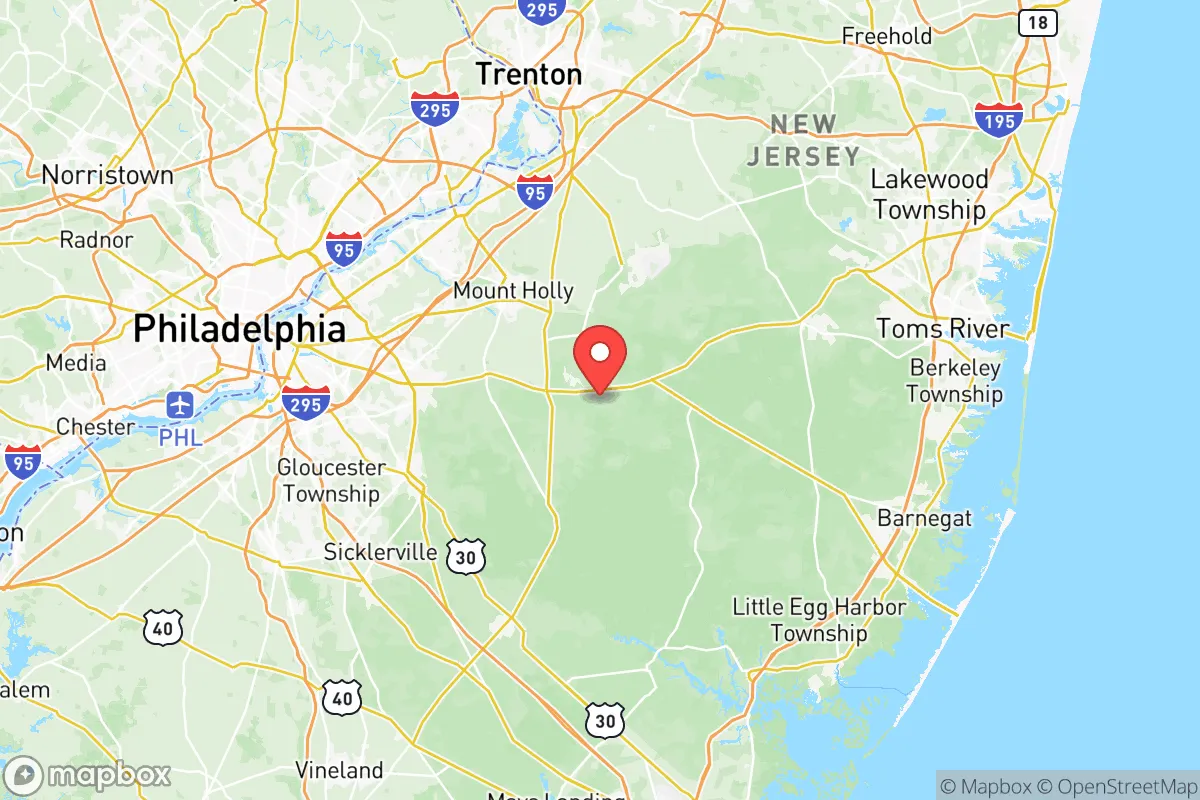
Burlington County, New Jersey, offers one of the most diverse quality-of-life spectrums in the Philadelphia metro area, spanning dense, transit-oriented river towns, sprawling suburban bedroom communities, and working farms in the Pine Barrens. The county’s character shifts dramatically from the Delaware River corridor in the west to the agricultural flatlands and protected forests of the east, drawing everyone from Philadelphia commuters seeking walkable historic districts to families wanting large lots on quiet country roads. With a cost of living index of 132 (100 = U.S. average), a median home value of $326,700, and a median rent of $1,669, the county provides a middle-ground price point between the higher costs of northern New Jersey and the lower costs of South Jersey’s interior.
Largest town(s) & population centers
The county’s largest population center is Mount Laurel (pop. ~44,000), a classic suburban hub anchored by the sprawling Moorestown Mall, major office parks along Route 38, and direct access to the New Jersey Turnpike. Daily life here is car-dependent but convenient, with large retail corridors, chain restaurants, and a heavy concentration of corporate headquarters and logistics centers. Burlington City (pop. ~9,900), the county seat along the Delaware River, offers a more historic, walkable downtown with Victorian architecture, a riverfront promenade, and a small but active arts scene. Moorestown (pop. ~20,500) is the county’s most affluent suburb, known for its top-rated school system, the Moorestown Field Club, and a quaint Main Street lined with boutiques and cafes. Willingboro (pop. ~32,000) and Pemberton Township (pop. ~27,000) are larger, more affordable communities with diverse housing stock and strong ties to Joint Base McGuire-Dix-Lakehurst, a major economic driver for the eastern half of the county.
Smaller towns & rural pockets
East of the suburban belt, the county opens into genuine rural territory. Tabernacle (pop. ~7,000) is a Pine Barrens community where homes sit on acre lots, dirt roads are common, and the Wharton State Forest provides immediate access to hiking, canoeing, and off-road trails. Shamong (pop. ~6,500) is similarly rural, with the Atsion Recreation Area and the historic Batsto Village drawing visitors, while residents commute to jobs in Mount Laurel or Cherry Hill. Bass River (pop. ~1,400) is the county’s least populated municipality, a forested township with cranberry bogs, blueberry farms, and virtually no commercial development. Springfield Township (pop. ~3,200) and Washington Township (pop. ~700) are unincorporated rural pockets where agriculture and equestrian properties dominate. These areas offer a lifestyle radically different from the western suburbs: lower property taxes per dollar of home value, no curbside trash pickup in many sections, and a strong sense of isolation.
Cost & lifestyle range
The cost and lifestyle spread across Burlington County is wide. At the high end, Moorestown and Medford (pop. ~23,000) command median home values well above the county average of $326,700, often exceeding $500,000, with top-tier schools, country clubs, and walkable village centers. Medford’s Main Street, with its historic inns and independent shops, contrasts sharply with the strip-mall landscape of Mount Laurel. At the lower end, Pemberton Borough (pop. ~1,100) and Beverly (pop. ~2,500) offer median home values closer to $200,000, with older housing stock and fewer retail amenities. Renters find the county’s median rent of $1,669 manageable compared to northern New Jersey, with the most affordable units concentrated in Willingboro and Pemberton Township. The average commute of 29.3 minutes reflects the county’s dual nature: western towns feed into Philadelphia via the River LINE light rail or I-295 in under 30 minutes, while eastern residents face longer drives to the same job centers, often exceeding 40 minutes one-way.
Burlington County’s strength is its ability to accommodate a wide range of preferences within a single county boundary. Young professionals and empty-nesters thrive in the walkable river towns of Burlington City and Riverside. Families seeking top-ranked schools gravitate to Moorestown, Medford, or Mount Laurel. Outdoor enthusiasts and those wanting acreage find genuine rural living in Tabernacle, Shamong, or Bass River. The county’s mix of suburban convenience, historic charm, and Pine Barrens wilderness means that the right fit depends almost entirely on which end of the spectrum a household prioritizes.

Crime in Burlington County
WARNING: The crime statistics are unreliable for this jurisdiction. Local authorities have either not reported or under reported their data to the FBI. This could be due to bad intentions, incompetence or technical issues. Regardless, we suggest skepticism.
Crime rates similar to the national median for U.S. locations.
Violent CrimeViolent Crime Analysis
Property CrimeProperty Crime Analysis
Crime Analysis
Burlington County, New Jersey, presents a mixed safety profile that is heavily influenced by its geography, with rural and suburban towns experiencing significantly lower crime rates than the county's urban centers near Philadelphia. The county's overall violent crime rate of 193.8 incidents per 100,000 residents sits below the national average, but its property crime rate of 1,237.7 per 100,000 is elevated, driven largely by theft and vehicle break-ins in transit-adjacent communities. Residents considering a move here must weigh the stark differences between towns like Mount Laurel and Moorestown versus cities such as Willingboro and Burlington City.
Crime in context
Burlington County's violent crime rate is roughly 45% lower than the national average of approximately 380 per 100,000, placing it among the safer counties in the Philadelphia metropolitan area. However, the property crime rate is about 10% higher than the national average of roughly 1,100 per 100,000. These figures mask a sharp internal divide: the county's eastern and northern townships—such as Medford, Tabernacle, and Shamong—report violent crime rates below 50 per 100,000, while the western corridor along the Delaware River, including Edgewater Park and Palmyra, sees rates double the county average. The Burlington County Prosecutor's Office, which handles all major felony cases, operates under a state-level judicial system that has seen increasing progressive influence in recent years, particularly in urban municipal courts. This trend, while intended to reduce incarceration, has raised concerns among residents about repeat property offenders cycling through the system with minimal consequences.
What residents experience
For most residents in Burlington County's affluent suburbs, crime is not a daily concern. Towns like Moorestown, ranked among the safest in New Jersey, report violent crime rates under 60 per 100,000 and property crime rates below 800 per 100,000. These communities benefit from well-funded local police departments and active neighborhood watch programs. In contrast, residents in Willingboro and Burlington City face a different reality. Willingboro's violent crime rate exceeds 350 per 100,000, nearly double the county average, with aggravated assault and robbery being the most common offenses. Property crime in these areas is also elevated, with car thefts and package thefts from porches being frequent complaints. The county's proximity to Philadelphia means that some property crime is linked to transient offenders using the PATCO Speedline and River LINE trains to access suburban targets. Residents in transit-adjacent towns like Cinnaminson and Delran report higher rates of vehicle burglaries than their inland neighbors.
Neighborhood-level variation within Burlington County is extreme and directly tied to municipal boundaries. The safest areas are concentrated in the Pine Barrens region—towns like Southampton, Bass River, and Washington Township—where low population density and strong community ties keep crime minimal. The most challenging areas are the urbanized riverfront communities, particularly Willingboro, Burlington City, and parts of Pemberton Township. These areas have struggled with economic disinvestment and, in some cases, lenient local court policies that critics argue fail to deter repeat offenders. For prospective residents, the choice is clear: towns with strong local police presence and conservative-leaning municipal courts, such as Moorestown and Medford, offer a much lower risk of victimization than communities where progressive judicial philosophies have taken hold. Anyone considering a move to Burlington County should research specific town crime maps and recent prosecutor office statistics, as the difference between a safe and a high-risk neighborhood can be a matter of just a few miles.
* Values derived from national, state, county, city and local statistics and may differ in a specific area. Last updated: 2026-10-24T22:55:13.000Z
Narrative content on this page is AI-generated and may contain mistakes. Verify any details that matter before acting on them.
ReloMaps may earn a commission from affiliate links at no extra cost to you.

