Photo: Wikipedia
Demographics of Burlington County
Affluence Level in Burlington County
A middle-class area roughly in line with national averages across income, home values, education, and employment.
People of Burlington County
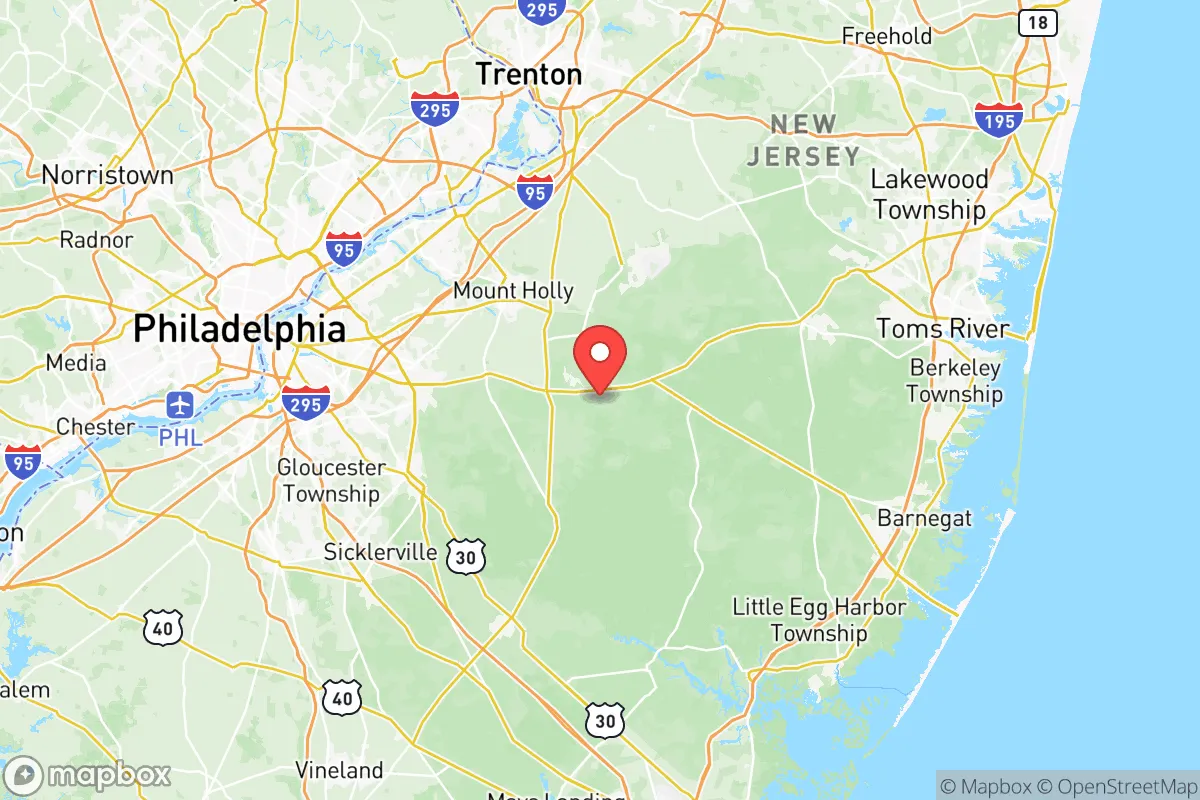
Today, Burlington County, New Jersey, is home to 464,226 residents who occupy a distinctive middle ground between Philadelphia’s urban orbit and the Pine Barrens’ rural quiet. The county’s character is defined by a predominantly white population (63.7%) alongside a significant Black community (15.8%) and a growing Hispanic presence (9.2%), with a notably low foreign-born share of just 3.7% — reflecting deep, multi-generational roots rather than recent international arrivals. Residents describe the county as a place of established suburbs, historic river towns, and working farms, where a 42.0% college-educated rate signals a professional-class tilt but not the hyper-competitive affluence of closer-in New Jersey suburbs. The identity is quietly conservative-leaning, family-oriented, and rooted in a history of gradual, organic settlement rather than boom-and-bust cycles.
Settlement & growth (pre-1960)
Long before European arrival, the Lenni-Lenape people — specifically the Unami and Munsee bands — inhabited the area between the Delaware River and the Pine Barrens, living in seasonal villages along the Rancocas Creek and the Delaware. Their presence is still visible in place names like Rancocas, but by the early 1700s, disease and displacement had reduced their numbers dramatically as English Quakers began arriving in force.
The first major European wave was English Quakers, who in 1677 founded Burlington City as the capital of West Jersey. These settlers were religious dissenters seeking both freedom of worship and fertile farmland along the Delaware. They established a grid of streets and a thriving port, and their descendants spread north to Bordentown and south to Beverly, where Quaker meetinghouses still stand. Unlike many colonies, West Jersey’s Quaker founders offered land on generous terms and allowed religious toleration, which attracted a second wave: Scots-Irish Presbyterians and German Lutherans who arrived in the 1720s–1740s. These groups pushed inland, clearing forests for farms in what are now Mount Holly, Medford, and Lumberton. By the Revolution, Burlington County was a patchwork of English Quaker merchants in the river towns and Scots-Irish yeoman farmers in the interior.
The 19th century brought two transformative forces: the Camden & Amboy Railroad and the rise of manufacturing. The railroad, completed in 1834, turned Bordentown into a transportation hub and spurred the growth of Palmyra and Riverton as Philadelphia commuter suburbs. Meanwhile, the county’s abundant clay deposits and water power fueled a pottery and textile industry that drew Irish immigrants in the 1840s–1850s, fleeing the Potato Famine. These Irish laborers settled in Burlington City and Mount Holly, building St. Mary’s and St. Andrew’s parishes. A smaller but notable wave of Italian immigrants arrived around 1900, working in the brickyards and farms of Florence and Roebling, where the Roebling Steel Mill (built for John A. Roebling’s wire-rope empire) employed hundreds.
The Great Migration of African Americans from the South reshaped the county between 1910 and 1960. Black families moved to Willingboro, Mount Holly, and Burlington City for factory jobs at the U.S. Pipe & Foundry and the New Jersey State Prison (in Trenton’s orbit). By 1960, Burlington County’s Black population had reached roughly 10%, concentrated in the older river towns and the emerging Levittown-style suburb of Willingboro, which was deliberately marketed to Black homebuyers in the 1950s — a rare example of integrated planned development in the Northeast.
Modern era (post-1965)
The 1965 Hart-Cellar Act had a muted effect on Burlington County compared to coastal New Jersey. The foreign-born share remains just 3.7%, far below the state average of 23%. Instead, the county’s post-1965 story is one of domestic migration: white flight from Philadelphia and Camden, and later, Black middle-class suburbanization. The construction of Interstate 295 and the New Jersey Turnpike extension in the 1960s–1970s opened the county’s interior to commuters, and towns like Marlton (in Evesham Township) and Mount Laurel exploded from farm villages into bedroom communities of split-level ranches and cul-de-sacs. By 1980, these towns were overwhelmingly white and professional-class, with residents working in Philadelphia, Cherry Hill, and the emerging corporate campuses of Mount Laurel.
The most significant demographic shift since 1965 has been the growth of the Black population, which now stands at 15.8%. This is not a new immigrant story but a continuation of the Great Migration’s second phase: Black families from Philadelphia and Camden moved to Willingboro, Burlington City, and Pemberton Township (near Fort Dix) for affordable housing and better schools. Willingboro, in particular, transitioned from a majority-white Levittown in 1970 to a majority-Black suburb by 2000, a pattern seen across older inner-ring suburbs nationwide.
Hispanic growth (now 9.2%) is more recent, accelerating after 2000. The largest group is Puerto Rican, followed by Mexican and Dominican immigrants, who have settled in Burlington City, Mount Holly, and Pemberton Township — drawn by low housing costs and service-sector jobs in warehousing and logistics. The county’s East/Southeast Asian population (2.5%) is smaller and more dispersed, with families concentrated in Marlton and Mount Laurel, often working in healthcare and technology. The Indian-subcontinent population (3.0%) follows a similar pattern, with professionals in IT and medicine settling in the same towns, drawn by good schools and proximity to the Princeton–New Brunswick corridor.
The future
Burlington County is becoming slightly more diverse, but slowly. The white share has declined from roughly 75% in 2000 to 63.7% today, while Hispanic and Asian shares have each risen a few points. The Indian-subcontinent population, though small, is the fastest-growing group, doubling between 2010 and 2020 as tech workers from Middlesex County seek more space. New construction is concentrated in the western townships — Mount Laurel, Evesham, and Medford — where large-lot subdivisions and townhome complexes are filling remaining farmland. These areas are likely to remain majority-white and professional-class, while the older river towns and the Fort Dix corridor will absorb most of the county’s Hispanic and Black growth.
The foreign-born share is expected to rise slowly, perhaps to 5–6% by 2035, as Indian and East Asian professionals continue to arrive for jobs in logistics (the county is a major warehouse hub for Amazon and FedEx) and healthcare (Virtua Health and Cooper University Health are large employers). However, Burlington County will not become a gateway for mass immigration; its appeal is to domestic movers seeking lower taxes and more space than Essex or Bergen counties. The cultural identity is likely to remain quietly conservative, family-centric, and rooted in the county’s historic pattern of gradual, organic change rather than rapid transformation.
For someone moving in now, Burlington County offers a stable, middle-class environment where demographic change is real but measured. The schools in Marlton and Mount Laurel are strong, the commute to Philadelphia is manageable, and the housing stock — from Victorian river-town homes to 1970s ranches to new subdivisions — provides options for a range of budgets. The county’s character is not flashy or trendy, but solid: a place where families put down roots and stay for generations, and where the population’s history is written in the quiet persistence of its towns.

* Values derived from national, state, county, city and local statistics and may differ in a specific area. Last updated: 2026-10-24T22:55:13.000Z
Narrative content on this page is AI-generated and may contain mistakes. Verify any details that matter before acting on them.
ReloMaps may earn a commission from affiliate links at no extra cost to you.

