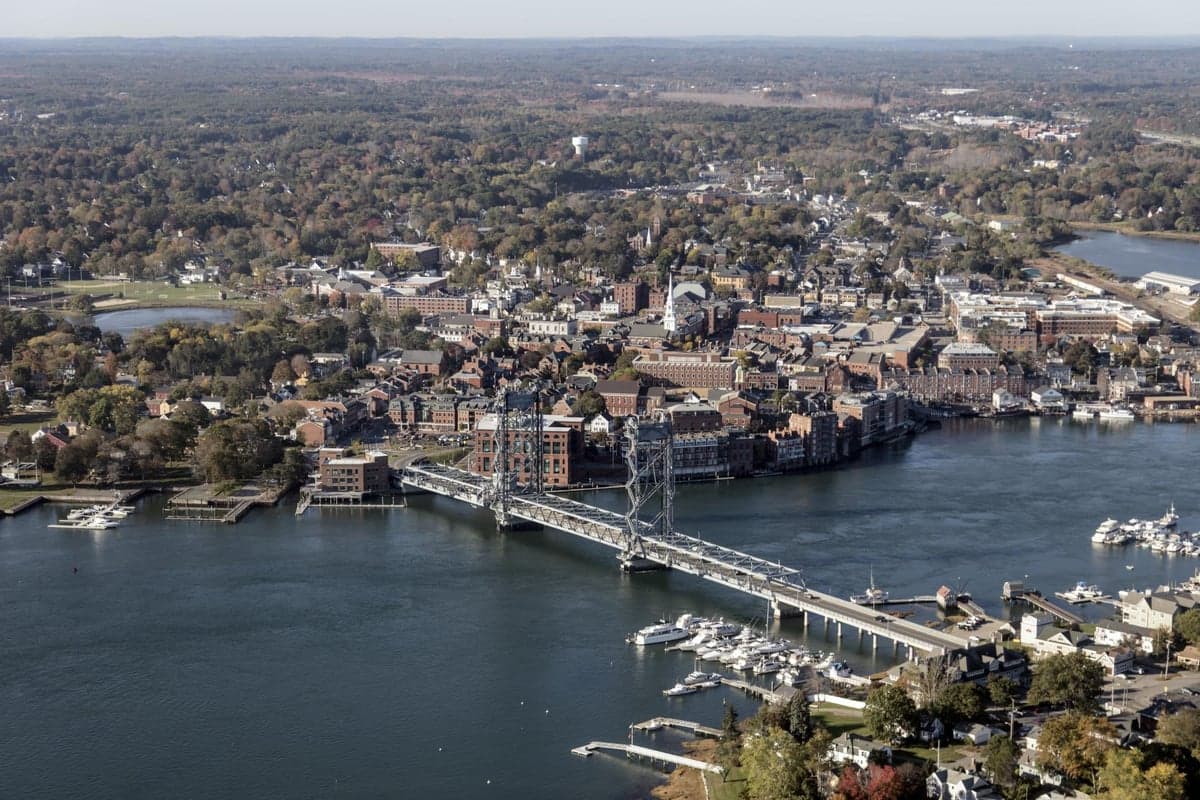
Photo: Wikipedia
Personal Sovereignty in Rockingham County
Viable for self-reliance. Generally workable, though some barriers may limit total independence.
What does Personal Sovereignty tell us?
Personal Sovereignty measures your capacity for self-reliance and independence with minimal government friction. Higher scores mean fewer barriers between you and the way you want to live... but it assumes you have the space you need and good neighbors.
What does this tell us?
Personal Sovereignty measures your capacity for self-reliance and independence with minimal government friction. Higher scores mean fewer barriers between you and the way you want to live... but it assumes you have the space you need and good neighbors.
State Policy
Energy independence: Importer (10% of energy produced in-state)
Personal Liberty
Homesteading

Personal Liberty Analysis
Rockingham County, New Hampshire, offers a notably high degree of personal sovereignty compared to much of the Northeast, anchored by New Hampshire’s “Live Free or Die” ethos and a state-level commitment to minimal government interference. While the county’s southern towns like Salem and Derry feel the gravitational pull of Massachusetts’ regulatory climate, the northern and western communities—such as Deerfield, Nottingham, and Fremont—maintain a distinctly independent, self-reliant character. For individuals and families prioritizing autonomy, the county presents a spectrum of freedom, from the near-libertarian atmosphere of its rural pockets to the more conventional, but still relatively light-touch, governance of its suburban centers.
Tax burden and regulatory posture: how New Hampshire’s structure benefits residents
Rockingham County residents benefit from New Hampshire’s unique tax structure, which imposes no state income tax on earned wages and no state sales tax. This directly increases disposable income and reduces the government’s claim on personal earnings. The state also has no general capital gains tax, though a 5% tax on interest and dividends applies to income over a certain threshold. Property taxes are the primary revenue source, and they vary significantly across the county: Exeter and Portsmouth have higher mill rates due to their historic districts and municipal services, while towns like Raymond and Epping offer lower effective rates, often under $20 per $1,000 of assessed value. The regulatory posture is generally business-friendly, with no statewide zoning or building codes beyond basic safety standards—towns like Candia and Chester have minimal land-use regulations, allowing for greater personal discretion in property use. However, the county’s southern tier, particularly Salem and Windham, has more commercial zoning and stricter subdivision rules, reflecting their proximity to the Massachusetts border and higher population density. Overall, the tax and regulatory environment is among the lightest in New England, with the state ranking consistently in the top 10 for fiscal freedom by the Cato Institute.
Self-defense and gun law specifics: what the “Live Free or Die” state allows
New Hampshire is a constitutional carry state, meaning no permit is required to openly carry or conceal a firearm for any law-abiding adult 18 or older. Rockingham County reflects this culture strongly, with gun ownership rates well above the national average—estimates suggest roughly 40-50% of households possess firearms. There is no state-level firearm registry, no waiting period for purchases, and no requirement to register firearms or ammunition. The state preempts local gun ordinances, so towns like Portsmouth or Exeter cannot impose stricter rules than the state, ensuring uniform rights across the county. Stand-your-ground laws are in effect, with no duty to retreat in any place where a person has a right to be. Self-defense is a complete defense to prosecution for deadly force if the person reasonably believes it is necessary to prevent imminent death or great bodily harm. The county’s gun-friendly culture is most pronounced in rural towns like Deerfield and Nottingham, where shooting ranges and hunting are common, but even in suburban Salem, gun shops and ranges operate openly. The state’s firearm laws are among the most permissive in the nation, ranking 4th in the Giffords Law Center’s annual scorecard for weakest gun laws.
Self-reliance and homesteading viability: lot sizes, zoning, and off-grid feasibility
Rockingham County offers substantial opportunities for self-reliance, though viability varies sharply by town. In the northern and western towns—such as Deerfield, Nottingham, and Fremont—minimum lot sizes of 2 to 5 acres are common, and zoning is minimal, allowing for livestock, gardens, and accessory structures without extensive permitting. Deerfield, for example, has no town-wide zoning ordinance, only subdivision regulations, meaning residents can build sheds, barns, or even tiny homes with few bureaucratic hurdles. Off-grid living is feasible in these areas: New Hampshire has no state law prohibiting rainwater collection, composting toilets, or solar panels, though well and septic permits are required. Towns like Raymond and Epping allow for alternative energy systems with simple building permits. In contrast, southern towns like Salem and Windham have stricter zoning—Salem requires minimum 1-acre lots in most residential zones and has detailed accessory structure rules—making large-scale homesteading impractical. Portsmouth and Exeter, with their historic districts and urban density, are largely unsuitable for self-reliant living. For those seeking true independence, the county’s rural northern tier offers the best balance of affordable land, lenient regulations, and community acceptance of alternative lifestyles.
Personal liberties: parental rights, medical autonomy, speech, and property
New Hampshire law strongly protects parental rights, with a statute affirming that parents have the fundamental right to direct the upbringing, education, and care of their children. No state mandate requires vaccination for school attendance—parents can claim a religious or philosophical exemption—and the state does not require parental notification for a minor’s abortion, though this remains a contentious issue. Medical autonomy is similarly robust: the state has no individual mandate for health insurance, and New Hampshire does not require a prescription for COVID-19 testing or treatment (though federal rules may apply). The state’s right-to-try law allows terminally ill patients access to experimental treatments, and there is no state-level vaccine passport system. Free speech protections are strong, with no state hate speech laws that could chill expression, and the state has a public forum law that protects speech on public property. Property rights are well-guarded: New Hampshire has a strong eminent domain statute that requires just compensation and a public use finding, and the state’s right-to-farm law protects agricultural operations from nuisance lawsuits. In Rockingham County, these liberties are most actively exercised in towns like Candia and Chester, where residents frequently attend town meetings to challenge zoning changes or advocate for property rights. The county’s southern towns, while still protected by state law, see more local government activity that can impinge on individual discretion—such as noise ordinances in Salem or historic district restrictions in Exeter.
Overall, Rockingham County offers a level of personal sovereignty that is exceptional for the Northeast, rivaled only by parts of northern New England and the rural West. The combination of no income or sales tax, constitutional carry, minimal zoning in rural towns, and strong protections for parental and property rights creates an environment where self-reliant individuals and families can operate with minimal government interference. For those willing to live in the county’s less densely populated towns—Deerfield, Nottingham, Fremont, Candia, and Chester—the autonomy is near-absolute. Even in the more suburban southern tier, the state’s legal framework ensures a baseline of freedom that exceeds most of the region. For a relocation audience prioritizing personal sovereignty, Rockingham County stands as a top-tier choice within the Northeast corridor.

* Values derived from national, state, county, city and local statistics and may differ in a specific area. Last updated: 2026-06-15T10:25:38.000Z
Narrative content on this page is AI-generated and may contain mistakes. Verify any details that matter before acting on them.
ReloMaps may earn a commission from affiliate links at no extra cost to you.

