Photo: Wikipedia
Demographics of Rockingham County
Affluence Level in Rockingham County
An upper-middle-class area. Household wealth, education levels, and homeownership run ahead of national benchmarks.
People of Rockingham County
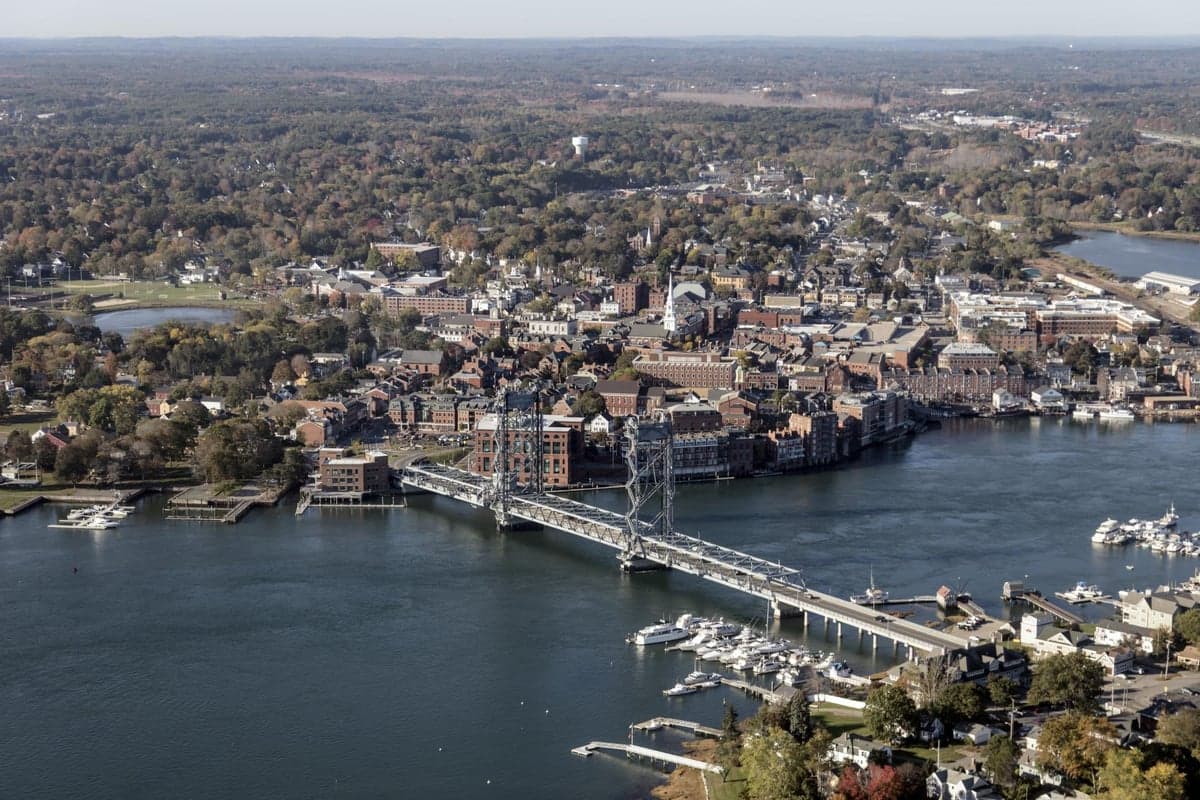
Rockingham County, New Hampshire, is home to 317,163 residents who form a predominantly white (90.0%), highly educated (44.8% college-educated) population with a distinctly low foreign-born share of just 1.8%. The county’s character is defined by its historic seacoast communities like Portsmouth and Exeter, its rapid suburban expansion from the Boston metro area, and a cultural identity rooted in early English settlement, later Yankee farming, and a steady influx of Massachusetts commuters. This is a region where deep New England traditions meet modern exurban growth, creating a population that is stable, prosperous, and notably less diverse than the national average.
Settlement & growth (pre-1960)
Long before European arrival, the area now known as Rockingham County was inhabited by the Pennacook and Abenaki peoples, Algonquian-speaking tribes who lived along the Merrimack River and the Atlantic coast, fishing, hunting, and farming seasonal camps. European contact began with English explorers in the early 1600s, and the first permanent English settlement in New Hampshire was established at Portsmouth in 1623, founded by a group of English fishermen and traders under the leadership of Captain John Mason. This coastal enclave quickly became a thriving port and shipbuilding center, drawing English settlers from the East Anglia region of England, who established the towns of Exeter (1638), Hampton (1638), and Newmarket (1727) as agricultural and trading outposts.
Throughout the 18th and early 19th centuries, the population of Rockingham County grew steadily through natural increase and continued English migration, with a smaller influx of Scots-Irish families who settled in the inland towns like Londonderry (1719) and Derry (1719). These Scots-Irish immigrants, primarily Presbyterian farmers from Ulster, brought a distinctive cultural influence, including the establishment of the first potato crop in the American colonies. The county’s economy remained rooted in agriculture, fishing, and maritime trade, with Portsmouth serving as the region’s commercial and political hub. The Industrial Revolution brought textile mills to Dover (though now in Strafford County) and Exeter, drawing a modest number of Irish and French-Canadian workers in the mid-19th century, but Rockingham County never experienced the heavy industrial immigration seen in southern New Hampshire mill cities like Manchester or Nashua.
From the late 19th century through 1960, the county’s population growth was relatively slow, driven primarily by natural increase and a trickle of domestic migration from other parts of New England. The region remained overwhelmingly Yankee Protestant, with small Catholic communities of Irish and French-Canadian descent concentrated in Portsmouth and Exeter. The construction of the Spaulding Turnpike in the 1950s began to open the county to commuters from the Boston area, but the major suburban transformation would not occur until after 1965.
Modern era (post-1965)
The 1965 Hart-Cellar Act had a minimal direct impact on Rockingham County’s demographics, as the county’s foreign-born population remains just 1.8% in 2026, far below the national average. Instead, the most significant demographic force since the 1970s has been domestic migration from Massachusetts, particularly from the Boston suburbs. The completion of Interstate 95 through the county in the 1960s and the expansion of the Spaulding Turnpike made towns like Salem, Windham, Londonderry, and Derry attractive bedroom communities for professionals working in the Greater Boston area. This wave of “Massachusetts transplants” brought higher incomes, a demand for good schools, and a more suburban, car-dependent lifestyle that reshaped the county’s built environment.
The racial and ethnic composition of Rockingham County has remained remarkably stable through this period. The white population stands at 90.0%, with the largest minority group being Hispanic residents at 3.5%, concentrated in Salem and Derry, where a small but growing community of Puerto Rican and Mexican heritage has established itself since the 1990s. East and Southeast Asian communities (1.3%) are most visible in Portsmouth and Exeter, often tied to the University of New Hampshire and the high-tech sector. The Indian subcontinent population (0.7%) is small but growing, with families drawn to the county’s excellent school districts in Windham and Bedford (though Bedford is in Hillsborough County). The Black population remains very low at 0.8%, with no significant enclave forming in any town. The county’s foreign-born population is predominantly from Canada, the United Kingdom, and Western Europe, reflecting the region’s historic ties and the limited draw for newer immigrant groups.
Suburbanization has been the dominant trend since 1970, with the county’s population nearly doubling from 138,951 in 1970 to 317,163 today. The most explosive growth has occurred in the I-93 corridor towns of Salem, Windham, and Londonderry, which have transformed from rural villages into dense suburban communities with strip malls, office parks, and large-lot housing developments. Portsmouth, by contrast, has maintained its historic character while becoming a destination for affluent retirees and remote workers, with a vibrant downtown and a growing arts scene. The county’s political character has shifted from reliably Republican to a competitive swing area, with the suburban towns trending more moderate as Massachusetts transplants bring their fiscal conservatism mixed with social liberalism.
The future
Rockingham County is projected to continue growing slowly, with the population likely reaching 330,000-340,000 by 2035, driven primarily by domestic migration from Massachusetts and other high-cost New England states. The county is not expected to become significantly more diverse; the white share will likely remain above 85%, with modest growth in the Hispanic and East/Southeast Asian populations, particularly in Salem and Derry. The Indian subcontinent population may grow slightly as professionals are attracted to top school districts like Windham and Exeter, but no large ethnic enclave is anticipated. The foreign-born share will likely remain below 3% for the foreseeable future, as the county lacks the industrial or service-sector jobs that attract large immigrant populations.
The most significant demographic trend is the aging of the population, with the median age rising as baby boomers retire to coastal towns like Portsmouth and Hampton, while younger families are priced out of the housing market. The county’s cultural identity is evolving from a quiet Yankee farming and fishing region into a high-cost exurb of Boston, with all the tensions that entails: rising property taxes, traffic congestion, and a clash between long-time residents and newcomers. The political landscape will likely remain competitive, with the suburban towns becoming more Democratic-leaning while the rural towns stay Republican.
For someone moving to Rockingham County today, this is a place of stability and prosperity, but also of high housing costs and limited diversity. The county offers excellent schools, low crime, and proximity to the coast and Boston, but newcomers should expect a population that is overwhelmingly white, native-born, and culturally rooted in New England traditions. The future points toward continued suburbanization, an aging demographic, and a slow but steady diversification that will not fundamentally alter the county’s character for at least another generation.

* Values derived from national, state, county, city and local statistics and may differ in a specific area. Last updated: 2026-06-15T10:25:38.000Z
Narrative content on this page is AI-generated and may contain mistakes. Verify any details that matter before acting on them.
ReloMaps may earn a commission from affiliate links at no extra cost to you.

