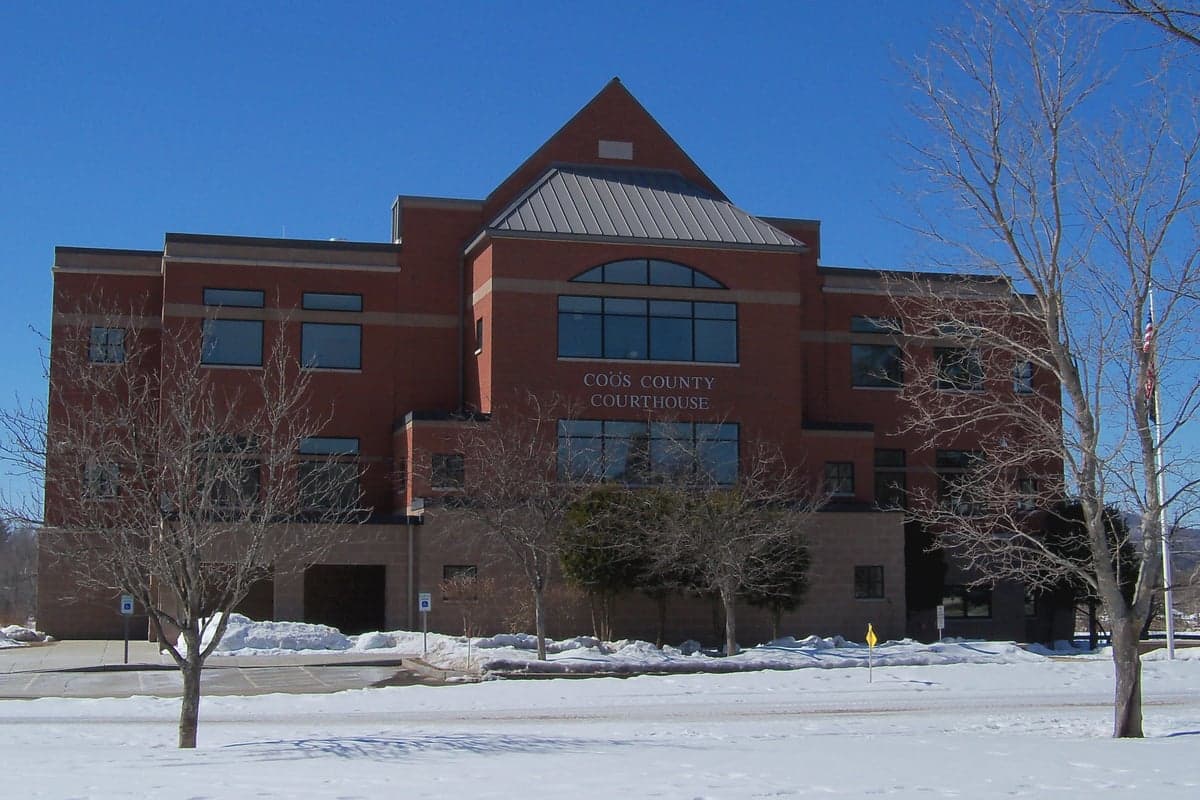
Photo: Wikipedia
Political ClimatePolitical Climate in Coos County
Showing district-level results — no local-only data available.
Local Political AnalysisPolitical Analysis of Coos County
Coos County, New Hampshire, is a fascinating political outlier: it's the only county in the state with a Cook Partisan Voting Index (PVI) of D+2, matching the state's overall D+2 lean, but that number masks a deeply divided and shifting landscape. For decades, this was a reliably blue-collar Democratic stronghold, but the 2016 and 2020 elections saw a sharp rightward shift, particularly in the county's northern and western towns. The 2024 election cemented this trend, with Donald Trump winning the county by a narrow margin, a stark reversal from Barack Obama's 2012 victory there, signaling that Coos is now a true battleground within a battleground state.
How it compares
While New Hampshire as a whole has trended slightly bluer in presidential races since 2016, Coos County has moved in the opposite direction, creating a widening gap between the county and the state. The state's D+2 PVI is largely driven by the populous, liberal-leaning southeastern corner (Rockingham and Hillsborough counties), but Coos is the state's most rural and economically distressed region. Within Coos, the political divide is stark: the county seat, Lancaster, and the college town of Berlin (home to a small satellite campus of White Mountains Community College) lean Democratic, with Berlin's working-class roots still showing in local elections. In contrast, Colebrook, Pittsburg, and Errol in the far north are deeply Republican, often voting 65-70% for GOP candidates. The swing precincts are the more populated, mixed-income areas like Gorham and Milan, where economic anxiety and cultural issues like gun rights and school choice often tip the balance. This internal variation means Coos is less a monolith and more a microcosm of the national urban-rural divide, compressed into a single county.
What this means for residents
For conservative residents, Coos County offers a place where their values are increasingly reflected in local governance, especially on issues like Second Amendment protections and opposition to state-level energy regulations. The county's Republican state representatives and county commissioners have pushed for lower property taxes and less restrictive land-use policies, which resonate in the logging and tourism-dependent north. For liberal residents, the picture is more complex: they often feel politically isolated in the northern towns but find solidarity in Berlin and Lancaster, where local Democratic committees remain active. The practical effect is a community where political conversations are unavoidable but often respectful, as neighbors share the same struggles with high heating costs, limited healthcare access, and a shrinking population. The county's D+2 label doesn't translate to a comfortable majority for either side; it means every election is a fight, and local issues like the future of the Androscoggin River dam removals or the expansion of snowmobile trails can become proxy battles for larger national debates.
Culturally, Coos County stands apart from the rest of New Hampshire in its fierce independence and skepticism of both Concord and Washington. The "Live Free or Die" ethos is not a slogan here but a lived reality, manifesting in a strong resistance to statewide mask mandates during the pandemic and a preference for local control over school curricula. Policy-wise, this means Coos often votes against state-level bond measures for infrastructure, preferring to fund its own roads and bridges through local property taxes, even if that results in rougher pavement. The county's political trajectory is toward a more polarized, competitive future, but its small population (roughly 31,000) means that personal relationships and local issues still carry more weight than party labels in most day-to-day decisions. For anyone moving here, the key takeaway is that your vote will matter more than in almost any other part of New Hampshire, and your neighbors will expect you to know why you cast it.

State Political ClimatePolitical Climate in New Hampshire
State Political AnalysisPolitical Environment in the State
New Hampshire is a classic swing state that has been drifting rightward over the past decade, with a Cook PVI of D+2 belying a deeply competitive, independent-minded electorate. The state voted for Hillary Clinton in 2016 by less than 3,000 votes, then backed Joe Biden by 7.5 points in 2020, but the 2024 election saw Donald Trump lose the state by only about 3 points — a clear sign the GOP is gaining ground. The dominant coalition is a mix of fiscally conservative, socially moderate-to-libertarian "Live Free or Die" types, alongside a more traditional Democratic base concentrated in the southeastern corner. Over the last 20 years, the state has shed its old Yankee Republican identity for a more polarized, purple reality, but it remains one of the few states where ticket-splitting and independent voters still decide elections.
Urban vs. rural divide
The political map of New Hampshire is a textbook case of the urban-rural split, with a few critical swing suburbs. The Democratic stronghold is the southeastern quadrant anchored by Manchester and Nashua, the state's two largest cities, along with the Seacoast region including Portsmouth and Dover. These areas are home to out-of-state transplants, tech workers, and union households, and they reliably deliver 60%+ margins for Democrats. The rural north and west — places like Berlin, Littleton, and Keene — lean heavily Republican, though Keene itself is a small liberal arts college town that votes blue. The real battleground is the Lakes Region and the Merrimack Valley suburbs like Bedford, Londonderry, and Windham, where fiscally conservative, socially moderate families have been shifting right. Hillsborough County, which includes Manchester and Nashua, flipped from blue to red in the 2024 presidential race, driven by working-class voters in the city's outskirts and exurbs. The rural-urban divide here is less about culture war and more about taxes, regulation, and the pace of growth — a dynamic that keeps the state competitive.
Policy environment
New Hampshire's policy environment is defined by its no state income tax and no state sales tax, making it a low-tax haven compared to neighboring Massachusetts, Vermont, and Maine. The state relies heavily on property taxes and business taxes, which are moderate but not punishing. The regulatory posture is generally business-friendly, with a right-to-work law (though not a "right-to-work" state in the union-busting sense — it's a "right-to-work" state for public employees only) and a relatively light permitting process for small businesses. Education policy is a hot-button issue: the state has a robust school choice program through the Education Freedom Accounts (EFAs), which allow public funds to follow students to private or homeschool settings, a policy that has expanded significantly under Republican governors. Healthcare is a mixed bag — the state expanded Medicaid under the Affordable Care Act, but the current Republican-led executive council has been pushing work requirements and cost controls. Election laws are famously open: same-day voter registration, no voter ID requirement at the polls (though you must show ID to register), and a strong tradition of ballot access. The state's motto, "Live Free or Die," is not just a slogan — it's reflected in the absence of a seatbelt law for adults, no helmet law for motorcyclists, and a general hands-off approach to personal behavior.
Recent policy direction
Over the past five years, New Hampshire has moved decisively in a conservative direction on several fronts. Gun and self-defense law is among the most permissive in the nation: the state has constitutional carry (no permit needed to carry a concealed firearm), no magazine capacity limits, and a "stand your ground" law passed in 2021. Parental and education rights have been a major focus — the 2023 "Parents' Bill of Rights" (HB 1431) requires schools to notify parents about curriculum changes and medical services, and the EFAs have been expanded to cover nearly all families regardless of income. Speech and privacy are protected by a strong state constitution, though there have been debates over library book challenges and drag show restrictions in some towns. Medical and bodily autonomy is a split issue: abortion remains legal up to 24 weeks, with a 2022 law (HB 1609) codifying protections, but the state has also passed a ban on gender-affirming surgeries for minors (HB 619) in 2024. Property rights are strong, with no statewide zoning mandates and a tradition of local control, though the housing crisis has led to some limited preemption of local restrictions. Taxation remains the crown jewel — the state has no plans to introduce an income or sales tax, and the Republican-controlled legislature has cut the business profits tax from 7.7% to 7.5% in 2024. Voting and ballot access remain open, but there have been pushes for voter ID laws and stricter residency requirements, which have so far failed to pass. The overall direction is toward more individual liberty in the classical liberal sense, with a strong tilt toward conservative social policy on education and medical issues.
Civil unrest & political movements
New Hampshire is not a state known for street protests, but it has a vibrant, organized political culture. The Free State Project, a movement of libertarians who relocated to the state to push for small government, has been active since the early 2000s and has had a real impact on local politics — they've helped elect libertarian-leaning Republicans to the state house and pushed for repealing gun laws and legalizing marijuana (which is still illegal for recreational use, though decriminalized). On the left, the Indivisible movement and local Democratic Socialists have been active in Manchester and Portsmouth, organizing around abortion rights and climate policy. Immigration politics are relatively low-key — the state is not a border state, and there are no sanctuary city policies, though Manchester has a "welcoming city" resolution that is largely symbolic. Election integrity controversies have been minimal compared to other states, thanks to the state's small size and tradition of hand-counted ballots in many towns. The most visible flashpoint in recent years has been the drag show debate in towns like Derry and Londonderry, where local library events drew protests and counter-protests, but these have been isolated and not escalated into violence. The overall political culture is more "town meeting" than "street fight" — people argue passionately but generally respect the process.
Projection
Over the next 5-10 years, New Hampshire is likely to continue its slow rightward drift, driven by two key demographic shifts. First, the state is seeing significant in-migration from Massachusetts, particularly from families and remote workers who are fleeing high taxes and restrictive COVID-era policies. These newcomers tend to be fiscally conservative and socially moderate, which bolsters the GOP's suburban base. Second, the state's native-born population is aging and shrinking, while the younger, more liberal cohort in Manchester and Nashua is not growing fast enough to offset the rural and exurban gains. The 2024 election results suggest that the state could become a lean-Republican state by 2030, especially if the national Democratic brand continues to struggle with working-class voters. However, the state's independent streak and the presence of the Free State Project mean that the GOP will have to stay libertarian-leaning on social issues to hold the coalition together. A new resident moving in now should expect a state that is increasingly conservative on taxes, education, and gun rights, but still moderate on abortion and personal freedoms — a place where the "Live Free or Die" ethos is taken seriously, but the political battles are fought over how to interpret that freedom.
For a conservative-leaning relocator, New Hampshire offers a rare combination of low taxes, strong gun rights, school choice, and a growing Republican presence — all within a state that is safe, clean, and close to Boston's economy. For a liberal relocator, the state still offers abortion protections, a vibrant civic culture, and a strong public education system, but the political winds are blowing against them. The bottom line is that New Hampshire is a state where your vote actually matters, and where the political climate is shaped more by local town meetings and state house races than by national cable news. If you value independence, low taxes, and the ability to live your life without much government interference, this is one of the best states in the country — just be prepared for a long winter and a short growing season for your political agenda.
* Values derived from national, state, county, city and local statistics and may differ in a specific area. Last updated: 2026-07-17T10:12:47.000Z
Narrative content on this page is AI-generated and may contain mistakes. Verify any details that matter before acting on them.
ReloMaps may earn a commission from affiliate links at no extra cost to you.

