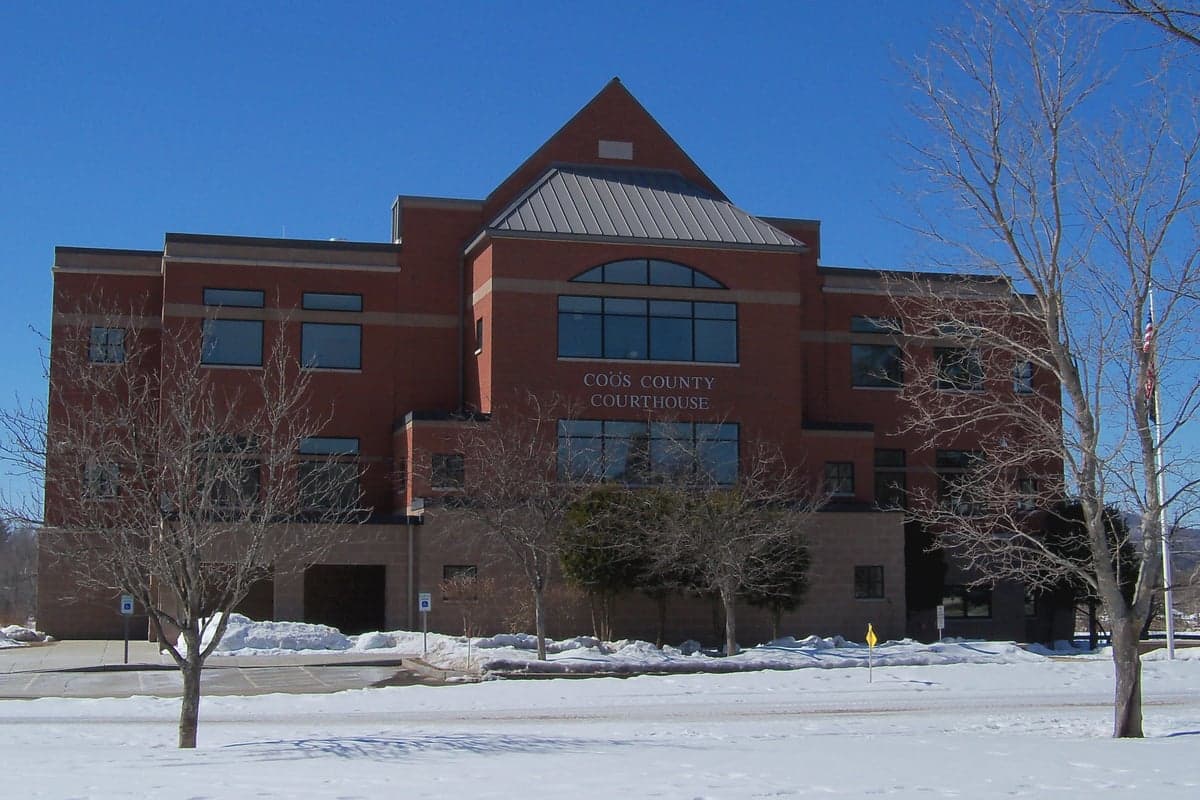
Photo: Wikipedia
Demographics of Coos County
Affluence Level in Coos County
A middle-class area roughly in line with national averages across income, home values, education, and employment.
People of Coos County
The people of Coos County, New Hampshire, today number just over 31,000, making it the state’s most rural and least densely populated county. The population is overwhelmingly white (92.9%) and native-born, with only 1.3% foreign-born residents, a figure that reflects the county’s limited immigration history and geographic isolation in the state’s northernmost reaches. Distinctive markers include a strong Franco-American heritage, a shrinking and aging population, and a cultural identity rooted in the region’s logging, mill, and railroad past rather than modern suburban growth. For a conservative-leaning audience, Coos County represents a place where traditional New England character persists, but where economic and demographic headwinds are reshaping daily life.
Settlement & growth (pre-1960)
Before European contact, the area now known as Coos County was inhabited by the Abenaki people, specifically the Sokoki and Cowasuck bands, who used the Connecticut River and its tributaries for fishing, travel, and seasonal settlement. The name "Coos" itself derives from an Abenaki word meaning "place of pines." European colonization began slowly: the region was part of the Masonian land grants in the 1740s and 1750s, but permanent settlement did not take hold until after the French and Indian War. The first significant wave of English-speaking settlers arrived from coastal New Hampshire and Massachusetts in the 1760s and 1770s, drawn by cheap land and the promise of self-sufficient farming. Towns like Lancaster (incorporated 1763), Colebrook (settled 1770s), and Stewartstown (granted 1770) became early population centers, with settlers clearing forests for subsistence agriculture and small-scale grist and saw mills.
The 19th century brought a transformative wave: French-Canadian immigration. Between 1840 and 1900, tens of thousands of French Canadians crossed the border from Quebec, fleeing rural poverty and seeking work in the booming lumber, paper, and railroad industries of northern New Hampshire. Coos County was a primary destination. Towns like Berlin (incorporated 1829) and Gorham (incorporated 1836) grew explosively as mill towns, with French-Canadian workers forming the backbone of the labor force. By 1900, Berlin was the largest city in the county, with a population of over 8,000, the majority of whom were French Canadian or of French-Canadian descent. The Catholic Church became a central institution, with parishes like St. Anne’s in Berlin and St. Joseph’s in Gorham serving as cultural anchors. A smaller but notable wave of Irish immigrants arrived in the 1850s and 1860s, primarily to work on the St. Lawrence and Atlantic Railroad and later in the mills, settling in clusters in Berlin and Northumberland.
The early 20th century saw the peak of the county’s population. The paper and pulp industry, centered on the Brown Company in Berlin, employed thousands, and the railroad network connected the region to markets in Boston and Montreal. The population of Coos County reached its all-time high of 38,948 in 1930. However, the Great Depression hit the region hard, and the post-World War II era brought a slow, steady decline. The mechanization of logging and the closure of smaller mills reduced the need for labor, and younger generations began leaving for southern New Hampshire and Massachusetts. By 1960, the county’s population had fallen to 37,140, and the Franco-American character of the region, while still dominant, was beginning to fray as English-language assimilation accelerated.
Modern era (post-1965)
The post-1965 period in Coos County is defined not by immigration but by domestic out-migration and demographic aging. The Hart-Cellar Act of 1965, which dramatically reshaped U.S. immigration patterns, had almost no effect on Coos County. The foreign-born population today stands at just 1.3%, and the county has never developed the immigrant enclaves seen in southern New Hampshire or the Boston suburbs. The small number of foreign-born residents who do live here are primarily from Canada (many of them French-Canadian retirees returning to family roots) and a scattering of European-born individuals, with negligible numbers from Asia, Latin America, or Africa.
The dominant demographic story since 1965 has been population loss and aging. The county’s population dropped from 35,147 in 1970 to 31,386 in 2020, a decline of roughly 11%. The paper industry, once the economic engine, underwent a series of closures and consolidations. The Brown Company’s Berlin mill, which had employed over 3,000 at its peak, closed its pulp operations in 2006, and the last paper machine shut down in 2017. This loss of high-wage blue-collar jobs accelerated out-migration, particularly among younger adults. Today, the median age in Coos County is 49.2 years, compared to the national median of 38.8, and the county has one of the highest proportions of residents aged 65 and older in New Hampshire.
Racial and ethnic diversity remains minimal. The Hispanic population is 2.3%, concentrated in Berlin and Milan, where a small number of Mexican-American families have moved for work in the remaining logging and trucking industries. The Black population is 1.5%, largely in Berlin and Lancaster, and is composed primarily of individuals who moved from southern New England for employment or family reasons. East and Southeast Asian communities (0.2%) and Indian-subcontinent residents (0.1%) are nearly absent, with only a handful of individuals in the entire county. The county’s white population, at 92.9%, is overwhelmingly of French-Canadian, English, and Irish ancestry, with the Franco-American identity still strong in Berlin, Gorham, and Whitefield.
The future
The demographic trajectory of Coos County points toward continued population decline and aging, with little prospect of significant diversification. The county’s population is projected to fall to roughly 28,000 by 2040, driven by a death rate that exceeds the birth rate and continued out-migration of young adults. The small Hispanic population may grow modestly as families move into the region for work in the service and healthcare sectors, but it is unlikely to exceed 5% of the total population in the next decade. The Franco-American cultural identity, while still present, will continue to fade as older generations pass away and younger residents assimilate into a broader American culture.
New communities are not forming in any significant concentration. The county lacks the economic pull to attract domestic migrants from other regions, and its remote location and harsh winters deter most newcomers. The one potential bright spot is the growth of remote work and second-home ownership, particularly in scenic towns like Pittsburg (the county’s northernmost town, popular for snowmobiling and fishing) and Dixville Notch (famous for its first-in-the-nation midnight voting). However, these are seasonal and part-time residents, not permanent population. The cultural identity of the county is likely to become more oriented toward outdoor recreation and tourism, with the traditional mill-town character giving way to a quieter, more retirement-focused community.
For someone moving in now, Coos County offers a place of deep-rooted community, low crime, and stunning natural beauty, but also one of economic stagnation and demographic contraction. The kind of person who thrives here is someone who values solitude, self-reliance, and a slower pace of life, and who is prepared for a region where the population is shrinking and the cultural fabric is slowly changing. It is not a place of growth or diversity, but it remains a place of genuine, if fading, New England character.

* Values derived from national, state, county, city and local statistics and may differ in a specific area. Last updated: 2026-07-17T10:12:47.000Z
Narrative content on this page is AI-generated and may contain mistakes. Verify any details that matter before acting on them.
ReloMaps may earn a commission from affiliate links at no extra cost to you.

