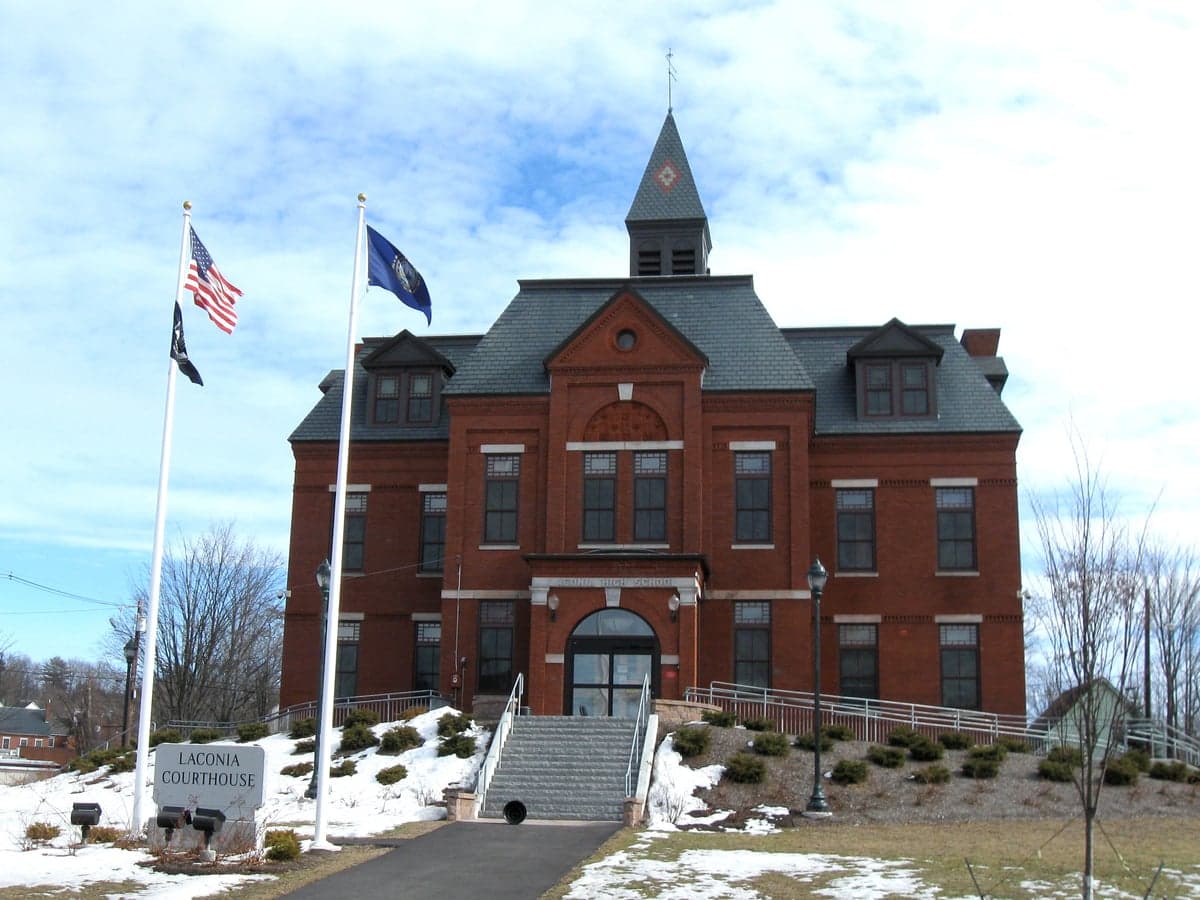
Photo: Wikipedia
Political ClimatePolitical Climate in Belknap County
Showing district-level results — no local-only data available.
Local Political AnalysisPolitical Analysis of Belknap County
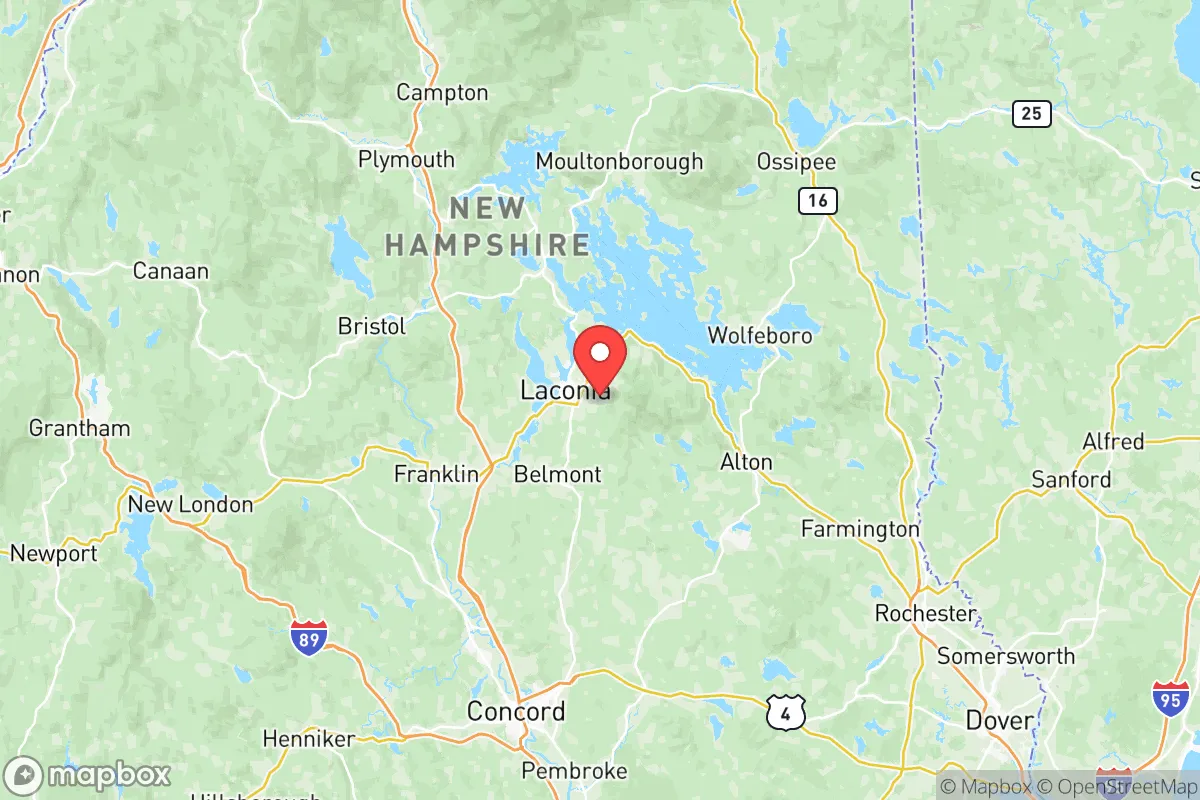
Belknap County, New Hampshire, sits in a fascinating political middle ground, carrying a Cook PVI of D+2 that matches the state of New Hampshire as a whole. This means the county is a near-perfect bellwether for statewide elections, but that overall number masks a sharp internal divide. The county's political trajectory has been one of slow, steady polarization, with the lakeside towns and the county seat of Laconia drifting more Democratic while the rural hill towns have hardened their Republican lean. If you want to understand where New Hampshire is going politically, you watch Belknap County—it's the state in miniature, but with its own distinct flavor.
How it compares
At the state level, New Hampshire's D+2 PVI makes it one of the most competitive states in the nation, and Belknap County mirrors that exactly. But the comparison gets interesting when you zoom in. The county's Democratic strength is concentrated in a few key areas: the city of Laconia (especially its downtown and lakefront wards), the town of Gilford along the lake, and the more affluent parts of Meredith. These are the places where you'll find the "Live Free or Die" libertarian streak blending with socially liberal, fiscally moderate voters. On the flip side, the towns of Alton, Barnstead, and New Durham are reliably Republican, often voting 60-40 or more for GOP candidates. The real swing precincts are in Belmont and the more rural parts of Gilmanton, where working-class voters and second-home owners create an unpredictable mix. Compared to the rest of New Hampshire, Belknap County is slightly more conservative than the Seacoast region (which leans D+5 or so) but noticeably more moderate than the North Country or the far western towns. It's the state's political center of gravity, for better or worse.
What this means for residents
For conservative residents, living in Belknap County means you're in a place where your views are the majority in most towns, but you're never far from a liberal enclave. The county commission and most local school boards tend to lean right, especially in the smaller towns, but you'll still see competitive races in Laconia and Gilford. For liberal residents, the picture is more mixed: you can find your people in the lakeside communities, but you'll need to drive 20 minutes to get to a reliably blue precinct. The practical effect is that local politics here are genuinely contested, not pre-decided. Town meetings in places like Meredith and Gilford can get heated over school budgets and development, and the outcomes are never a foregone conclusion. For both sides, this means your vote actually matters—a reality that's increasingly rare in America.
The cultural and policy distinctions in Belknap County are subtle but real. The county has a strong libertarian streak that cuts across party lines: property tax caps are a perennial issue, and there's broad skepticism of both state and federal overreach. You'll find gun rights supporters and anti-vaccine activists alongside environmentalists fighting to protect Lake Winnipesaukee's water quality. The biggest local flashpoint is development pressure—the tension between preserving the rural, lake-centric character of the area and accommodating the growth that comes with being a desirable place to live. That debate doesn't break neatly along party lines, which is what makes Belknap County such an interesting place to watch. It's not red or blue; it's a complicated, independent-minded purple that reflects the best and worst of New Hampshire's political culture.

State Political ClimatePolitical Climate in New Hampshire
State Political AnalysisPolitical Environment in the State
New Hampshire has long been known as a fiercely independent swing state, but its political reality in 2026 is more nuanced than the classic "Live Free or Die" motto suggests. With a Cook Partisan Voting Index of D+2, the state leans slightly Democratic in presidential elections, yet it has a deeply split government and a libertarian streak that often defies national party lines. Over the past 20 years, the state has shifted from a reliably Republican stronghold in the 1980s and 1990s to a purple battleground, driven largely by the explosive growth of the southern tier and the Massachusetts exurbs, while the northern and western counties have held firm or moved right.
Urban vs. rural divide
The political map of New Hampshire is a story of two distinct regions. The southeastern corner, anchored by Manchester, Nashua, and the Seacoast area around Portsmouth, is the engine of the state's Democratic lean. These are the population centers, home to tech workers, healthcare professionals, and a growing number of out-of-state transplants who bring more liberal voting habits. Hillsborough and Rockingham counties, which contain these cities, have trended blue in recent cycles, with Manchester's Ward 1 and Ward 2 often delivering decisive margins for Democrats. In contrast, the rest of the state is a different world. Berlin and Coös County in the far north, along with Carroll County and much of the Lakes Region, are deeply red, driven by a rural, older, and more culturally conservative population. Salem, a border town with Massachusetts, is a fascinating microcosm: it's a suburban swing community where local races are often decided by a few hundred votes, reflecting the tension between its commuter base and its native Granite State identity. The divide isn't just geographic—it's cultural, with the southern cities feeling more connected to Boston's orbit and the north and west clinging to a self-reliant, small-town ethos.
Policy environment
New Hampshire's policy environment is a direct reflection of its split personality. The state famously has no broad-based income tax and no sales tax, a point of pride that unites both parties. Property taxes are high, however, and are the primary revenue source, which fuels constant debate in Concord. The regulatory posture is generally business-friendly, with a right-to-work law on the books and a relatively low corporate tax rate, but the state also has a minimum wage that is tied to the federal floor ($7.25) and has not been raised since 2009, a point of contention. On education, the state is a national outlier: it provides no dedicated state funding for public schools, relying almost entirely on local property taxes, which has led to a series of court battles over equity. Healthcare is a mixed bag; the state expanded Medicaid under the Affordable Care Act, but the program has a work requirement and a sunset clause, reflecting the legislature's ongoing tug-of-war. Election laws are famously open: same-day voter registration is allowed, and there is no voter ID law requiring a photo, making it one of the easiest states to vote in, a fact that conservatives often criticize and liberals defend.
Recent policy direction
The last few years have seen New Hampshire lurch in a distinctly more conservative direction on several fronts, even as the state's presidential vote has stayed blue. In 2024, the Republican-controlled legislature passed a series of bills that would have reshaped the state's character, though many were vetoed by Governor Chris Sununu or later moderated. On gun and self-defense law, the state remains one of the most permissive in the nation: constitutional carry (no permit required to carry a concealed firearm) has been law since 2017, and there is no state-level assault weapons ban or magazine capacity limit. In 2024, a bill to ban "ghost guns" failed. On parental and education rights, the state passed a "Parents' Bill of Rights" in 2022, requiring schools to notify parents about curriculum changes and medical services, and in 2024, a law was enacted allowing parents to opt their children out of any instructional material they find objectionable. A school voucher-like program, the Education Freedom Accounts, has been expanded, allowing public funds to follow students to private or homeschool settings. On medical and bodily autonomy, the state codified abortion rights into law in 2023, protecting access up to 24 weeks, a move that Sununu signed despite his own pro-life stance. On property rights, the state has resisted rent control and has a strong tradition of local zoning control, though a 2024 bill to preempt local short-term rental regulations failed. On voting and ballot access, the state has resisted efforts to impose stricter voter ID laws, but a 2024 bill to require proof of citizenship for registration passed the House before stalling in the Senate. The overall direction is a state that is pulling in two directions at once: culturally libertarian on guns and taxes, but increasingly polarized on education and social issues.
Civil unrest & political movements
New Hampshire is not a state known for large-scale civil unrest, but it has a vibrant and visible activist scene on both sides. The Free State Project, a movement that encourages libertarians to relocate to the state, has been a notable force since the early 2000s, with members concentrated in the Keene and Portsmouth areas. They have been influential in pushing for gun rights, tax limitation, and school choice, though their impact on statewide elections has been limited. On the left, the state has seen active Indivisible chapters and environmental groups, particularly around the Seacoast, where opposition to offshore drilling and the Northern Pass transmission line has been fierce. Immigration politics are relatively low-key compared to border states, but there have been flashpoints: in 2023, Manchester saw protests after a local school district implemented a policy allowing undocumented students to enroll without a Social Security number, drawing national attention from both sides. Election integrity has been a recurring theme since 2020, with Republican activists in Windham and other towns pushing for hand-counting of ballots and audits, though no major fraud has been found. The state's tradition of town hall meetings means that political arguments are often personal and local, not just abstract national fights.
Projection
Looking ahead 5 to 10 years, New Hampshire's political trajectory is likely to remain a tug-of-war, but the demographic trends favor a slow, steady shift to the left. The southern tier, particularly Nashua and Salem, continues to grow as a bedroom community for Boston, bringing in younger, more diverse, and more Democratic-leaning residents. The northern and western counties are aging and losing population, which will gradually reduce their electoral weight. However, the state's independent streak and the influence of the Free State Project mean that it will never become a deep blue state like its neighbor Massachusetts. Expect continued gridlock in Concord, with a Republican legislature and a Democratic governor (or vice versa) being the norm. The most likely scenario is that the state remains purple, with a slight Democratic lean in presidential years, but with enough conservative and libertarian muscle to block major tax increases, gun control, or a state income tax. For a new resident, this means you will live in a state where your vote truly matters, where local politics are accessible and often decisive, and where the culture war is fought block by block, not just on cable news.
For a conservative-leaning individual or family considering a move, New Hampshire offers a rare combination: low taxes, strong gun rights, school choice, and a culture of personal liberty, all within a state that is politically competitive. You will not find a conservative monoculture here—your neighbors in Manchester or Portsmouth may be progressive activists—but you will find a state where your values have a real voice in elections and where the government is structurally limited. The practical takeaway is that New Hampshire rewards engagement: if you show up to town meeting, run for school board, or simply vote, you can have an outsized impact. It is a state that is still small enough to be shaped by its residents, and that is its greatest political asset.
* Values derived from national, state, county, city and local statistics and may differ in a specific area. Last updated: 2026-07-08T15:10:53.000Z
Narrative content on this page is AI-generated and may contain mistakes. Verify any details that matter before acting on them.
ReloMaps may earn a commission from affiliate links at no extra cost to you.

