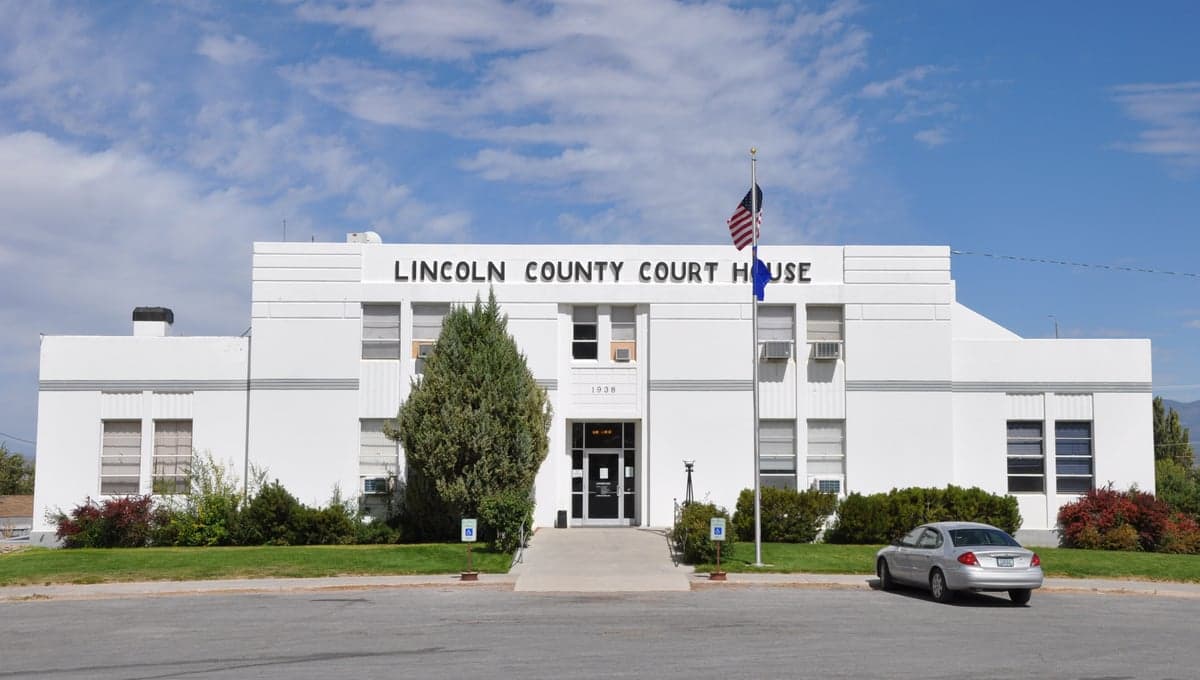
Photo: Wikipedia
Personal Sovereignty in Lincoln County
Viable for self-reliance. Generally workable, though some barriers may limit total independence.
What does Personal Sovereignty tell us?
Personal Sovereignty measures your capacity for self-reliance and independence with minimal government friction. Higher scores mean fewer barriers between you and the way you want to live... but it assumes you have the space you need and good neighbors.
What does this tell us?
Personal Sovereignty measures your capacity for self-reliance and independence with minimal government friction. Higher scores mean fewer barriers between you and the way you want to live... but it assumes you have the space you need and good neighbors.
State Policy
Energy independence: Importer (15% of energy produced in-state)
Personal Liberty
Homesteading

Personal Liberty Analysis
Lincoln County, Nevada offers one of the most permissive personal sovereignty environments in the western United States, with a governing philosophy that consistently prioritizes individual autonomy over regulatory oversight. The county’s vast, sparsely populated geography—home to roughly 4,500 residents spread across 10,637 square miles—naturally limits the reach of local government, and state-level protections further insulate residents from intrusive mandates. For a relocation reader seeking maximum personal freedom, Lincoln County presents a compelling alternative to the more heavily regulated urban corridors of Clark County or Washoe County, though the trade-offs in access to services and economic opportunity are significant.
Tax burden and regulatory posture: How Lincoln County compares to Nevada and the West
Nevada’s absence of a state income tax is the cornerstone of Lincoln County’s low-tax environment, and the county itself imposes no additional local income tax. Property taxes are among the lowest in the nation, with the effective rate in Lincoln County averaging roughly 0.55% of assessed value—well below the national average of 1.07%. A home valued at $300,000 would incur annual property taxes of approximately $1,650. Sales tax in the county is 7.6% (state base of 6.85% plus a 0.75% county option), which is moderate by Nevada standards but lower than the 8.38% rate in Clark County. The county’s regulatory posture is notably light-touch: there is no county-wide building code for unincorporated areas, no zoning overlay districts in most rural townships, and no business license requirement for home-based enterprises under certain thresholds. Towns like Caliente and Pioche have minimal municipal codes, while Panaca operates with a largely informal governance structure. The county’s planning department focuses primarily on large-scale mining and energy projects, leaving individual landowners largely to their own devices. This stands in stark contrast to the regulatory density found in Nevada’s urban centers, where Clark County enforces strict building codes, business licensing, and environmental review processes.
Self-defense and gun law specifics: Constitutional carry and stand-your-ground in practice
Nevada is a constitutional carry state, meaning no permit is required to carry a concealed firearm for anyone 18 or older who is legally allowed to possess a firearm. Lincoln County fully aligns with this framework, and local law enforcement—the Lincoln County Sheriff’s Office—is known for a pro-Second Amendment stance. The county has no additional firearm restrictions beyond state law, and there are no local ordinances limiting magazine capacity, firearm types, or storage requirements. Nevada’s stand-your-ground law, codified in NRS 200.120, eliminates any duty to retreat before using deadly force in self-defense, provided the individual is in a place they have a legal right to be. In practice, this means a resident in Alamo or Rachel who defends their home or person against an intruder faces no legal presumption of wrongdoing. The county’s sheriff has publicly stated that deputies will not enforce federal firearm regulations they deem unconstitutional, a position that aligns with the broader rural Nevada sentiment. For a relocation reader prioritizing self-defense rights, Lincoln County offers one of the most permissive legal environments in the nation, with no waiting periods, no firearm registration, and no restrictions on open carry.
Self-reliance and homesteading viability: Lot sizes, zoning, and off-grid feasibility across the county
Lincoln County’s land-use policies are exceptionally favorable to self-reliant living. The county has no zoning ordinance for most unincorporated areas, meaning there are no minimum lot size requirements, no setback mandates, and no restrictions on livestock or agricultural use on residential parcels. In towns like Ursine and Hiko, residents routinely live on parcels ranging from 1 to 40 acres with no county oversight of building materials, septic systems (beyond basic health department approval), or water collection. Off-grid living is entirely feasible: Nevada law explicitly protects the right to harvest rainwater (NRS 534.150), and Lincoln County imposes no additional permitting for solar panels, wind turbines, or composting toilets. The county’s building department does not require permits for structures under 120 square feet, and many residents build larger homes without formal permits, relying on the county’s lack of enforcement capacity. However, the Meadow Valley Wash area near Caliente has some floodplain restrictions, and the Bureau of Land Management (BLM) controls roughly 87% of the county’s land, meaning any development on federal parcels requires a special use permit. For a homesteader, the key distinction is between private land in the valleys—where regulatory freedom is near-absolute—and BLM-managed rangeland, where federal oversight applies. The county’s remote character also means that self-reliance is not just a legal option but a practical necessity: the nearest Home Depot is 120 miles away in St. George, Utah, and emergency services can have response times exceeding 45 minutes in the most isolated areas.
Personal liberties: Parental rights, medical autonomy, speech, and property protections
Nevada’s legal framework provides strong protections for parental rights, medical autonomy, and free speech, and Lincoln County’s local culture reinforces these principles. Parental rights are explicitly protected under NRS 128.010, which affirms that parents have the primary right to direct the upbringing, education, and healthcare of their children. The county’s school district—Lincoln County School District—operates with a conservative board that has resisted state-level mandates on curriculum and health policies, and parents in Pioche and Caliente report high levels of involvement in school governance. Medical autonomy is less robust than in some states: Nevada does not have a right-to-try law for terminally ill patients (though it does allow experimental treatments under certain conditions), and the state’s vaccine mandate for schoolchildren remains in effect, though exemptions are available for medical and religious reasons. Lincoln County’s healthcare infrastructure is limited—the county has one small hospital in Caliente and a clinic in Pioche—so residents often travel to St. George or Las Vegas for specialized care, which effectively limits the practical impact of state-level medical mandates. Free speech protections are strong under both the Nevada Constitution and the First Amendment, and the county has no local ordinances restricting political speech, signage, or assembly. Property rights are protected by Nevada’s strong eminent domain laws, which require just compensation and a public purpose, and Lincoln County has not engaged in any controversial takings in recent memory. The county’s assessor’s office is known for valuing property conservatively, which keeps tax burdens low and reduces the incentive for government to seize land for non-payment.
Overall, Lincoln County ranks among the most sovereignty-friendly jurisdictions in the Intermountain West, comparable to rural counties in Idaho and Montana but with the added advantage of Nevada’s no-income-tax structure and constitutional carry laws. The county’s regulatory vacuum is a double-edged sword: it maximizes personal freedom but also means residents must be self-sufficient in areas like waste management, emergency response, and infrastructure maintenance. For a relocation reader who values autonomy over convenience, Lincoln County offers a rare combination of low taxes, minimal regulation, strong gun rights, and permissive land-use policies that is increasingly difficult to find in the contiguous United States.

* Values derived from national, state, county, city and local statistics and may differ in a specific area. Last updated: 2026-07-03T04:50:51.000Z
Narrative content on this page is AI-generated and may contain mistakes. Verify any details that matter before acting on them.
ReloMaps may earn a commission from affiliate links at no extra cost to you.

