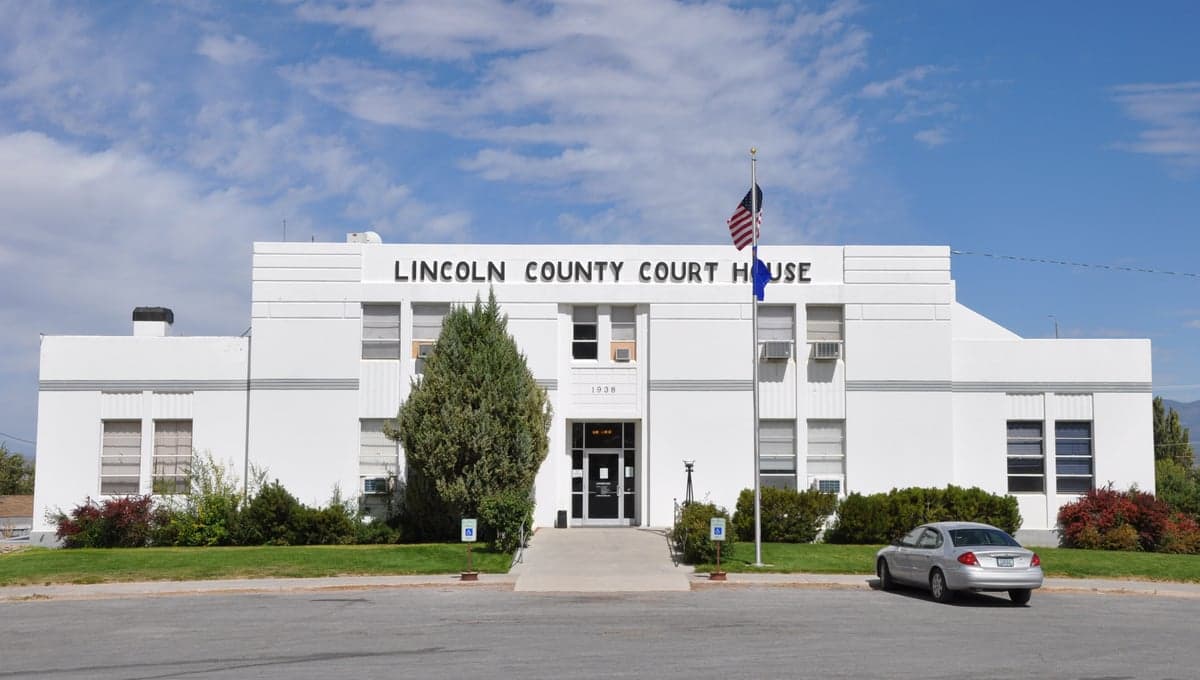
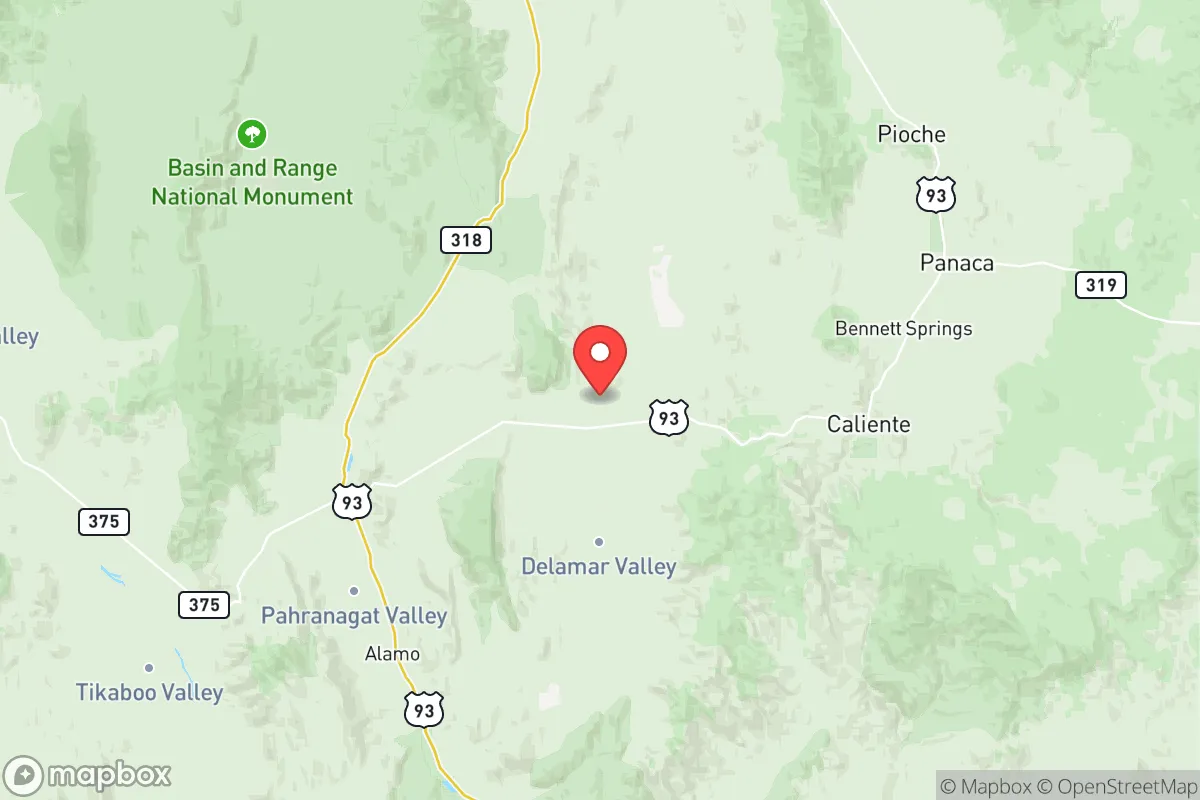
Photo: Wikipedia
Demographics of Lincoln County
Affluence Level in Lincoln County
A middle-class area roughly in line with national averages across income, home values, education, and employment.
People of Lincoln County
The people of Lincoln County, Nevada today are a small, predominantly white population of 4,452 spread across a vast, remote high-desert landscape. The county is marked by its rural character, low population density, and a distinctive identity rooted in mining, ranching, and government-related employment. With a foreign-born population of just 0.5% and a Hispanic share of 5.3%, the area remains one of the least diverse counties in Nevada, though small Black (4.2%) communities exist, primarily linked to the prison industry and related services.
Settlement & growth (pre-1960)
Long before European contact, the land that is now Lincoln County was the seasonal home of the Southern Paiute and Western Shoshone peoples. These tribes followed game and gathered pinyon nuts across the region's spring-fed valleys and mountain ranges, leaving a sparse but enduring archaeological footprint. The first non-Native presence came in the 1820s and 1830s, when Mexican and American fur trappers, including Jedediah Smith, passed through. However, no permanent settlement occurred until the Mormon colonization of the 1860s. Brigham Young dispatched Latter-day Saint missionaries to establish farming communities in the Meadow Valley Wash area, founding Panaca in 1864 as the county's first permanent settlement. Panaca remains a predominantly Mormon community today, with historic homes and a strong church presence.
The county's real population driver was the mining boom of the 1870s. The discovery of silver and lead in the Pioche Hills drew a wave of miners, merchants, and speculators, turning Pioche into a raucous boomtown that briefly rivaled Virginia City. By the 1880s, Pioche was one of Nevada's largest cities, attracting Cornish, Irish, and German miners alongside Chinese laborers who built railroads and worked in the smelters. As the mines played out and silver prices collapsed, Pioche's population plummeted, though it remained the county seat. Chinese residents were driven out by the 1880s, and the county became overwhelmingly white and Mormon.
The early 20th century brought railroad construction and ranching expansion. The completion of the Las Vegas & Tonopah Railroad in the 1910s linked the county to wider markets, allowing cattle and sheep ranching to flourish on the valley floors. Small communities like Caliente grew around railroad maintenance yards, while Alamo became a farming and ranching hub in the Pahranagat Valley. The Dust Bowl and Great Depression sent few new migrants here—the county was too arid and remote for significant agricultural settlement. Instead, population declined steadily as mining mechanized and ranch consolidation reduced the need for labor. By 1960, Lincoln County's population hovered around 2,500, scattered across a handful of small towns and isolated ranches.
Modern era (post-1965)
The 1965 Hart-Cellar Immigration Act had almost no direct effect on Lincoln County. The county's foreign-born population remains at just 0.5%, and there are no enclaves of post-1965 immigrants. Instead, the county's modern demographic story is one of domestic out-migration and a single large government facility. The 1970s and 1980s saw continued decline as young adults left for jobs in Las Vegas (90 miles south) and Salt Lake City (200 miles north). Caliente lost its railroad yards, and Pioche's tourism economy struggled to replace mining.
Two developments reshaped the population. First, the opening of the Nevada Youth Training Center (a juvenile correctional facility) in Caliente in the 1970s brought state employees and their families, stabilizing the town's population. Second, the construction and expansion of the U.S. Highway 93 corridor—a major route between Las Vegas and Salt Lake City—increased traffic and some service-industry jobs in Alamo and Caliente. But the most notable change was the construction of the state prison system's core facilities. The Ely State Prison (opened 1989) and the High Desert State Prison (opened 2000) sit on the border of Lincoln and White Pine counties, drawing correctional officers and support staff. This accounts for the county's 4.2% Black population—largely prison staff rather than inmates—since inmates are counted at their home addresses. The county's college education rate of 19.0% reflects the mix of correctional staff (many with associate degrees) and the limited professional employment base.
Hispanic population growth has been minimal, rising from less than 2% in 1990 to 5.3% today, primarily through Hispanic correctional officers and some farmworkers on ranches. No distinct Hispanic enclave exists. Asian and Indian subcontinent populations are effectively zero, a rarity in the Intermountain West.
The future
Lincoln County's population is projected to hover near its current level for the next 10–20 years. The county's natural decrease—deaths exceeding births—is offset only by modest in-migration from correctional employees and retirees seeking cheap land and solitude. The area is becoming slightly more diverse as the Hispanic and Black shares inch upward, but it will remain overwhelmingly white for the foreseeable future. The biggest demographic unknown is the potential for renewed mining activity. If lithium or other critical mineral deposits in the county are developed, an influx of construction workers and engineers could temporarily boost population and diversity. However, without such a boom, the county's small towns—Pioche, Caliente, Alamo, Panaca—will continue to age, with school enrollments shrinking and services consolidating. The cultural identity of the county remains rooted in ranching, mining history, and Mormon tradition, resistant to rapid change.
For someone moving in now, Lincoln County offers a place of extreme quiet, low cost of living, and strong community bonds, but also limited economic opportunity, minimal diversity, and long distances to urban amenities. The population is stable but aging; the county is not growing or diversifying meaningfully. A move here means joining a society built on self-reliance and neighborliness, where change arrives slowly and the past remains deeply present in the landscape and the people.

* Values derived from national, state, county, city and local statistics and may differ in a specific area. Last updated: 2026-07-03T04:50:51.000Z
Narrative content on this page is AI-generated and may contain mistakes. Verify any details that matter before acting on them.
ReloMaps may earn a commission from affiliate links at no extra cost to you.

