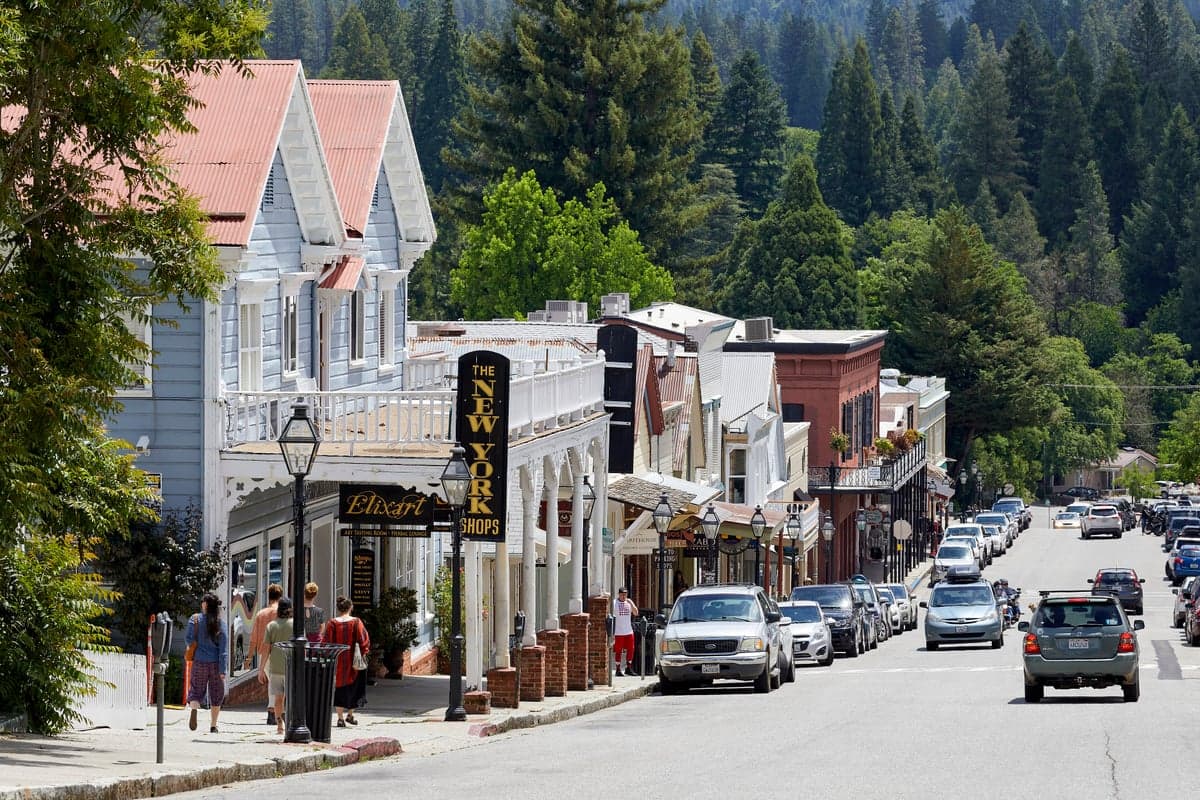
Photo: Wikipedia
Political ClimatePolitical Climate in Nevada City, CA
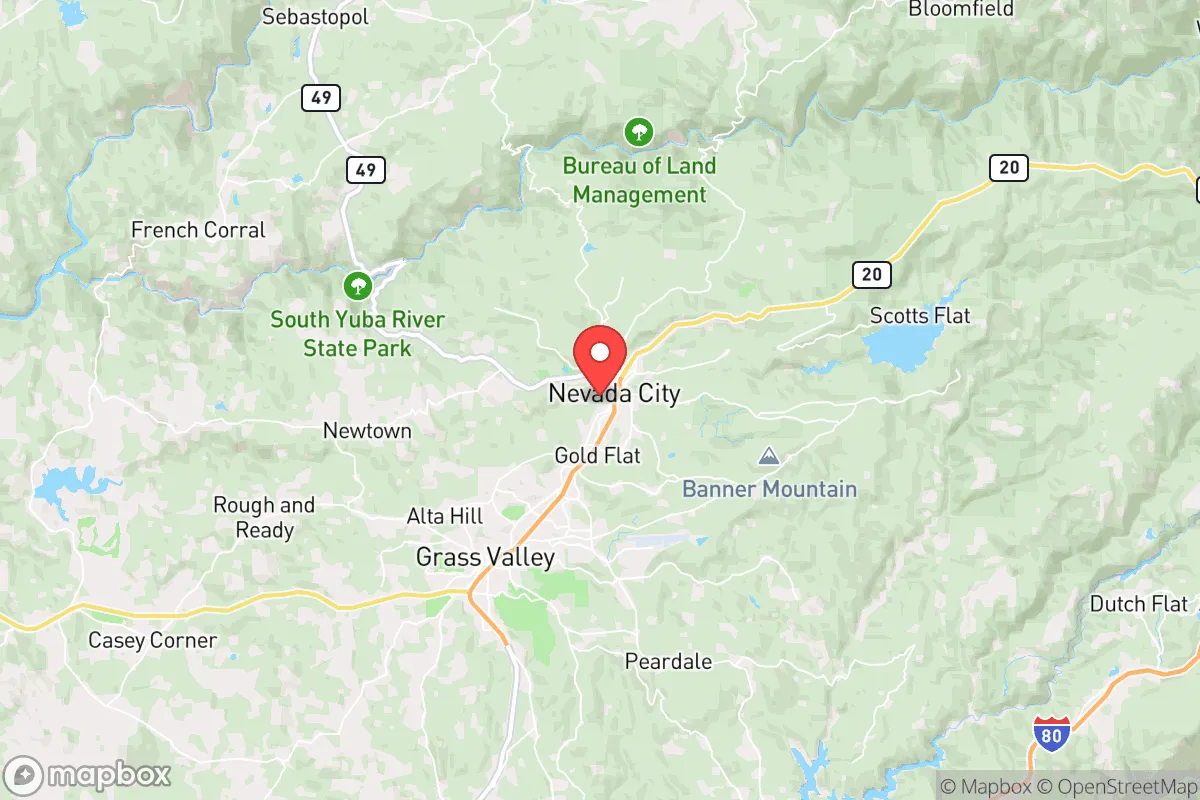
District shown is the primary district for this city’s centroid. Cities may span multiple districts.
Local Political AnalysisPolitical Analysis of Nevada City, CA
Nevada City has a political identity that’s a bit of a head-scratcher if you only look at the county-level numbers. The area carries a Cook PVI of R+2, meaning it leans slightly Republican compared to the national average, but that single stat doesn’t capture the real texture on the ground. In practice, Nevada City is a classic Western small town where a deep-rooted libertarian streak, a strong environmentalist community, and a growing progressive population all rub shoulders. The trajectory over the last decade has been a slow but steady shift leftward, especially as more remote workers and retirees from the Bay Area have moved in, but the old-guard conservative families and mining-era traditions still hold significant sway in local governance and daily life.
How it compares
Compared to California as a whole, Nevada City is a political outlier. The state’s overall Cook PVI is unknown in the data, but California is overwhelmingly Democratic at the statewide level—think D+13 or more in most presidential elections. Nevada City, by contrast, sits in Nevada County, which has voted for the Democratic presidential candidate in every election since 2008, but only by narrow margins (e.g., Biden won the county by about 4 points in 2020). The city itself is more progressive than the surrounding county, but it’s still a far cry from the deep-blue uniformity of places like San Francisco or Los Angeles. For a real contrast, drive 15 minutes east to Grass Valley, which feels noticeably more conservative—more Trump signs in yards, more pickup trucks with gun racks, and a stronger evangelical presence. Head 30 minutes south to Auburn in Placer County, and you’re in solidly Republican territory (R+11). So Nevada City sits in a kind of political buffer zone: liberal enough to have a thriving farmers’ market and a city council that talks about sustainability, but conservative enough that the local gun shop does brisk business and the county fair still features a 4-H livestock auction.
What this means for residents
For conservative residents, Nevada City is a place where you can still feel heard. The county sheriff is a Republican, the local paper gives balanced coverage, and there’s a strong tradition of fiscal conservatism in city budgeting. You won’t feel like a pariah at the grocery store, but you will notice that the city council and school board have tilted left in recent elections. For liberal residents, the upside is that your values are represented in local policy—the city has a climate action plan, a plastic bag ban, and a strong public arts program—but you’ll also have neighbors who openly disagree with you on taxes, gun rights, and land use. The practical reality is that most people here get along because they have to: the town is small enough that you see the same faces at the post office, the hardware store, and the farmers’ market. Political arguments tend to stay civil, and the biggest flashpoints are usually about development (how much, where, and for whom) rather than national culture wars.
Culturally, Nevada City stands apart from much of California by its fierce independence. The city has a long history as a gold rush town, and that “don’t tread on me” attitude still lingers. You’ll find more support for local control and skepticism of Sacramento than in most of the state. The local marijuana industry, for example, was legalized early and regulated with a light touch, reflecting both the libertarian and progressive strains in the community. Policy-wise, the city has been slower than coastal California to adopt strict housing density mandates or rent control, and the school board has resisted some of the more progressive curriculum changes seen in larger districts. For anyone moving here, the key takeaway is that Nevada City is not a political echo chamber—it’s a place where you’ll need to talk to your neighbors, listen to their perspectives, and find common ground on things like potholes and fire safety. That’s the real political climate here, and it’s why people who can’t stand the polarization of the big cities often find this town a relief.

State Political ClimatePolitical Climate in California
State Political AnalysisPolitical Environment in the State
California is a deeply blue state, with Democrats holding every statewide office and supermajorities in both legislative chambers, but that monolithic label hides a far more complex reality. The state hasn't voted Republican in a presidential race since 1988, and in 2024, Kamala Harris carried it by roughly 20 points. Yet over the last 10-20 years, the Democratic coalition has shifted: the old moderate, suburban Republican base has largely collapsed, replaced by a more progressive, urban-core coalition that is increasingly at odds with the state's vast interior. For a conservative-leaning relocator, the practical takeaway is that you will be living under one-party rule, but the experience varies wildly depending on whether you settle in coastal Los Angeles or inland Bakersfield.
Urban vs. rural divide
The political map of California is a study in extremes. The entire coastal corridor — from San Francisco and the Bay Area down through Los Angeles and San Diego — is the engine of the state's Democratic dominance. These metros are home to the state's largest population centers, tech and entertainment industries, and the most progressive activist bases. In contrast, the Central Valley and inland mountain regions are solidly red. Bakersfield (Kern County) is a Republican stronghold, voting +20 for Trump in 2024, while Fresno and Modesto are more purple but trending redder as working-class voters drift away from the Democratic brand. The real story is the exurbs: places like Temecula in Riverside County and Simi Valley in Ventura County were once reliably red but have shifted left as coastal liberals move inland for cheaper housing. Meanwhile, rural counties like Shasta (Redding) and Placer (Auburn) remain deeply conservative, with Trump winning some precincts by 40 points. The divide isn't just ideological — it's cultural. A resident of Orange County, once the heart of California conservatism, now lives in a swing county that voted for Biden in 2020 and Harris in 2024, driven by Asian-American and Latino suburbanites who lean left on social issues.
Policy environment
California's policy environment is defined by high taxes, heavy regulation, and a progressive social agenda. The state has a progressive income tax with a top marginal rate of 13.3% (the highest in the nation), a state sales tax that can exceed 10% in some cities, and some of the highest gas taxes in the country. Property taxes are capped by Prop 13, which is a major relief for long-term homeowners but creates a two-tier system that penalizes new buyers. On education, California spends more per pupil than most states but ranks near the bottom in reading and math proficiency — a paradox that frustrates both conservative and liberal parents. Healthcare is heavily regulated, with the state running its own insurance exchange (Covered California) and expanding Medi-Cal to all low-income adults regardless of immigration status. Election laws are among the most liberal: universal mail-in ballots, same-day registration, and no voter ID requirement. For a conservative, the policy environment feels like a constant headwind — high costs, limited school choice (though charter schools exist), and a regulatory apparatus that makes starting a business or building a home expensive and slow.
Recent policy direction
The last five years have seen California double down on its progressive trajectory. On gun and self-defense law, the state has passed some of the nation's strictest measures: a 2023 law effectively bans carrying firearms in most public places, and a 2024 law requires microstamping for all new handguns. On parental and education rights, the state passed AB 1955 in 2024, which prohibits school districts from requiring parental notification when a child changes their gender identity — a direct response to conservative school boards in places like Temecula and Orange County that tried to implement notification policies. On speech, California has a robust free speech tradition, but recent laws targeting hate speech and disinformation have raised concerns about chilling effects. On privacy and surveillance, the California Privacy Rights Act (CPRA) of 2020 gives residents strong data protections, but local police departments increasingly use license plate readers and drones. On medical and bodily autonomy, California is a sanctuary for abortion access, with a 2022 law protecting providers and patients from out-of-state prosecution. On property rights, the state has aggressively pursued rent control (AB 1482 caps annual increases at 5% plus inflation) and is considering a 2026 ballot measure to expand rent control statewide. On taxation, a 2024 ballot measure (Prop 5) would have made it easier to raise property taxes for affordable housing, but it failed. On voting and ballot access, the state continues to expand mail-in voting and automatic registration, with no signs of tightening. The overall direction is clear: more regulation, more state control, and a willingness to override local conservative communities on social issues.
Civil unrest & political movements
California has a long history of political activism, and recent years have been no exception. The 2020 George Floyd protests in Los Angeles and Oakland were among the largest and most destructive in the nation, with looting and arson that reshaped downtown LA's retail landscape. On the right, the "Recall Newsom" movement in 2021 gathered over 1.6 million signatures and came within 4 points of ousting the governor — a sign of deep dissatisfaction even in a blue state. Immigration politics are a constant flashpoint: California is a "sanctuary state" (SB 54), limiting local law enforcement cooperation with federal immigration authorities, and border crossings in the southern part of the state remain a political issue. Secession rhetoric is mostly a fringe phenomenon, though the "Calexit" movement has periodically surfaced. Election integrity controversies are less visible than in swing states, but conservative activists in Shasta County and Orange County have challenged voting procedures. A new resident will notice the political activism most in the form of protests — whether for climate, abortion, or immigrant rights — that are common in urban centers, while rural areas are quieter but more politically organized through local GOP clubs and Second Amendment groups.
Projection
Over the next 5-10 years, California's political trajectory is likely to remain blue, but the nature of that blue is shifting. The state is losing population to Texas, Arizona, and Idaho — a net outflow of roughly 500,000 residents since 2020 — and those leaving tend to be moderate and conservative-leaning. The people moving in are disproportionately young, college-educated, and progressive, drawn to tech and entertainment jobs. This demographic shift will likely make the state even more Democratic, but also more internally divided between a progressive coastal core and a shrinking but entrenched conservative interior. The big wild card is housing: if the state fails to build enough homes, the cost of living will continue to drive out the middle class, leaving a bifurcated population of wealthy progressives and low-income service workers. For a conservative moving in now, expect to see more rent control, more gun restrictions, and more state preemption of local conservative policies. The Republican Party in California is unlikely to regain statewide power, but it may consolidate its hold on the Central Valley and inland counties, creating a more polarized but geographically stable red-blue map.
For a new resident, the bottom line is this: California offers unmatched natural beauty, economic opportunity, and cultural diversity, but it comes with a political environment that is actively hostile to many conservative values. If you value low taxes, gun rights, school choice, and local control, you will find yourself constantly swimming against the current. If you can afford the cost of living and are willing to live in a red pocket like Bakersfield or Redding, you can carve out a comfortable life. But if you move to Los Angeles or the Bay Area, expect to be surrounded by progressive politics in your daily life — from your neighbors to your local government to the policies that shape your commute, your kids' schools, and your wallet. Choose your city carefully, because in California, the zip code determines more than just the weather.
* Values derived from national, state, county, city and local statistics and may differ in a specific area. Last updated: 2026-09-22T20:11:04.000Z
Narrative content on this page is AI-generated and may contain mistakes. Verify any details that matter before acting on them.
ReloMaps may earn a commission from affiliate links at no extra cost to you.

