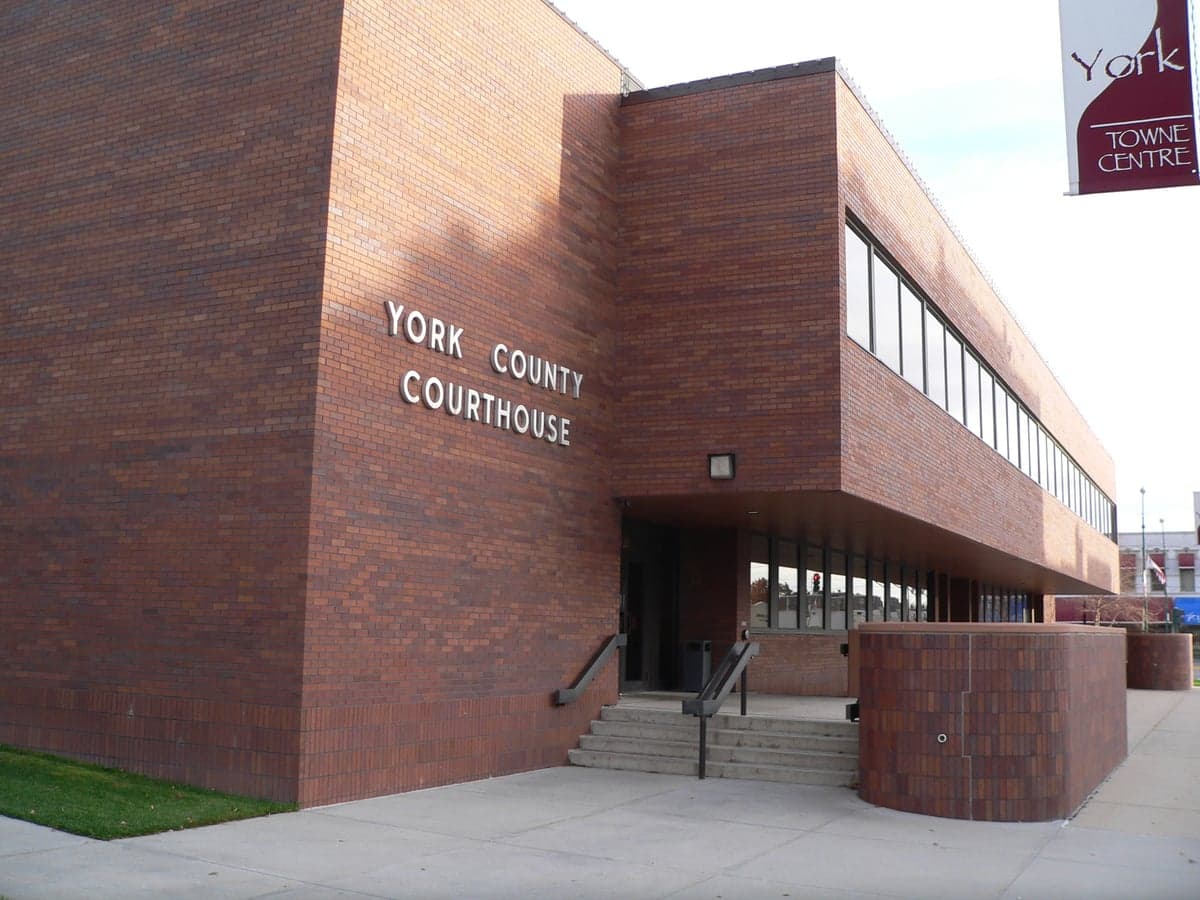
Photo: Wikipedia
Political ClimatePolitical Climate in York County
Showing district-level results — no local-only data available.
Local Political AnalysisPolitical Analysis of York County
York County, Nebraska, is one of the most reliably Republican areas in the state, with a Cook Partisan Voting Index (PVI) of R+27, meaning it votes nearly 27 points more Republican than the national average. This is a stark contrast to the state of Nebraska as a whole, which sits at R+10, and it reflects a deep, generational conservatism that has only solidified over the past two decades. The county's politics are overwhelmingly shaped by its agricultural base and small-town values, with the city of York itself acting as the conservative anchor, while the smaller towns like Waco, Benedict, and Gresham tend to be even more uniformly red, with virtually no organized Democratic presence.
How it compares
To put the R+27 rating in perspective, Nebraska's statewide R+10 already makes it a solidly red state, but York County is in a different league entirely. The county's voting patterns are more akin to the state's most conservative western panhandle counties than to the more moderate suburban areas around Omaha or Lincoln. For example, while Lancaster County (Lincoln) leans Democratic and Douglas County (Omaha) is a swing county, York County has not voted for a Democratic presidential candidate since Lyndon B. Johnson in 1964. In the 2024 election, Donald Trump carried York County with over 78% of the vote, compared to his 59% statewide. The only real variation within the county is in the city of York itself, where a handful of precincts near the college (York College) and the hospital might see a slightly higher Democratic vote share—maybe 20-25%—but even those areas are still overwhelmingly Republican. The rural townships, like those around Bradshaw and Thayer, regularly hit 85% Republican or higher.
What this means for residents
For conservative residents, the political climate is a comfortable fit. Local government, school boards, and county commissions are uniformly Republican, and policy debates tend to focus on tax cuts, agricultural regulations, and Second Amendment rights. There is little political friction in daily life, and most community events—from the county fair to church potlucks—are non-partisan in practice. For liberal residents, the reality is more isolating. There is no organized Democratic party infrastructure in the county, and progressive viewpoints are rarely represented in local media or public forums. A liberal resident might feel pressure to keep their political opinions private, especially in smaller towns like McCool Junction or Henderson, where social circles are tight and political conformity is the norm. That said, the county is not hostile; people are generally polite and neighborly, but the political homogeneity can feel stifling for those on the left.
One notable cultural distinction is the influence of the Mennonite and conservative Christian communities in and around Henderson, which reinforce the county's socially conservative bent on issues like abortion and marriage. This is a more pronounced cultural force than in the rest of Nebraska, where urban and suburban areas have become more secular. Looking ahead, the county's political trajectory is unlikely to shift much. The population is aging and stable, with little in-migration from outside the region, so the R+27 lean is baked in for the foreseeable future. For anyone moving here, the takeaway is simple: if you're conservative, you'll feel right at home; if you're liberal, you'll need to be comfortable being in a clear minority, but you won't face outright hostility. It's a place where politics is less about daily conflict and more about a shared, quiet consensus.

State Political ClimatePolitical Climate in Nebraska
State Political AnalysisPolitical Environment in the State
Nebraska is a solidly Republican state with a Cook PVI of R+10, but it’s not a monolith. The dominant coalition is a mix of rural conservatives, agricultural interests, and a growing suburban base, while the state’s two urban centers—Omaha and Lincoln—provide a persistent Democratic counterweight. Over the last 10-20 years, the state has shifted rightward in presidential races, but the 2020 and 2024 elections showed a slight tightening in the Omaha metro area, where suburban voters have become more competitive. The 2022 gubernatorial race saw Republican Jim Pillen win by 27 points, but the 2nd Congressional District (Omaha) has flipped between parties, sending Democrat Don Bacon to Congress in 2024 by a narrow margin. This isn’t a deep-red state like Oklahoma or Kansas; it’s a place where the rural-urban split creates a distinct political geography.
Urban vs. rural divide
The political map of Nebraska is a textbook case of urban-rural polarization. The eastern third of the state, anchored by Omaha (Douglas County) and Lincoln (Lancaster County), is the Democratic stronghold. Douglas County voted for Joe Biden in 2020 by 12 points, and Lincoln’s Lancaster County went for Biden by 8 points. These two counties alone account for over half the state’s population, but they’re surrounded by a sea of red. The rest of the state—from the Sandhills to the Panhandle—votes Republican by margins of 30 to 50 points. In 2024, rural counties like Cherry, Box Butte, and Scotts Bluff gave Trump over 75% of the vote. The Omaha suburbs, particularly in Sarpy County (Bellevue, Papillion, La Vista), are the key battleground: Sarpy voted for Trump by 12 points in 2024, down from 18 in 2020, showing a suburban drift toward the center. The city of Grand Island (Hall County) is a microcosm of the state—a mix of meatpacking workers and farmers, it voted for Trump by 15 points in 2024, but its growing Latino population is slowly shifting the needle. The divide isn’t just about geography; it’s about lifestyle. Rural voters prioritize agriculture, property rights, and gun access, while urban voters focus on education, healthcare, and infrastructure.
Policy environment
Nebraska’s policy environment is conservative but pragmatic. The state has no personal or corporate income tax on the horizon—the legislature passed a bill in 2024 to phase out the state income tax by 2030, though it’s still in progress. Property taxes are a perennial headache, with the state relying heavily on them to fund schools; the average effective property tax rate is 1.5%, among the highest in the Plains. The regulatory posture is business-friendly: Nebraska is a right-to-work state, and the state’s Department of Economic Development offers generous incentives for data centers and manufacturing. Education policy is a flashpoint: the state passed a school choice bill in 2023 (LB 753) that created a tax-credit scholarship program for private schools, but it was narrowly upheld after a referendum challenge. Healthcare is a mixed bag: Nebraska expanded Medicaid under the Affordable Care Act in 2020 via a ballot initiative, but the state has some of the strictest abortion laws in the region—a 12-week ban passed in 2023, with exceptions for rape, incest, and medical emergencies. Election laws are moderately restrictive: voter ID is required (passed in 2021), and the state has no-excuse absentee voting, but early voting is limited to 30 days before an election. The state’s unique unicameral, nonpartisan legislature means bills often pass with bipartisan coalitions, but the body is effectively controlled by Republicans.
Recent policy direction
Nebraska’s recent legislation points toward a conservative trajectory, but with notable exceptions. On gun rights, the state passed constitutional carry in 2023 (LB 77), allowing permitless concealed carry for anyone 21 or older. This was a major win for gun owners, and the state has no red-flag law. On parental rights, the “Parents’ Bill of Rights” (LB 1084) passed in 2024, requiring schools to notify parents about curriculum changes and allowing them to opt their children out of sex education. On education, the state banned critical race theory in K-12 schools in 2021 (LB 452), and the 2023 school choice bill expanded options for families. On speech, Nebraska has no hate speech law, and the state’s public universities have faced pressure to protect free expression. On privacy and surveillance, the state passed a data privacy law in 2024 (LB 1074) that gives residents the right to opt out of data collection, but it’s weaker than California’s. On medical and bodily autonomy, the 12-week abortion ban is the headline, but the state also passed a law in 2023 requiring parental consent for minors seeking gender-affirming care. On property rights, the state has strong eminent domain protections, and the 2024 “Landowner Bill of Rights” (LB 1200) strengthened compensation rules for pipeline easements. On taxation, the income tax phase-out is the biggest story, but it’s paired with a sales tax increase on services to offset revenue loss. On voting, the 2021 voter ID law was upheld in court, and the state has no automatic voter registration. The overall direction is toward more individual liberty on guns and taxes, but more state control on abortion and education.
Civil unrest & political movements
Nebraska is not a hotbed of civil unrest, but there have been flashpoints. In 2020, Omaha saw protests after the death of George Floyd, with some property damage and a curfew imposed by the mayor. The state’s immigrant community, particularly in the meatpacking towns of Grand Island, Lexington, and South Sioux City, has been a focus of activism. In 2023, a proposed state law to ban sanctuary cities (LB 535) sparked protests from immigrant rights groups, but the bill ultimately failed. The “Moms for Liberty” movement has a strong presence in the Omaha suburbs, pushing for book bans and parental rights in school board meetings. On the left, the Nebraska Democratic Party has focused on grassroots organizing in Omaha and Lincoln, with some success in flipping the 2nd Congressional District. Election integrity controversies have been minimal—Nebraska’s mail-in voting system is secure, and the 2020 election saw no major fraud allegations. The state’s unique electoral college system, where the 2nd Congressional District gets its own electoral vote, has been a target for national Republicans, who tried to change it to a winner-take-all system in 2023 but failed. A new resident would notice the lack of visible political tension in daily life—most Nebraskans are polite and avoid political arguments in public, but the divide is real in private conversations.
Projection
Over the next 5-10 years, Nebraska’s political trajectory is likely to remain conservative, but with a slow shift toward the center in the Omaha metro area. Demographic trends are key: the state’s population is growing slowly (about 0.5% annually), with most growth in Douglas and Sarpy counties. The Latino population is growing rapidly, especially in Grand Island and the Panhandle, and this group leans Democratic but is not monolithic—many are Catholic and socially conservative. In-migration from California and Colorado is modest, but it’s concentrated in Lincoln and Omaha, bringing more moderate voters. The rural population is aging and shrinking, which will reduce the Republican base over time. The 2024 election showed that the 2nd Congressional District is now a true toss-up, and by 2030, it could be solidly Democratic. The state legislature will remain Republican, but the unicameral system means moderate Republicans and Democrats can still pass bills. The income tax phase-out, if completed, will make Nebraska more attractive to businesses, but it will also strain funding for schools and roads. A new resident moving in now should expect a state that is reliably Republican but not deeply polarized—a place where you can live your life without constant political noise, but where the culture wars are simmering just below the surface.
For a new resident, the bottom line is this: Nebraska offers a conservative policy environment with low taxes, strong gun rights, and a business-friendly climate, but it’s not a hardline state. The urban-rural divide means your experience will vary dramatically depending on where you live. If you’re in Omaha or Lincoln, you’ll find a mix of progressive and conservative neighbors, with good schools and a vibrant economy. If you’re in a small town like Scottsbluff or Norfolk, you’ll find a more traditional, community-oriented life. The state’s political stability is a plus—no major unrest, no dramatic policy swings—but the slow demographic shift means the political landscape will look different in a decade. For conservatives, it’s a safe bet. For liberals, it’s a place where you can live comfortably in the cities, but you’ll be in the minority statewide. Either way, Nebraska is a state where politics doesn’t dominate daily life—it’s just part of the background.
* Values derived from national, state, county, city and local statistics and may differ in a specific area. Last updated: 2026-07-27T08:33:01.000Z
Narrative content on this page is AI-generated and may contain mistakes. Verify any details that matter before acting on them.
ReloMaps may earn a commission from affiliate links at no extra cost to you.

