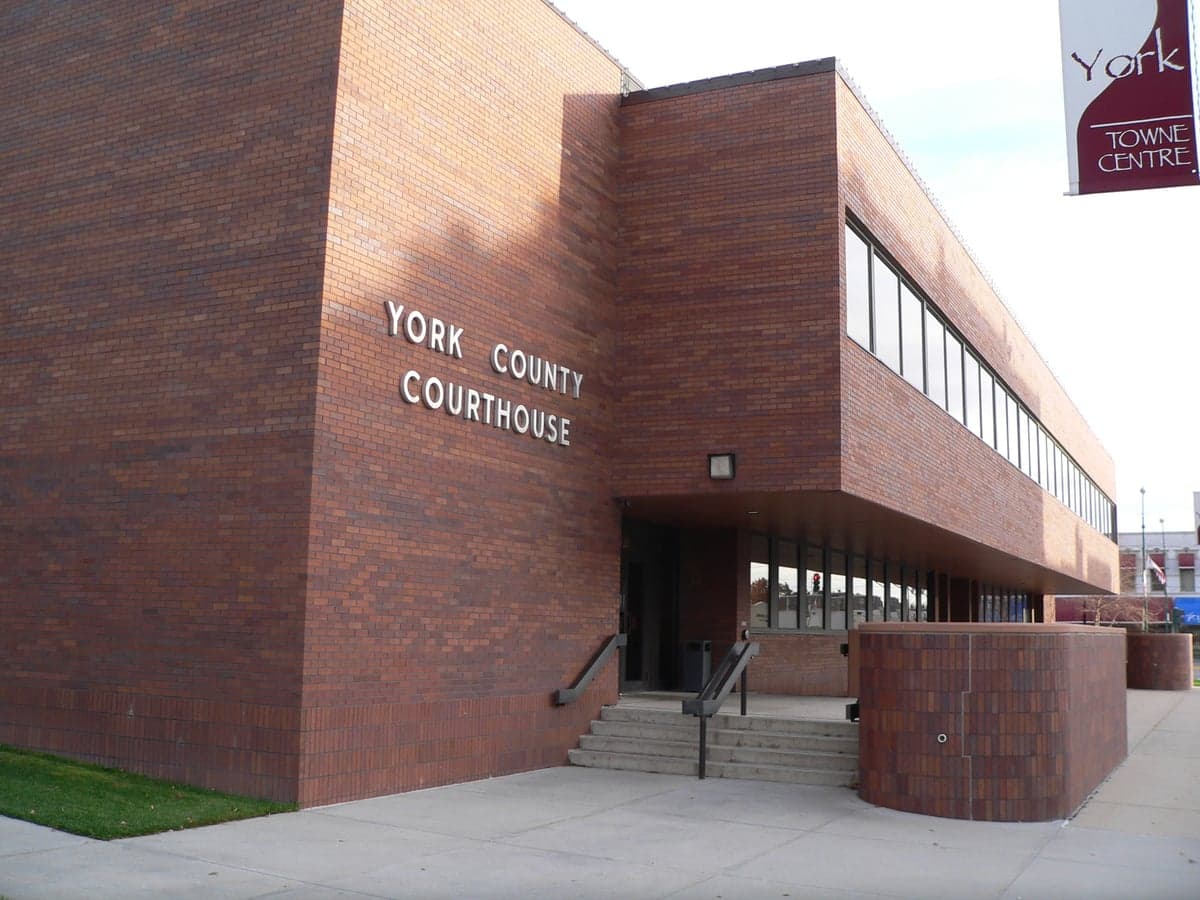
Photo: Wikipedia
Demographics of York County
Affluence Level in York County
A middle-class area roughly in line with national averages across income, home values, education, and employment.
People of York County
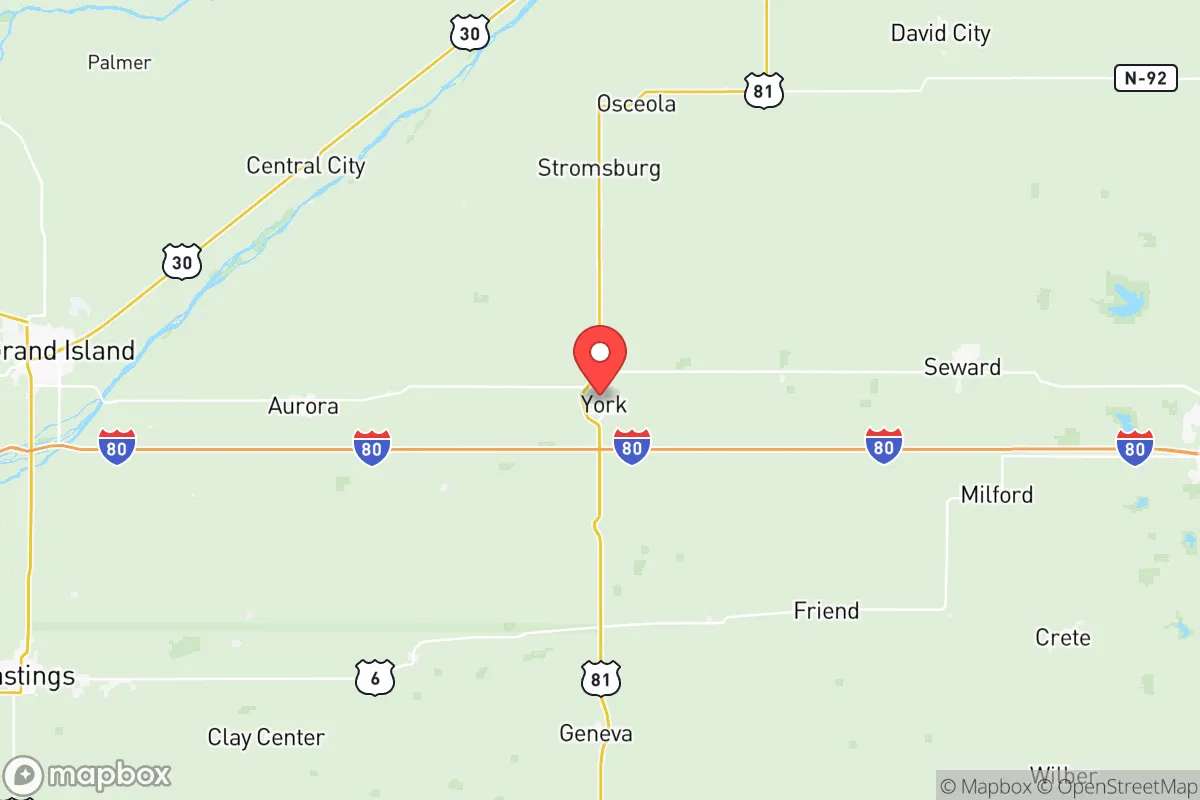
York County, Nebraska, is a predominantly white, rural community of 14,231 residents where agricultural roots and a strong sense of local identity define daily life. With a population density of roughly 15 people per square mile, the county is characterized by its small towns—York, the county seat and largest city, along with Henderson, McCool Junction, Waco, Gresham, and Thayer—where the population is 88.5% white, 6.0% Hispanic, and 1.2% Black, with a foreign-born share of just 1.6%. The area’s distinctive identity is shaped by a history of German and Czech settlement, a deeply ingrained work ethic tied to the land, and a conservative social fabric that remains largely intact despite modest demographic shifts.
Settlement & growth (pre-1960)
Before American settlement, the land that is now York County was part of the traditional territory of the Pawnee and Otoe-Missouria nations, who used the region for seasonal hunting and farming along the Big Blue River and its tributaries. The U.S. government forcibly removed these tribes through treaties and land cessions in the 1850s, opening the area to homesteaders under the 1862 Homestead Act. The first wave of settlers arrived in the late 1860s and 1870s, primarily native-born Americans from the Midwest—especially Iowa, Illinois, and Ohio—who claimed 160-acre parcels for dryland farming. The town of York was platted in 1869 as a stop on the Burlington and Missouri River Railroad, quickly becoming the county’s commercial and governmental hub.
The most significant immigrant wave came between 1870 and 1900, when German-speaking settlers from Russia—often called Volga Germans—arrived in large numbers. These families, who had lived in the Volga River region of Russia for generations under Catherine the Great’s promises of land and religious freedom, were drawn to Nebraska’s cheap, fertile prairie. They established the town of Henderson in 1878, which became the cultural and religious heart of the Volga German community in York County. The town’s Evangelical Lutheran and Mennonite churches, along with its German-language newspapers and schools, preserved a distinct identity well into the 20th century. A smaller but notable wave of Czech immigrants also settled in the county, particularly around Waco and Gresham, where they founded Catholic parishes and fraternal organizations like the Czech-Slovak Protective Society.
By 1900, York County’s population had surged to over 18,000, driven by railroad expansion and the agricultural boom in wheat, corn, and livestock. The county’s economy diversified with the establishment of the York State Bank (1882) and the York College (1890), a private liberal arts school affiliated with the Churches of Christ. The Dust Bowl and Great Depression of the 1930s hit the county hard, causing a population decline that continued through the 1950s as mechanization reduced the need for farm labor. Many young people left for cities like Lincoln and Omaha, but the core German and Czech communities remained anchored in towns like McCool Junction and Thayer, where family farms passed down through generations.
Modern era (post-1965)
The 1965 Hart-Cellar Act, which eliminated national-origin quotas, had a minimal direct impact on York County due to its remote, agricultural character. The foreign-born population today stands at just 1.6%, far below the national average of 13.7%. The most notable demographic change since the 1970s has been the growth of the Hispanic population, which rose from less than 1% in 1980 to 6.0% by 2020. This growth is driven primarily by Mexican and Central American immigrants who came to work in meatpacking plants, dairy operations, and crop harvesting—industries that expanded in the region after the 1990s. The Hispanic community is concentrated in York, where a small but visible presence of Spanish-language services and a Catholic Mass in Spanish have emerged, though no formal ethnic enclave has formed.
Domestic migration patterns have been more influential than immigration. Since the 1970s, York County has experienced a steady outflow of young adults seeking education and employment in larger cities, offset by a modest inflow of retirees and remote workers drawn to the county’s low cost of living and slower pace. The population peaked at 18,000 in 1900 and has since declined to 14,231, with the most significant losses occurring in the 1980s farm crisis. Suburbanization has been limited: the county’s largest town, York, has grown slightly to about 8,000 residents, while smaller towns like Henderson (pop. 1,000) and Waco (pop. 300) have held steady or shrunk. The Black population remains very small at 1.2%, largely consisting of families connected to the University of Nebraska–Lincoln’s extension programs or the state prison system. East/Southeast Asian residents make up 0.5%, primarily through medical professionals at the York General Hospital or academic staff at York College. The Indian-subcontinent population is effectively zero.
Culturally, the county remains deeply conservative, with a strong emphasis on church attendance, volunteerism, and local governance. The Volga German heritage is still visible in Henderson’s annual Heritage Days festival and the town’s historic brick streets, while Czech traditions survive in Waco’s kolache bake-offs and polka dances. The county’s educational attainment is below the national average—23.9% of adults hold a bachelor’s degree or higher, compared to 33.7% nationally—reflecting the agricultural economy’s lower demand for college credentials.
The future
York County’s population is projected to remain stable or decline slightly over the next 10–20 years, as the aging white population (median age 42) is not fully replaced by younger families. The Hispanic share is likely to grow gradually, potentially reaching 8–10% by 2040, as agricultural employers continue to recruit immigrant labor and as second-generation families remain in the area. However, the county’s low housing stock and limited job diversity outside of farming, manufacturing, and healthcare will constrain significant in-migration. The towns of York and Henderson will likely absorb most new residents, while smaller hamlets like Gresham and Thayer may continue to lose population. The county’s cultural identity will remain predominantly white and conservative, with the German and Czech heritage preserved through festivals and local history museums, but with a slowly growing Hispanic influence in schools and churches.
For someone moving in now, York County offers a stable, low-crime, family-oriented environment where neighbors know each other and community institutions—churches, schools, and the county fair—are central to life. The population is not becoming more diverse in a dramatic sense, but it is becoming slightly more Hispanic, which will add new cultural layers to a historically homogeneous region. The county’s future is one of gradual, modest change rather than transformation, making it a predictable choice for those seeking a quiet, rural lifestyle rooted in agricultural tradition.

* Values derived from national, state, county, city and local statistics and may differ in a specific area. Last updated: 2026-07-27T08:33:01.000Z
Narrative content on this page is AI-generated and may contain mistakes. Verify any details that matter before acting on them.
ReloMaps may earn a commission from affiliate links at no extra cost to you.

