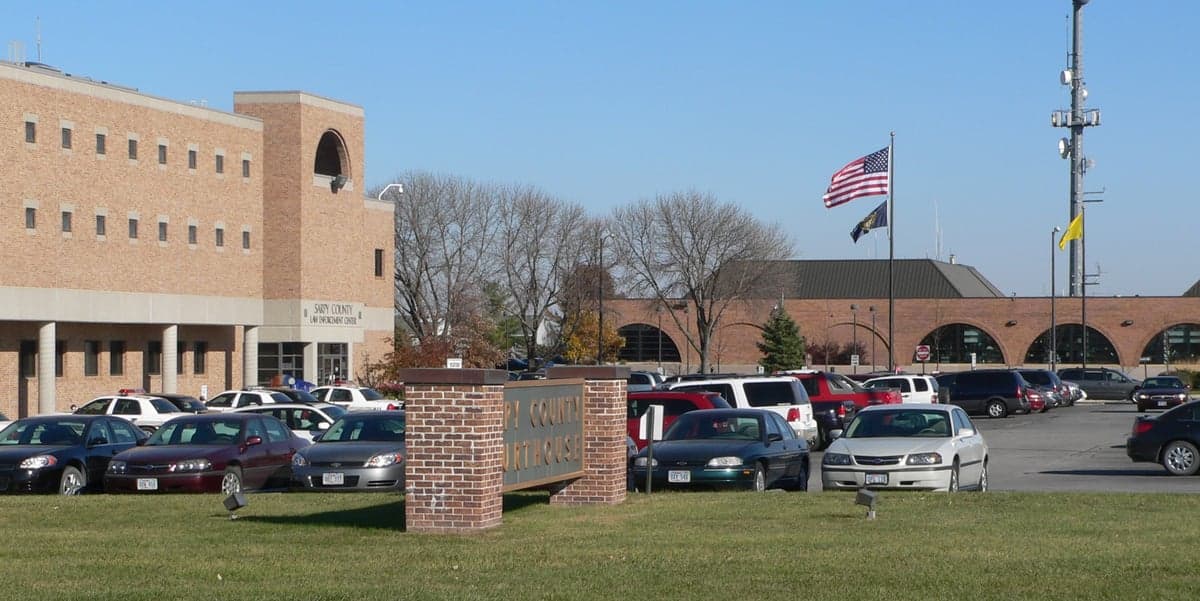
Photo: Wikipedia
Political ClimatePolitical Climate in Sarpy County
Showing district-level results — no local-only data available.
Local Political AnalysisPolitical Analysis of Sarpy County
Sarpy County has undergone a dramatic political shift over the past decade, transforming from a reliably red suburban stronghold into a competitive battleground that now leans Democratic. The county’s Cook Partisan Voting Index (PVI) of D+3 marks a stark departure from the rest of Nebraska, which sits at R+10. This isn’t a fluke—it’s the result of steady in-migration from Omaha and Lincoln, a growing population of younger families and professionals, and a suburban electorate that has increasingly split from the state’s rural conservative base. In 2020, Joe Biden became the first Democrat to carry Sarpy County since 1964, and local races have followed suit, with Democrats now winning county board seats and state legislative districts that were once safely Republican.
How it compares
The contrast between Sarpy County and Nebraska as a whole is one of the most pronounced urban-rural divides in the Great Plains. While the state’s vast agricultural regions and smaller cities like Scottsbluff and Norfolk vote heavily Republican, Sarpy County’s political geography is far more nuanced. Within the county, Bellevue and Papillion have become the epicenters of Democratic gains, with precincts near Offutt Air Force Base and the new mixed-use developments along Highway 370 swinging blue by double digits in recent elections. Meanwhile, Gretna and the rural eastern fringes near the Platte River remain reliably red, often voting 60-40 or more for Republican candidates. The swing precincts are concentrated in the central corridor around La Vista and Ralston, where moderate voters—many of them former Republicans—have shifted toward Democrats on issues like education funding, infrastructure, and abortion rights. This internal split means Sarpy County is now a microcosm of national suburban politics, where the GOP’s rural base is offset by a growing Democratic-leaning suburban bloc.
What this means for residents
For conservative residents, the political shift means they can no longer take local elections for granted. Republican candidates still win in Gretna and the county’s unincorporated areas, but they must now campaign actively in Bellevue and Papillion, where Democratic turnout has surged. For liberal residents, the change has been empowering—they now have a real voice in county government, with Democrats holding seats on the Sarpy County Board and in the Nebraska Legislature for districts covering Bellevue and La Vista. In practice, this has led to more balanced policy debates: the county has maintained its low property tax rates (among the lowest in the metro area) while also funding new parks, sidewalks, and public transit connections to Omaha. The political tension is most visible in school board races, where debates over curriculum and library books have become heated, reflecting the broader national divide. But overall, the county’s governance remains pragmatic—neither party has pushed extreme agendas, and the local economy continues to thrive with a mix of defense contractors, healthcare, and retail.
Culturally, Sarpy County still feels more Midwestern than coastal, with a strong sense of community and a love for high school football and county fairs. But the political shift has brought new dynamics: the annual Sarpy County Democratic Party picnic now draws hundreds, while the local GOP has had to adapt to a more diverse electorate. The presence of Offutt Air Force Base, home to U.S. Strategic Command, injects a steady stream of military families from across the country, many of whom lean moderate or liberal. This has made the county more open to discussions about climate resilience (the Platte River floodplain is a constant concern) and veterans’ services, while still maintaining a strong pro-business, low-regulation ethos. For anyone moving here, the key takeaway is that Sarpy County is no longer a predictable Republican suburb—it’s a place where your vote truly matters, and where the political future is being written by the people moving into those new subdivisions along Highway 370.

State Political ClimatePolitical Climate in Nebraska
State Political AnalysisPolitical Environment in the State
Nebraska is a solidly Republican state with a Cook PVI of R+10, but that number masks a more complicated reality: it’s a state where a deep-red rural expanse coexists with a reliably blue urban core in Omaha and a swingier Lincoln area. Over the last 20 years, the state has shifted rightward in presidential races—Trump won it by 19 points in 2024, up from 15 in 2020—but the real story is the growing urban-rural chasm, with Douglas County (Omaha) becoming more Democratic while the rest of the state hardens its GOP allegiance. For a relocator, this means you’ll find a conservative policy environment at the state level, but your day-to-day political experience will vary dramatically depending on whether you land in Omaha, Lincoln, or a small town like Scottsbluff or Kearney.
Urban vs. rural divide
The political map of Nebraska is essentially three distinct zones. Douglas County (Omaha) is the Democratic stronghold, voting for Biden by 12 points in 2020 and Harris by a similar margin in 2024. Omaha’s 2nd Congressional District is the only competitive seat in the state—it flipped to Biden in 2020 and back to Trump in 2024, reflecting its swingy nature. Lancaster County (Lincoln) is more purple, voting for Trump by just 3 points in 2024 after backing Biden by 2 in 2020. The rest of the state—places like Scottsbluff in the Panhandle, Kearney in the central Platte Valley, and Norfolk in the northeast—routinely votes 70-80% Republican. The divide isn’t just about population density; it’s cultural. Omaha’s economy is driven by finance, insurance, and tech (think Berkshire Hathaway and Mutual of Omaha), while rural areas depend on agriculture, ranching, and manufacturing, creating a natural split on issues like trade policy, environmental regulation, and social spending.
Policy environment
Nebraska’s state-level policy is consistently conservative, shaped by a unicameral, nonpartisan legislature that nonetheless operates along party lines. The state has a flat income tax rate of 5.84% (with a scheduled phase-down to 3.99% by 2027), no tax on Social Security benefits, and a relatively low property tax burden compared to neighboring states like Kansas and Iowa. There is no state sales tax on groceries or prescription drugs. Education policy is a hot topic: the state passed a school choice law in 2023 (LB 753) that created a dollar-for-dollar tax credit for donations to scholarship-granting organizations, effectively a voucher program. Public school funding remains a perennial debate, with rural districts often feeling shortchanged. On healthcare, Nebraska expanded Medicaid under the Affordable Care Act in 2020 via a ballot initiative, but the state has not pursued a state-based exchange or public option. Election laws are moderately restrictive: voter ID is required (passed in 2021, effective 2024), and the state has a 30-day residency requirement for registration. Nebraska is one of only two states (along with Maine) that splits its Electoral College votes by congressional district, a quirk that gives Omaha’s 2nd District outsized national attention.
Recent policy direction
The last five years have seen Nebraska move decisively rightward on a range of fronts. Gun laws: In 2023, the legislature passed a permitless carry law (LB 77), allowing any law-abiding adult to carry a concealed firearm without a permit. The state already had a strong preemption law preventing local gun ordinances. Parental and education rights: A 2023 law (LB 574) banned gender-affirming care for minors and restricted abortion after 12 weeks, with exceptions for rape, incest, and medical emergencies. The same bill also required schools to notify parents of any changes to a student’s health or well-being, a flashpoint in the culture war. Property rights: Nebraska has a strong right-to-farm law that limits nuisance lawsuits against agricultural operations, and it’s a “Dillon’s Rule” state, meaning local governments only have powers explicitly granted by the state—a check on local zoning and regulation. Taxation: The 2024 legislative session passed a major property tax relief package (LB 34) that increased the state’s property tax credit and capped local levy growth, though critics argue it shifts the burden to sales and income taxes. Voting access: The voter ID law, combined with a 2024 law (LB 106) that shortened the early voting window from 35 to 30 days, has tightened ballot access, though Nebraska still allows no-excuse absentee voting. On privacy and surveillance, the state has no comprehensive data privacy law, and a 2023 bill to restrict government use of facial recognition failed.
Civil unrest & political movements
Nebraska is not a hotbed of civil unrest, but it has seen organized activism on both sides. In 2020, Omaha was the site of significant Black Lives Matter protests following the death of George Floyd, with some clashes between demonstrators and police. The state’s immigrant community, concentrated in Omaha’s South Side and in meatpacking towns like Grand Island and Lexington, has been a focal point for immigration politics. In 2023, a bill (LB 535) that would have banned sanctuary cities failed, but the issue remains live—several rural counties have passed symbolic resolutions declaring themselves “Second Amendment sanctuaries” or opposing federal land management. Election integrity controversies have been relatively muted compared to states like Arizona or Georgia, though the 2020 and 2024 cycles saw some local GOP officials question the security of mail-in voting. The most visible political movement in recent years has been the “school choice” push, which mobilized both conservative advocacy groups and rural public school defenders. A new resident in Omaha might notice occasional protests at the state capitol in Lincoln, but in smaller towns like North Platte or Beatrice, politics is more likely to surface in letters to the editor and county board meetings than in street demonstrations.
Projection
Over the next 5-10 years, Nebraska’s political trajectory points toward continued polarization. Omaha’s 2nd District will remain the only competitive seat in the state, and its swingy nature means it could flip again in 2028 depending on the national environment. The urban-rural divide will likely deepen as Omaha’s population grows (it’s the fastest-growing major city in the state) and its economy diversifies into tech and biotech, while rural counties continue to lose population. In-migration is modest—Nebraska ranks in the middle of states for net domestic migration—but the newcomers who do arrive tend to settle in Omaha or Lincoln, slowly nudging those areas leftward. At the state level, the GOP supermajority in the legislature is likely to hold, meaning continued conservative policy on taxes, guns, and social issues. The property tax debate will be a perennial fight, as will school funding, especially as the voucher program expands. One wild card: the state’s nonpartisan unicameral system can produce unexpected coalitions—in 2023, a filibuster by progressive senators blocked a near-total abortion ban, showing that the legislature isn’t a rubber stamp. A relocator moving in now should expect a state where the political center of gravity is firmly right, but where local elections in Omaha and Lincoln can produce genuine surprises.
For a new resident, the bottom line is this: if you’re conservative, Nebraska offers a policy environment that aligns with your values—low taxes, strong gun rights, school choice, and a culture of self-reliance. If you’re liberal, you’ll find a welcoming community in Omaha or Lincoln, but you’ll be swimming against the current at the state level. The practical takeaway is that your experience will be shaped more by your choice of city or town than by the state’s overall lean. In Omaha, you can find a vibrant, diverse city with a competitive political scene; in Scottsbluff or Kearney, you’ll be in deep-red territory where conservative values are the baseline. Either way, Nebraska’s politics are stable, predictable, and unlikely to surprise you—which, for many relocators, is exactly the point.
* Values derived from national, state, county, city and local statistics and may differ in a specific area. Last updated: 2026-07-23T11:35:36.000Z
Narrative content on this page is AI-generated and may contain mistakes. Verify any details that matter before acting on them.
ReloMaps may earn a commission from affiliate links at no extra cost to you.

