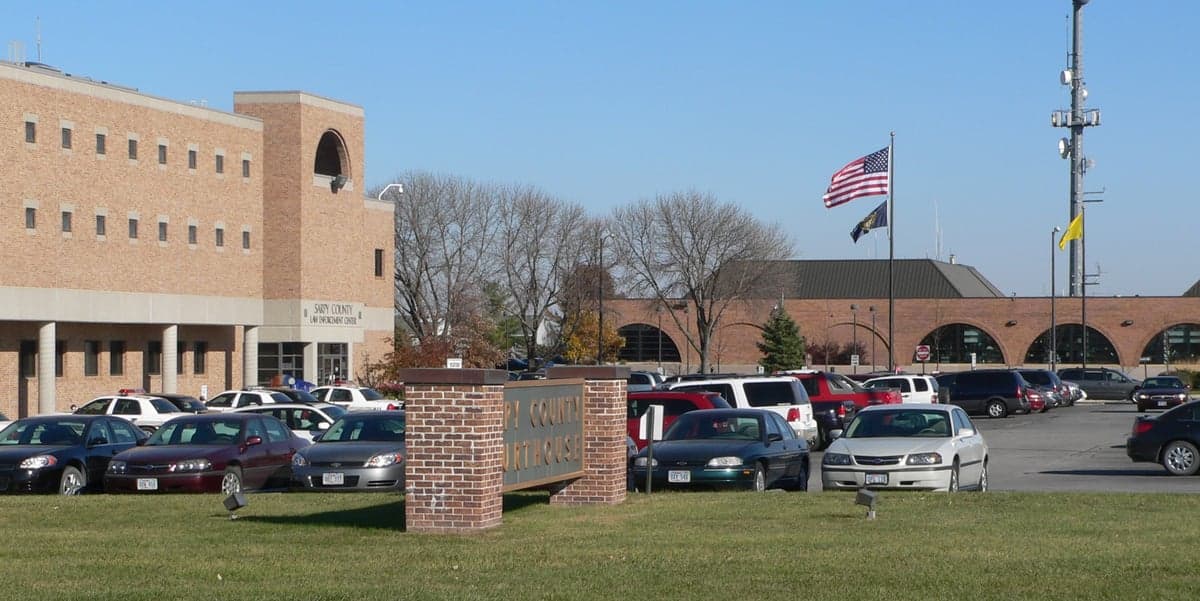
Photo: Wikipedia
Personal Sovereignty in Sarpy County
Moderate friction. Expect trade-offs in some aspect of personal liberty and independence.
What does Personal Sovereignty tell us?
Personal Sovereignty measures your capacity for self-reliance and independence with minimal government friction. Higher scores mean fewer barriers between you and the way you want to live... but it assumes you have the space you need and good neighbors.
What does this tell us?
Personal Sovereignty measures your capacity for self-reliance and independence with minimal government friction. Higher scores mean fewer barriers between you and the way you want to live... but it assumes you have the space you need and good neighbors.
State Policy
Energy independence: Importer (35% of energy produced in-state)
Personal Liberty

Personal Liberty Analysis
Sarpy County, Nebraska, offers a notably high degree of personal sovereignty compared to many suburban areas in the Midwest, largely due to Nebraska’s preemption laws and a state-level political culture that favors individual choice. While the county is part of the Omaha-Council Bluffs metropolitan area and subject to some urban-style regulations, its residents enjoy a lighter regulatory touch than those in neighboring Douglas County (Omaha) or across the river in Iowa. The autonomy environment here is best described as "pragmatic libertarian" — the state and county generally stay out of personal decisions regarding self-defense, property use, and family matters, while still maintaining standard public safety and zoning frameworks. For a relocation reader prioritizing freedom, Sarpy County represents a strong balance of suburban convenience and personal independence.
Tax burden and regulatory posture: How Sarpy County compares to Omaha and Lincoln
Sarpy County’s tax burden is moderate by Nebraska standards but favorable when compared to the immediate urban core. The county’s property tax rate hovers around 1.8% of assessed value, slightly below Douglas County’s average of 2.0% and well below the 2.3% seen in some Lincoln precincts. Nebraska has no state income tax on Social Security benefits and offers a flat state income tax rate of 5.84% as of 2026, which is competitive for the region. The regulatory posture in unincorporated areas of Sarpy County — such as Gretna and Springfield — is notably lighter than in the city limits of Bellevue or Papillion. For example, Gretna has no business license requirement for home-based enterprises under certain size thresholds, while Papillion requires a $50 annual permit. The county also benefits from Nebraska’s strong preemption laws: no city or county in Sarpy can impose stricter regulations than the state on firearms, occupational licensing, or agricultural operations. This means a resident in La Vista or Offutt AFB enjoys the same baseline regulatory freedom as someone in rural Nebraska, despite being minutes from downtown Omaha.
Self-defense and gun law specifics: What Sarpy County residents can and cannot do
Nebraska is a constitutional carry state, and Sarpy County fully respects that. As of 2023, any law-abiding adult 21 or older can carry a concealed firearm without a permit. For those who want reciprocity with other states, a concealed handgun permit is available through the Sarpy County Sheriff’s Office — the process takes about 30 days and costs $100. The county has no additional firearm restrictions beyond state law, meaning no magazine capacity limits, no assault weapon bans, and no waiting periods. Bellevue and Papillion both have city ordinances that prohibit discharging firearms within city limits except at approved ranges, but this is standard for suburban areas. In unincorporated areas near Gretna and Springfield, target shooting on private property is generally allowed as long as it’s done safely and not within 100 yards of an occupied dwelling. Stand-your-ground laws apply statewide, and Nebraska’s castle doctrine explicitly covers vehicles and occupied structures. For a reader who prioritizes self-defense rights, Sarpy County is one of the most permissive suburban environments in the Great Plains — only Wyoming and South Dakota offer fewer restrictions among neighboring states.
Self-reliance and homesteading viability: Lot sizes, zoning, and off-grid feasibility
Homesteading viability in Sarpy County varies dramatically by location. The eastern half of the county, including Bellevue and Papillion, is largely suburban with minimum lot sizes of 6,000 to 8,000 square feet and standard HOA covenants that restrict livestock, outdoor storage, and alternative energy systems. However, the western and southern portions of the county — particularly around Gretna, Springfield, and the unincorporated area of Richfield — offer significantly more flexibility. In these areas, agricultural zoning allows lots as small as 2 acres for hobby farms, and there are no county-level restrictions on rainwater collection, composting toilets, or solar panel installation. Off-grid feasibility is highest in the Richfield area, where properties often have well water and septic systems already in place. Nebraska’s net metering law requires utilities to credit solar producers at the retail rate, making grid-tied solar a viable option even in suburban subdivisions. The county does not have any building codes that explicitly prohibit straw bale or earth-sheltered construction, though standard electrical and plumbing permits are required. For a family wanting to raise chickens, keep a few goats, and grow most of their own food, a 5-acre parcel near Gretna offers a realistic path — far more feasible than anything inside the Omaha city limits.
Personal liberties: Parental rights, medical autonomy, speech, and property
Nebraska has strong protections for parental rights in education and healthcare. The state’s Parents’ Bill of Rights, enacted in 2023, guarantees that parents can review all instructional materials, opt their children out of any curriculum they object to, and consent to any medical treatment provided by schools. Sarpy County school districts — including Papillion-La Vista, Bellevue Public Schools, and Gretna Public Schools — have all adopted policies that align with this law. Medical autonomy is similarly robust: Nebraska does not have a state-level vaccine mandate for adults or children, and the state’s 2023 law prohibiting COVID-19 vaccine mandates by employers and government entities remains in effect. Speech protections are strong under both the Nebraska Constitution and the state’s anti-SLAPP statute, which provides a mechanism to dismiss frivolous lawsuits aimed at silencing public participation. Property rights are reinforced by Nebraska’s private property rights protection act, which requires government to compensate landowners for any regulatory taking that reduces property value by more than 50%. In practice, this means Sarpy County’s planning department is cautious about imposing restrictions that could trigger compensation claims — a fact that benefits anyone looking to build a workshop, install a fence, or subdivide land.
Overall, Sarpy County ranks among the top 20% of U.S. counties for personal sovereignty when measured by tax burden, gun freedom, and regulatory flexibility. It offers a distinctly different environment from the more restrictive policies found in Omaha proper or across the river in Iowa. For a conservative-leaning individual or family who values self-reliance and minimal government interference, the western and southern parts of the county — particularly Gretna, Springfield, and Richfield — provide the highest degree of autonomy while still being within a 20-minute drive of Omaha’s jobs and amenities. The trade-off is that the eastern suburbs like Bellevue and Papillion have more HOAs and zoning restrictions, but even there, state preemption laws ensure that core freedoms — carrying a firearm, homeschooling, and running a home business — remain intact. For a relocation decision, Sarpy County represents a rare combination: suburban infrastructure with a rural-libertarian legal framework.

* Values derived from national, state, county, city and local statistics and may differ in a specific area. Last updated: 2026-07-23T11:35:36.000Z
Narrative content on this page is AI-generated and may contain mistakes. Verify any details that matter before acting on them.
ReloMaps may earn a commission from affiliate links at no extra cost to you.

