Photo: Wikipedia
Political ClimatePolitical Climate in Jefferson County
Showing district-level results — no local-only data available.
Local Political AnalysisPolitical Analysis of Jefferson County
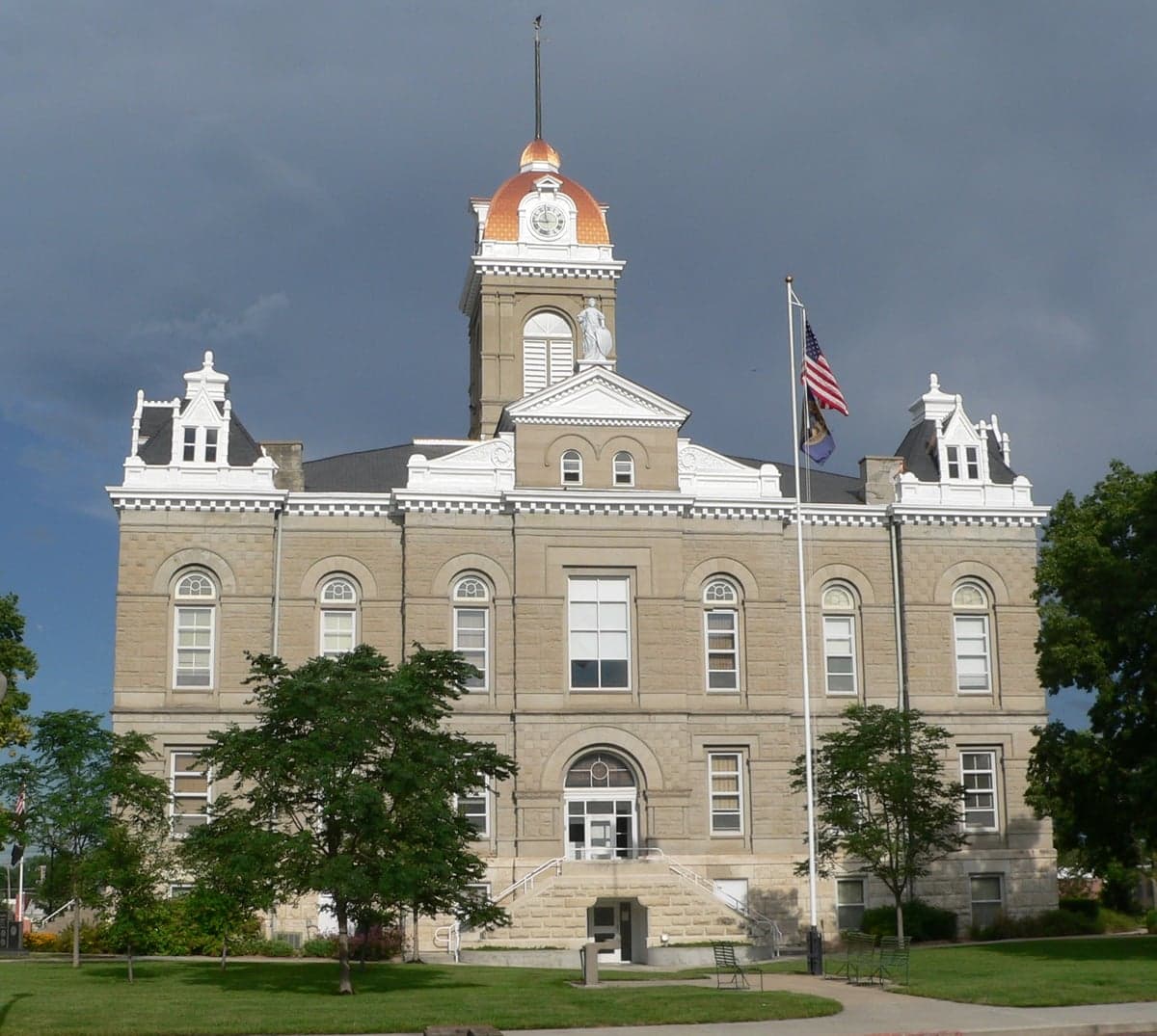
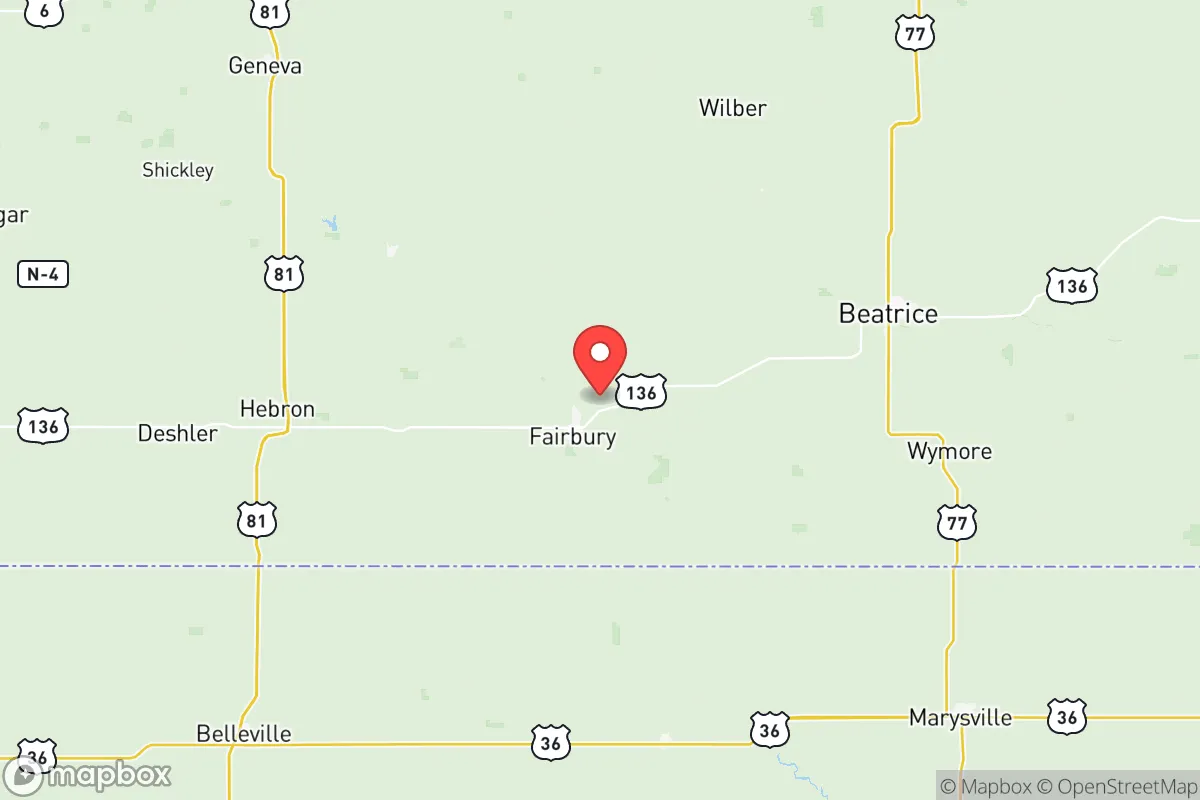
Jefferson County, Nebraska, is one of the most reliably Republican areas in the state, with a Cook Partisan Voting Index (PVI) of R+27, meaning it votes about 27 points more Republican than the national average. This is a deep, stable red that has only gotten redder over the past two decades. The county seat, Fairbury, anchors the county’s politics, but there’s a subtle urban-rural split: Fairbury itself, with its population of about 3,900, has a few precincts that occasionally vote within 10 points of the statewide average, while the small towns of Diller, Daykin, and Reynolds are reliably +30 or more Republican. The county’s trajectory is toward even deeper red, driven by out-migration of younger, more moderate voters and the consolidation of agricultural and manufacturing interests.
How it compares
Compared to Nebraska as a whole, which has a Cook PVI of R+10, Jefferson County is nearly three times as conservative by that metric. The state’s R+10 rating already makes it one of the most Republican states in the nation, but Jefferson County is in a different league. In the 2024 presidential election, the county gave Donald Trump over 78% of the vote, while the state as a whole gave him about 60%. The gap is even wider in down-ballot races: state legislative districts covering Jefferson County have gone unopposed by Democrats in recent cycles, while statewide races like the U.S. Senate seat still see competitive Democratic campaigns in Omaha and Lincoln. The county’s R+27 PVI is closer to the panhandle’s most conservative counties than to the state’s average, meaning Jefferson County is a political outlier even within a red state.
What this means for residents
For conservative residents, the political climate is a comfortable fit. Local government, school boards, and county commissions are uniformly Republican, and policy debates tend to focus on tax rates, agricultural regulations, and infrastructure rather than social issues. For liberal residents, the reality is more isolating. There is no organized Democratic party presence in the county, and progressive viewpoints are rarely voiced in public forums. A liberal resident in Fairbury might find common ground with neighbors on local issues like road maintenance or the hospital levy, but national politics are a minefield. The practical effect is that political engagement is low — voter turnout in primaries is often below 30% — because the general election outcome is a foregone conclusion. This can feel like a double-edged sword: low political drama, but also low accountability for incumbents.
One cultural distinction worth noting is the county’s relationship with the state’s larger cities. Jefferson County residents often feel overlooked by the state government in Lincoln, which they see as dominated by Omaha and Lincoln interests. This fuels a localist, anti-establishment streak that sometimes puts the county at odds with the state’s Republican leadership. For example, the county has been a vocal supporter of property tax relief measures that shift funding away from state-level programs, a position that aligns with its deep-red lean but also reflects a pragmatic, rural-first worldview. The political reality here is less about ideology and more about survival: the county’s population has been declining for decades, and the politics reflect a community focused on keeping its schools open, its main street alive, and its taxes low. Whether you’re conservative or liberal, that’s the lens through which everything is viewed.

State Political ClimatePolitical Climate in Nebraska
State Political AnalysisPolitical Environment in the State
Nebraska is a solidly Republican state with a Cook PVI of R+10, but that number masks a deeply layered political reality. The state hasn't voted for a Democratic presidential candidate since Lyndon Johnson in 1964, and Republicans hold every statewide office and a supermajority in the legislature. However, the past 20 years have seen a slow but steady shift: the Omaha metro area has become more Democratic, while the rest of the state has hardened its Republican lean, creating a political landscape that feels like two different states under one capitol dome.
Urban vs. rural divide
The political map of Nebraska is defined by a stark urban-rural split. Omaha (Douglas County) is the state's Democratic stronghold, consistently voting blue in presidential elections and sending a Democrat to Congress in the 2nd Congressional District. In 2020, Joe Biden won that district by about 6 points, and in 2024, Kamala Harris carried it again. Lincoln (Lancaster County) is a purple battleground—it voted for Biden in 2020 but has a Republican mayor and a mix of state legislative seats. The rest of the state is overwhelmingly red. Grand Island, Kearney, and North Platte are reliably Republican, with margins often exceeding 30 points. The most conservative counties are in the Panhandle and Sandhills—places like Chase County and Arthur County routinely vote 85-90% Republican. A notable exception is Thurston County, home to the Winnebago and Omaha reservations, which leans Democratic due to tribal voting patterns. The divide isn't just about population density; it's cultural. Omaha and Lincoln are driven by insurance, finance, and university economies, while the rest of the state is dominated by agriculture, ranching, and manufacturing—each with distinct political priorities.
Policy environment
Nebraska's policy environment is conservative but with a pragmatic, non-ideological streak. The state has a unicameral, nonpartisan legislature—the only one in the country—which means bills are introduced without party labels, though in practice, the body operates along partisan lines. There is no state income tax on Social Security benefits, and the top individual income tax rate was cut from 6.84% to 5.84% in 2023, with a path to 3.99% by 2027. Property taxes are a perennial flashpoint, with agricultural landowners pushing for relief. The state has a right-to-work law and is a "constitutional carry" state for firearms—no permit needed for concealed carry since 2023. Education policy is a major battleground: Nebraska passed a school choice law in 2023 (LB 753) creating tax-credit scholarships for private school tuition, though it faced a referendum challenge. The state also banned abortion at 12 weeks in 2023 (LB 574), with exceptions for rape, incest, and medical emergencies. Election laws are moderately restrictive: voter ID is required (passed in 2023), and same-day registration is not allowed. There is no statewide sanctuary policy; in fact, a 2023 law (LB 817) requires law enforcement to cooperate with federal immigration authorities.
Recent policy direction
The last three years have seen Nebraska move decisively right on multiple fronts. On gun rights, the 2023 constitutional carry law (LB 77) eliminated the permit requirement and preempted local gun ordinances, meaning Omaha and Lincoln cannot enact their own restrictions. On education and parental rights, the 2023 "Parents' Bill of Rights" (LB 705) requires schools to notify parents of any material changes to a student's health or well-being, including gender identity. The school choice law (LB 753) is being phased in, with $10 million in annual tax credits for private school scholarships. On medical and bodily autonomy, the 12-week abortion ban (LB 574) also banned gender-affirming care for minors, though that provision was temporarily blocked by a court. On property rights, the state has strong eminent domain protections for landowners, and a 2022 law (LB 1062) restricted local governments from regulating short-term rentals like Airbnb. On taxation, the 2023 tax cut package (LB 754) accelerated income tax rate reductions and expanded property tax credits. On voting and ballot access, the 2023 voter ID law (LB 514) requires a photo ID at the polls, and early voting by mail is available without an excuse. The overall direction is toward lower taxes, expanded gun rights, and tighter control over education and medical policy—a package that appeals to conservative relocators but may give pause to those on the left.
Civil unrest & political movements
Nebraska is not known for large-scale civil unrest, but there have been notable flashpoints. In 2020, Omaha saw several nights of protests after George Floyd's murder, including a confrontation at the Douglas County Courthouse and the toppling of a statue of Christopher Columbus. More recently, the 2023 abortion ban sparked protests at the state capitol in Lincoln, with activists on both sides holding rallies. The school choice law (LB 753) triggered a petition drive to put it on the 2024 ballot, though the Nebraska Supreme Court ultimately ruled the petition invalid, keeping the law in place. Immigration politics are less visible here than in border states, but the 2023 law requiring cooperation with ICE (LB 817) was a response to a small number of sanctuary-like policies in Omaha. There is no serious secession or nullification movement, though some rural counties have discussed "seceding" to join a more conservative state—a symbolic gesture that never gains traction. Election integrity controversies are muted compared to states like Arizona or Georgia; Nebraska's nonpartisan legislature and paper ballot system are generally trusted, though the 2020 election saw Trump's campaign challenge a few thousand ballots in Douglas County without success. A new resident would notice that political activism is mostly channeled through organized groups: the Nebraska Republican Party, the Nebraska Democratic Party, and issue-specific organizations like Nebraska Right to Life and the ACLU of Nebraska.
Projection
Over the next 5-10 years, Nebraska's political trajectory is likely to continue its slow polarization. Omaha's 2nd Congressional District will remain competitive, possibly flipping between parties depending on national trends, while the rest of the state stays deeply red. In-migration is modest—Nebraska's population grew only 3.5% from 2010 to 2020—and most newcomers are moving to Omaha and Lincoln, which will gradually increase Democratic voting power in those metros. However, the rural population is aging and shrinking, which could amplify the Republican lean of the rest of the state. The unicameral legislature's nonpartisan structure may moderate some of the most extreme bills, but the Republican supermajority means conservative priorities will continue to advance. Expect further tax cuts, especially on property taxes, and continued battles over school choice and abortion access. The 2024 election will be a key test: if Democrats hold the 2nd District and flip a few state legislative seats, it could signal a slow blue shift in the urban corridor. But for the foreseeable future, Nebraska will remain a reliably Republican state with a single competitive district—a place where conservative relocators will find their values reflected in state law, and liberal residents will find their influence concentrated in Omaha and Lincoln.
For a new resident, the bottom line is this: Nebraska offers a stable, low-tax, gun-friendly environment with a conservative policy framework that is unlikely to change dramatically in the next decade. If you're a conservative family or individual, you'll find a state government that aligns with your values on education, taxes, and personal liberties. If you're a liberal, you'll find a welcoming community in Omaha or Lincoln, but you'll need to accept that state-level policy will often run counter to your preferences. The political climate is not volatile—there are no recall elections, no dramatic flip-flops—but it is deeply divided along geographic lines. Choose your county wisely, and you'll find a place that feels like home.
* Values derived from national, state, county, city and local statistics and may differ in a specific area. Last updated: 2026-07-14T00:35:20.000Z
Narrative content on this page is AI-generated and may contain mistakes. Verify any details that matter before acting on them.
ReloMaps may earn a commission from affiliate links at no extra cost to you.

