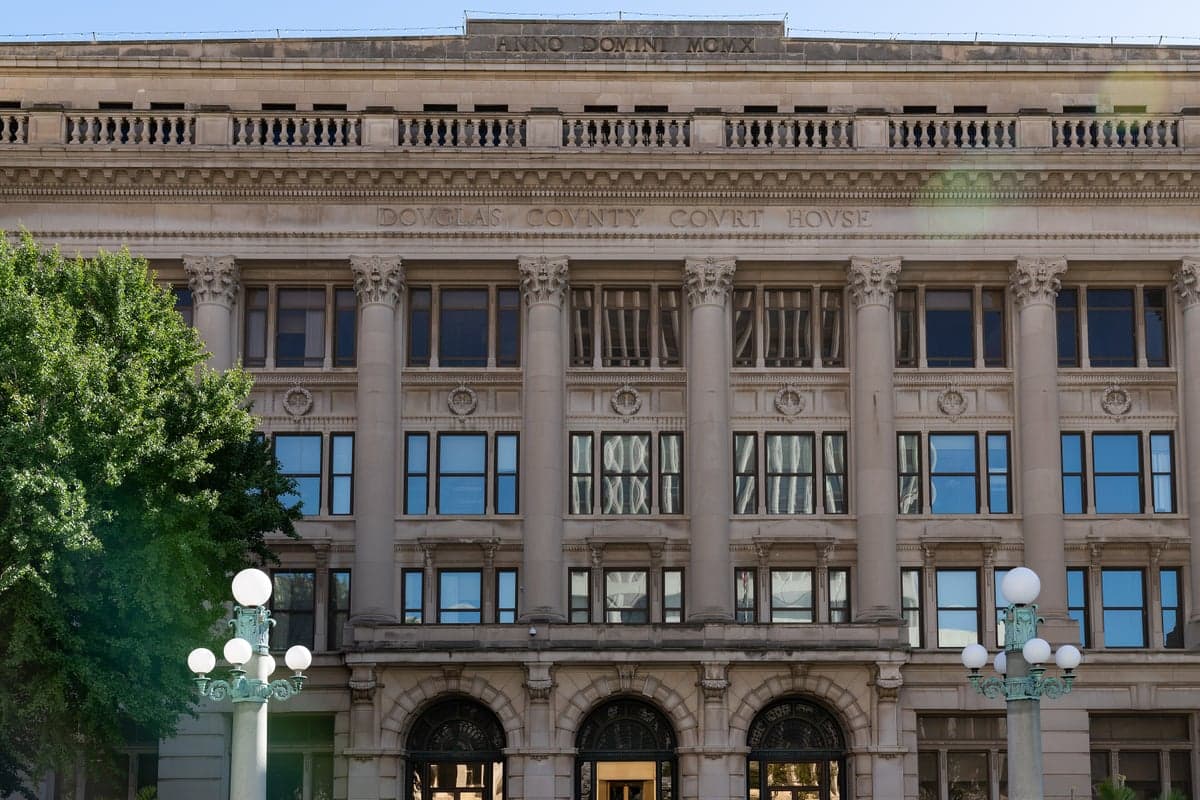
Photo: Wikipedia
Political ClimatePolitical Climate in Douglas County
Showing district-level results — no local-only data available.
Local Political AnalysisPolitical Analysis of Douglas County
Douglas County, Nebraska, has shifted from a traditional battleground to a solidly Democratic-leaning island within a deep red state. With a Cook Partisan Voting Index (PVI) of D+3, the county now reliably votes blue in presidential elections, a stark contrast to the state of Nebraska’s overall R+10 rating. This transformation has been driven largely by the explosive growth of Omaha and its inner suburbs, which have become younger, more diverse, and more educated over the past two decades. The county hasn't voted for a Republican presidential candidate since George W. Bush in 2004, and the margin has only widened since then, with Joe Biden carrying it by over 11 points in 2020.
How it compares
The political divide between Douglas County and the rest of Nebraska is one of the sharpest urban-rural splits in the country. While the state as a whole is reliably Republican, Douglas County is a Democratic stronghold, and its influence is magnified by Nebraska’s unique unicameral, nonpartisan legislature. This means that Omaha-area senators, who often lean left, can hold outsized power in a body that is otherwise conservative. The contrast is most visible when you drive west out of Omaha. In Elkhorn, a formerly independent town now part of Omaha’s western edge, you’ll see plenty of Trump signs and a reliably red voting record. Head east into Midtown Omaha or the Dundee-Memorial Park area, and you’re in some of the bluest precincts in the entire state. The swing precincts are no longer in the city proper; they’ve moved to the first-ring suburbs like Ralston and La Vista, where ticket-splitting is still common, though trending blue. Meanwhile, the rural townships in the far northern and western reaches of the county, like Waterloo and Valley, vote more like the rest of Nebraska, but their populations are too small to shift the countywide total.
What this means for residents
For a liberal resident, living in Douglas County means your vote actually counts in a way it wouldn't in the rest of the state. You’re represented by a reliably progressive city council and county board, and you benefit from Omaha’s more generous social services and progressive policies, like a higher minimum wage and strong non-discrimination ordinances. For a conservative resident, the reality is more complicated. You’ll likely feel outnumbered in local elections, but your state-level representation is still solidly Republican, and your property taxes are kept in check by a state legislature that is skeptical of big-city spending. The practical effect is a constant tug-of-war: Omaha tries to pass local gun safety measures or raise the minimum wage, only to have them preempted or watered down by the state. This dynamic creates a unique political culture where residents are hyper-aware of both local and state politics, and where a city council race can feel as consequential as a gubernatorial one.
The cultural and policy distinctions are tangible. Douglas County is the only place in Nebraska where you’ll find a robust, year-round farmers market culture, a thriving arts scene centered on the Benson and Blackstone districts, and a city government that actively courts immigrants and refugees. The county’s Democratic lean means it’s a safe haven for progressive policies on everything from climate action to criminal justice reform, but it also means it’s a perennial target for state-level preemption. The long-term trajectory is clear: as Omaha continues to grow and diversify, the county will only get bluer, widening the gap with the rest of Nebraska and intensifying the political friction that defines life here.

State Political ClimatePolitical Climate in Nebraska
State Political AnalysisPolitical Environment in the State
Nebraska is a solidly Republican state with a Cook PVI of R+10, meaning it votes about ten points more conservative than the national average in presidential elections. Over the past 20 years, the state has shifted rightward, driven by rural population growth and the consolidation of conservative voters in the western and central regions, while the Omaha metro area has become a competitive battleground. The state’s unique unicameral, nonpartisan legislature often produces pragmatic policy, but the overall trajectory is unmistakably conservative, with recent cycles cementing GOP dominance in statewide races.
Urban vs. rural divide
The political map of Nebraska is defined by a sharp urban-rural split. The Omaha metro area, centered on Douglas County, is the state’s Democratic stronghold, regularly voting blue in presidential and Senate races. Lincoln, home to the University of Nebraska, leans Democratic but is less reliably so than Omaha. The rest of the state — from the Sandhills to the Panhandle — is deeply Republican. Counties like Scotts Bluff, Dawes, and Box Butte in the west routinely deliver 70-80% GOP margins. A notable exception is Sarpy County, a fast-growing suburban area south of Omaha, which has trended rightward in recent cycles, flipping from a swing county to a solidly Republican one by 2024. This urban-rural divide means that while Omaha and Lincoln drive Democratic votes, the vast rural expanse ensures the state remains red.
Policy environment
Nebraska’s policy environment reflects its conservative lean. The state has no income tax on Social Security benefits and a flat individual income tax rate that has been steadily reduced, with a goal of reaching 3.99% by 2027. Property taxes are a perennial concern, with the state relying heavily on local levies for school funding. The regulatory posture is business-friendly, with right-to-work laws and minimal zoning restrictions outside major cities. Education policy is decentralized, with strong local control and a growing school choice movement; the state passed a tax-credit scholarship program in 2023. Healthcare policy is mixed: Nebraska expanded Medicaid under the Affordable Care Act via a 2018 ballot initiative, but the state has not pursued a state-based exchange. Election laws are moderately restrictive, with voter ID requirements passed in 2021 and implemented for the 2024 cycle. The state also uses a unique system for allocating its Electoral College votes, awarding two to the statewide winner and one to the winner of each congressional district, which has occasionally given Omaha’s 2nd District outsized national attention.
Recent policy direction
Recent legislation in Nebraska points toward a more conservative policy landscape. In 2023, the state passed a permitless carry law for concealed handguns, allowing residents to carry without a permit or training. The same year, the legislature banned abortion at 12 weeks, with exceptions for rape, incest, and medical emergencies, overriding a filibuster by a single vote. On education, the state enacted a school choice tax credit program and passed a law requiring schools to notify parents of curriculum changes, a nod to parental rights movements. Property rights were strengthened with a 2022 law limiting eminent domain for carbon pipelines, a response to the controversial Keystone XL and CO2 pipeline projects. On privacy and surveillance, Nebraska has not passed broad data privacy laws, but it did enact a ban on TikTok on state devices in 2023. Voting access remains stable, with early voting by mail available without an excuse, though the new voter ID law has been implemented without major controversy. The overall direction is toward lower taxes, expanded gun rights, and tighter abortion restrictions, with a pragmatic streak that sometimes produces bipartisan compromise, such as the 2023 law funding mental health services in schools.
Civil unrest & political movements
Political movements in Nebraska are active but rarely boil over into sustained unrest. The most visible flashpoint in recent years has been the debate over carbon pipelines, particularly the proposed Summit Carbon Solutions pipeline, which would carry CO2 from ethanol plants to North Dakota. Landowners in counties like Stanton and Colfax have organized protests and lawsuits, citing eminent domain concerns, and the issue has drawn bipartisan opposition. Immigration politics are less heated than in border states, but Omaha has seen local debates over sanctuary policies, with the city council rejecting a sanctuary city designation in 2019. Election integrity controversies have been minimal, though the 2020 and 2022 cycles saw some Republican activists questioning mail-in voting procedures, leading to the voter ID law. Organized activist movements include the Nebraska Democratic Socialists of America, active in Omaha, and the Nebraska Republican Party’s grassroots wing, which has pushed for more restrictive abortion laws. Overall, the state’s political culture is relatively civil, with protests typically focused on specific policy issues rather than broader ideological clashes.
Projection
Over the next 5-10 years, Nebraska is likely to remain solidly Republican, but demographic shifts could moderate the trend. The Omaha metro area is growing, driven by young professionals and immigrants, which could strengthen Democratic performance in Douglas County and the 2nd Congressional District. However, the rural population is aging and shrinking, which may amplify the GOP’s rural advantage. In-migration from other states is modest, but the state’s low cost of living and business-friendly climate could attract more conservative-leaning newcomers from high-tax states like California and Illinois. The unicameral legislature’s nonpartisan structure may continue to produce occasional bipartisan deals, but the overall policy direction will likely remain conservative, with further tax cuts and abortion restrictions on the horizon. A new resident moving in now should expect a state where conservative values dominate policy, but where Omaha and Lincoln provide a counterbalance on cultural and social issues.
For a new resident, the bottom line is that Nebraska offers a stable, conservative political environment with low taxes and a business-friendly regulatory climate, but with enough urban diversity to avoid a monolithic culture. Conservatives will find a welcoming policy landscape, while liberals will find safe havens in Omaha and Lincoln. The state’s pragmatic, nonpartisan legislative tradition means that even contentious issues are often resolved without the gridlock seen elsewhere. If you’re moving here, expect a place where your vote matters more in local races than in presidential ones, and where the pace of political change is deliberate rather than dramatic.
* Values derived from national, state, county, city and local statistics and may differ in a specific area. Last updated: 2026-07-07T22:56:50.000Z
Narrative content on this page is AI-generated and may contain mistakes. Verify any details that matter before acting on them.
ReloMaps may earn a commission from affiliate links at no extra cost to you.

