Photo: Wikipedia
Political ClimatePolitical Climate in Dodge County
Showing district-level results — no local-only data available.
Local Political AnalysisPolitical Analysis of Dodge County
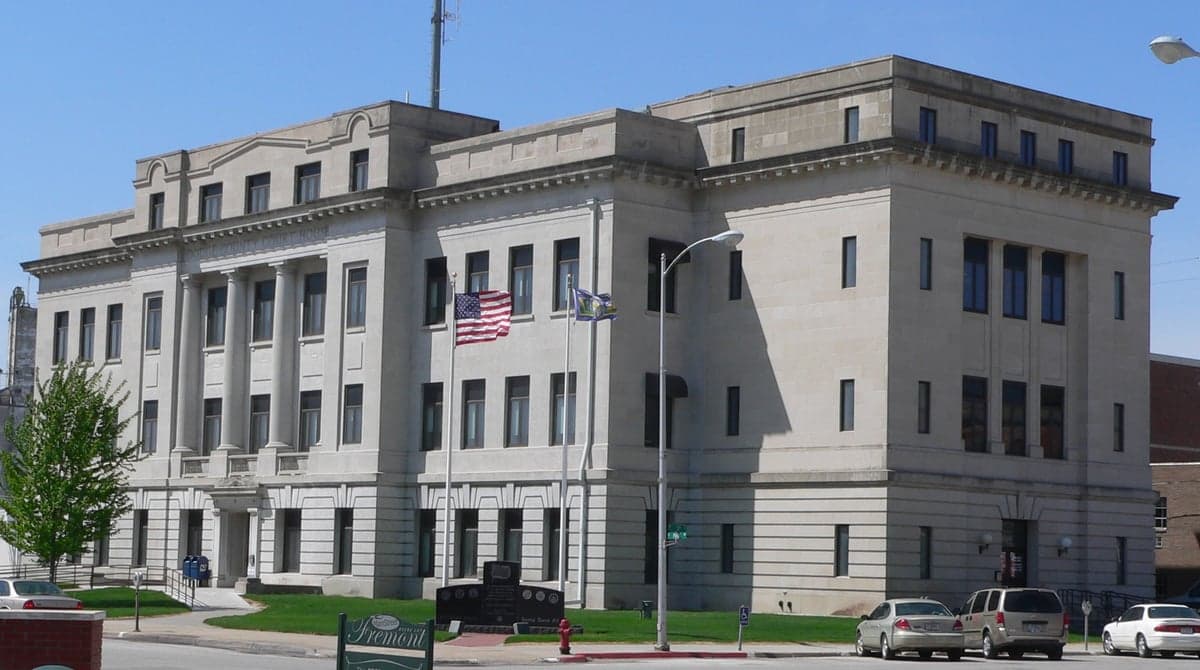
Dodge County, Nebraska, has a Cook Partisan Voting Index (PVI) of R+6, meaning it consistently votes about six points more Republican than the national average. That makes it a solidly red county, but it's notably less conservative than the state of Nebraska as a whole, which sits at R+10. This four-point gap is significant—it means Dodge County is a relative moderate within a deeply red state, and its political trajectory has been shaped by a mix of small-town conservatism, a growing Hispanic population, and the influence of Fremont, the county seat and largest city.
How it compares
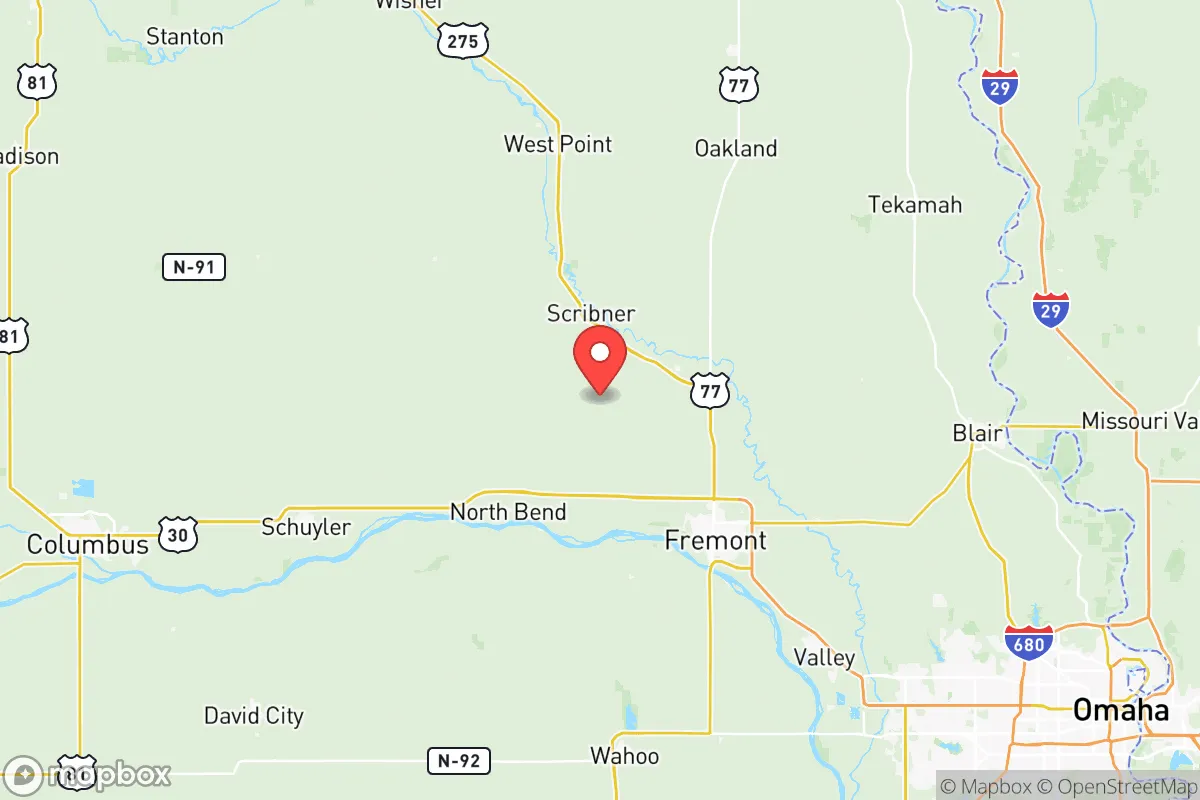
The R+6 rating puts Dodge County to the left of most of its neighbors. For context, neighboring Saunders County is R+15, and Washington County is R+16. The difference is driven almost entirely by Fremont, which is home to about 26,000 of the county's 37,000 residents. Fremont itself is a classic swing city: its downtown and older neighborhoods lean blue, while the outer subdivisions and rural fringe are deep red. In the 2024 presidential election, Fremont's precincts split roughly 52-48 in favor of the Republican candidate, while the rest of the county—towns like Hooper, Scribner, and North Bend—voted closer to 70-30 Republican. The county's overall R+6 reflects this tug-of-war: a reliably red rural base pulling the county right, but a competitive urban core keeping it from being as lopsided as the rest of eastern Nebraska. The state's R+10 rating, by contrast, is buoyed by the deep-red western and central counties, where margins often exceed 80-20.
What this means for residents
For conservative residents, Dodge County is a comfortable place to live. Republicans hold every countywide elected office, and the county commission is all-Republican. The local GOP is active and well-organized, with a strong presence in Fremont and the smaller towns. For liberal residents, the picture is more nuanced. Fremont provides a political foothold—the city council has a mix of Republicans and Democrats, and the local Democratic Party maintains a modest but persistent presence. However, statewide and national Democratic candidates rarely campaign in the county, and progressive policy proposals (like expanded public transit or affordable housing initiatives) face an uphill battle. The practical effect is that conservative residents see their values reflected in local policy, while liberal residents often feel they're swimming against the current, but not drowning—Fremont's blue-leaning precincts give them a voice, even if it's not a majority.
Cultural and policy distinctions
The most telling cultural distinction in Dodge County is the Fremont meatpacking plant (operated by Cargill), which has drawn a large Hispanic workforce since the 1990s. This has made immigration a hot-button local issue—Fremont passed a controversial ordinance in 2010 banning the harboring of undocumented immigrants, which was later upheld by the courts. That fight split the city along predictable lines: the rural precincts and older, white neighborhoods supported it; the newer, more diverse precincts near the plant opposed it. Today, the county's politics are still shaped by this tension. The local GOP tends to emphasize law-and-order and border security, while the local Democratic Party focuses on worker rights and integration. For a newcomer, the takeaway is that Dodge County isn't a monolith—it's a place where the national culture war plays out in microcosm, with Fremont as the battleground and the surrounding towns as the conservative anchor. If you're moving here, expect a community that's polite but politically aware, where the local newspaper's letters to the editor still get heated over property taxes and school funding, and where the divide between Fremont and the farm towns is as real as the Platte River that runs through them.

State Political ClimatePolitical Climate in Nebraska
State Political AnalysisPolitical Environment in the State
Nebraska is a solidly Republican state with a Cook PVI of R+10, but its politics are far from monolithic. The state has a long tradition of pragmatic, independent-minded conservatism, though the national GOP’s influence has grown over the past two decades. While the rural expanse votes overwhelmingly red, the state’s two population centers—Omaha and Lincoln—create a meaningful blue counterweight, making Nebraska one of the few states that splits its Electoral College votes by congressional district. Over the last 10-20 years, the state has shifted rightward on cultural issues while maintaining a fiscally conservative, low-tax posture, but the urban-rural divide has widened, with Douglas County (Omaha) and Lancaster County (Lincoln) becoming more reliably Democratic and the rest of the state hardening its Republican allegiance.
Urban vs. rural divide
The political map of Nebraska is a classic study in contrast. Douglas County (Omaha) is the state’s Democratic stronghold, voting for Joe Biden in 2020 and consistently sending moderate Democrats to the legislature. Lancaster County (Lincoln) leans blue as well, though less emphatically, with the University of Nebraska–Lincoln campus driving a younger, more progressive vote. In the 2022 governor’s race, Douglas County went for Democrat Carol Blood by 10 points, while the rest of the state delivered Republican Jim Pillen a landslide. The rural counties—like Cherry County in the Sandhills and Chase County in the southwest—routinely vote 80%+ Republican. The 2nd Congressional District (Omaha metro) is the only competitive district in the state, flipping between parties and awarding one electoral vote to Biden in 2020. Suburbs like Papillion and La Vista in Sarpy County are reliably red but have shown slight softening in recent cycles, while Fremont and Columbus remain deeply conservative manufacturing and agricultural hubs.
Policy environment
Nebraska’s policy environment is defined by fiscal conservatism and a hands-off approach to business. The state has a flat income tax rate of 5.84% (phasing down to 4.99% by 2027), no tax on Social Security benefits, and a relatively low property tax burden compared to neighboring Iowa and Kansas. The unicameral, nonpartisan legislature is unique—officially no party labels, but in practice Republicans hold a supermajority. Right-to-work is law, and the state is a constitutional carry state (permitless concealed carry since 2023). Education policy is locally controlled, with school choice advocates pushing for expansion of charter schools and tax-credit scholarships—a bill passed in 2023 that created a $10 million scholarship fund for private school tuition. Healthcare is a mixed bag: Nebraska expanded Medicaid under the Affordable Care Act in 2020 via a ballot initiative, but the state has not legalized medical or recreational marijuana, and abortion is banned after 12 weeks (with exceptions for rape, incest, and life of the mother) under the Nebraska Heartbeat Act (LB 574) passed in 2023. Election laws are moderately restrictive: voter ID is required (implemented in 2024), early voting is available, and same-day registration is not allowed.
Recent policy direction
The last three years have seen a sharp turn toward culturally conservative legislation. LB 574 (2023) combined a 12-week abortion ban with a ban on gender-affirming care for minors—a controversial pairing that sparked a record-breaking filibuster. LB 77 (2023) eliminated the permit requirement for concealed carry, making Nebraska the 26th constitutional carry state. On education, LB 753 (2023) created the school choice scholarship program, and LB 1084 (2024) banned diversity, equity, and inclusion (DEI) offices at public universities. Property rights remain strong—Nebraska has no statewide zoning, and eminent domain for carbon pipelines (like the contentious Keystone XL route) has been a flashpoint, with the legislature passing LB 432 (2023) to restrict eminent domain for private pipelines. On privacy, the state passed a data privacy law (LB 1074, 2024) giving residents the right to opt out of data sales, but surveillance laws are minimal—no warrant requirement for cell-site simulators. Voting access tightened slightly with the voter ID law, but no major restrictions on mail-in ballots or early voting have passed. For a relocator, the bottom line: Nebraska is moving right on social issues while maintaining a low-tax, business-friendly baseline.
Civil unrest & political movements
Nebraska is not a hotbed of civil unrest, but it has seen organized activism on both sides. The 2020 George Floyd protests in Omaha were large and occasionally violent, leading to property damage and a National Guard deployment. Since then, the Omaha Black Lives Matter chapter has remained active, pushing for police reform and affordable housing. On the right, the Nebraska Republican Party has been split between establishment conservatives and a more populist, Trump-aligned faction—visible in the 2022 primary where Charles Herbster, a Trump-endorsed candidate, lost the gubernatorial nomination to Jim Pillen. The Nebraska Freedom Coalition (a Moms for Liberty affiliate) has been active in school board races, particularly in Papillion-La Vista and Millard school districts, pushing for book bans and parental rights. Immigration politics are relatively quiet—Nebraska is not a border state, but Fremont passed an anti-sanctuary city ordinance in 2020 (later upheld by the state supreme court). There is no serious secession or nullification movement, though rural counties occasionally float resolutions opposing federal land management. Election integrity controversies are muted compared to states like Arizona or Georgia; the 2020 election in Nebraska was not seriously contested, though the state GOP has since pushed for tighter voter ID and ballot security measures. A new resident would notice the activism mostly in school board meetings and legislative hearings in Lincoln, not in daily life.
Projection
Over the next 5-10 years, Nebraska’s political trajectory points toward continued polarization along the urban-rural axis. Omaha’s 2nd District will remain competitive, possibly flipping back and forth, while the rest of the state solidifies as R+15 or deeper. In-migration is modest—Nebraska grows about 0.5% annually—but the newcomers tend to settle in the Omaha and Lincoln metros, gradually shifting those areas leftward. The rural population continues to decline, meaning the state’s overall partisan lean may actually soften slightly at the statewide level, though the legislature will stay Republican-dominated due to gerrymandering. Expect further movement on school choice (likely universal Education Savings Accounts), continued tax cuts (the flat income tax may drop to 3.99% by 2030), and more restrictions on abortion and transgender rights. The unicameral, nonpartisan structure may face pressure from partisan activists who want to add party labels, but that change is unlikely in the near term. For a relocator, the key takeaway: Nebraska will remain a reliably conservative state for the foreseeable future, but the Omaha metro will become an increasingly blue island, offering a genuine political choice within a single state.
For a new resident, the practical implications are straightforward. If you’re conservative, you’ll find a state government that largely shares your values on taxes, guns, and education, with a business climate that encourages growth. If you’re liberal, you’ll have a vibrant community in Omaha or Lincoln where your vote counts, but you’ll be living under a state government that is actively moving right on social issues. The nonpartisan legislature means less partisan gridlock than in other states, but also less transparency—bills can move quickly with little public debate. The bottom line: Nebraska offers a stable, low-cost, low-tax environment with a clear political identity, but the urban-rural divide means your experience will vary dramatically depending on whether you settle in Omaha, Lincoln, or a small town like Kearney or Norfolk.
* Values derived from national, state, county, city and local statistics and may differ in a specific area. Last updated: 2026-07-14T07:53:38.000Z
Narrative content on this page is AI-generated and may contain mistakes. Verify any details that matter before acting on them.
ReloMaps may earn a commission from affiliate links at no extra cost to you.

