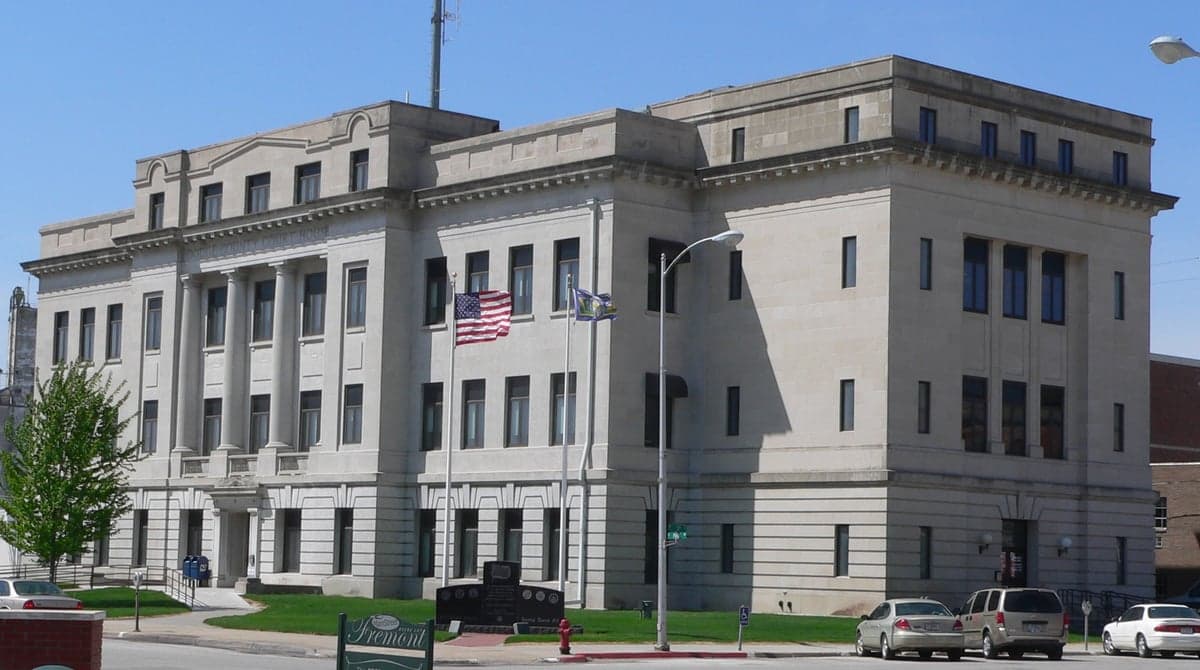
Photo: Wikipedia
Demographics of Dodge County
Affluence Level in Dodge County
A middle-class area roughly in line with national averages across income, home values, education, and employment.
People of Dodge County
The people of Dodge County, Nebraska today form a predominantly white, historically rooted community of 37,146 residents, characterized by a strong agricultural and small-town identity centered on the county seat of Fremont. With a population that is 78.8% white and 17.1% Hispanic, the county reflects a blend of deep European settlement heritage and a growing Hispanic presence, particularly in Fremont and the smaller towns of Hooper and Scribner. The county’s foreign-born population stands at 4.3%, and its college-educated share of 21.5% is below the national average, aligning with its blue-collar and farming economy. Distinctive markers include a conservative political tilt, a high rate of church affiliation, and a sense of place shaped by the Platte River valley and the legacy of the Union Pacific Railroad.
Settlement & growth (pre-1960)
Before American settlement, the area that is now Dodge County was part of the traditional territory of the Pawnee and Omaha nations, who lived along the Platte River and its tributaries. The Pawnee, in particular, used the region for seasonal hunting and farming, with their villages concentrated further west along the Loup River. French fur traders and trappers passed through the area in the 18th century, but no permanent European settlements were established until after the United States acquired the land through the Louisiana Purchase of 1803.
The first major wave of American settlers arrived in the 1850s and 1860s, drawn by the Homestead Act of 1862 and the promise of cheap, fertile land along the Platte River valley. These early pioneers were overwhelmingly of Yankee and Mid-Atlantic stock—families from New York, Pennsylvania, Ohio, and Indiana—who established the first towns, including Fremont (founded 1856), North Bend (1856), and Scribner (1867). Fremont quickly became the county’s commercial and transportation hub after the Union Pacific Railroad reached it in 1866, linking the area to the transcontinental rail network. The railroad brought a second wave of settlers: Irish and German immigrants who worked as track layers, section hands, and laborers. German families, in particular, settled in farming communities around Hooper (founded 1872) and Uehling (1887), where they established Catholic and Lutheran churches that remain landmarks today.
By the 1880s, Dodge County’s population had surged past 12,000, driven by the expansion of corn and wheat farming and the establishment of grain elevators and mills in towns like Snyder and Winslow. A smaller but notable group of Danish immigrants arrived in the 1880s and 1890s, settling near Nickerson and forming tight-knit agricultural enclaves. The early 20th century saw a slowdown in new immigration, but the county’s population continued to grow through natural increase, reaching a peak of 25,385 by 1930. The Dust Bowl and Great Depression of the 1930s hit the region hard, causing a modest out-migration of farm families to California and urban centers, but the county’s agricultural base proved resilient. After World War II, a modest influx of returning veterans and their families settled in Fremont, which saw light industrial growth with the opening of a Hormel meatpacking plant in 1948. By 1960, the county’s population stood at 27,588, with Fremont accounting for roughly half of that total.
Modern era (post-1965)
The 1965 Hart-Cellar Act, which abolished national-origin quotas, had a limited direct impact on Dodge County compared to urban areas. However, it set the stage for a gradual demographic shift that began in earnest in the 1990s. The most significant change has been the growth of the Hispanic population, which rose from under 2% in 1990 to 17.1% by 2020. This wave was driven by labor demand in meatpacking and food processing—particularly at the Fremont Beef Company and the Hormel plant—as well as in agricultural work such as corn detasseling and dairy farming. The majority of these new residents are of Mexican origin, with smaller numbers from Guatemala and El Salvador. They have concentrated in Fremont, where a Hispanic commercial corridor has developed along East Military Avenue, and in the smaller towns of Hooper and Scribner, where they have revitalized declining main streets and filled school enrollment gaps.
Domestic migration patterns since 1965 have been more modest. The county has experienced a slow, steady out-migration of younger, college-educated whites to larger cities like Omaha and Lincoln, a trend common across rural Nebraska. At the same time, some retirees and remote workers have moved into Fremont from the Omaha metro area, drawn by lower housing costs and a quieter lifestyle. Suburbanization has been limited; Fremont has expanded its city limits modestly, but the county remains overwhelmingly rural, with no major suburban sprawl. The Asian population remains tiny at 0.4%, consisting mostly of a few families of Vietnamese and Filipino descent who work in healthcare or manufacturing. The Indian-subcontinent population is effectively zero. The Black population, at 0.5%, is similarly small and concentrated in Fremont, with roots in a small number of families who moved from Omaha for jobs in the 1970s and 1980s.
Racial and ethnic relations have been shaped by periodic tensions. In 2010, Fremont passed a controversial ordinance banning the harboring of undocumented immigrants, which was later upheld in court after a lengthy legal battle. The ordinance reflected a cultural divide between long-established white residents and the growing Hispanic community, though by the 2020s, many local businesses and civic leaders had adopted a more pragmatic, integration-focused approach. The county’s overall racial composition remains 78.8% white, but the white population is aging, with a median age of 42 compared to 28 for the Hispanic population.
The future
Dodge County is becoming more diverse, but slowly and unevenly. The Hispanic share of the population is projected to rise to 22-25% by 2040, driven by higher birth rates and continued labor demand in meatpacking and agriculture. This growth will likely concentrate in Fremont, where the school district already reports a majority-minority enrollment among elementary students. The white population will continue to decline in absolute numbers due to out-migration and an aging demographic, but will remain the majority for at least another generation. New immigrant groups from outside Latin America are unlikely to arrive in significant numbers, given the county’s limited economic draw for East/Southeast Asian or African migrants. The county’s cultural identity is evolving from a purely white, Protestant, farm-based community to a more pluralistic one, with Spanish-language church services, Hispanic grocery stores, and bilingual signage becoming more common in Fremont. For someone moving in now, Dodge County offers a stable, affordable, and safe environment with a strong sense of community, but also a place where the pace of change is deliberate and where newcomers—especially those from different backgrounds—will find both welcome and resistance.
Bottom-line: Dodge County is a conservative, agricultural heartland community in demographic transition, where a shrinking white majority and a growing Hispanic minority are slowly reshaping the social and economic landscape. For a family or individual seeking low cost of living, good schools in Fremont, and a slower pace of life, it remains a viable option—provided they are comfortable with a community that is still negotiating its own identity.

* Values derived from national, state, county, city and local statistics and may differ in a specific area. Last updated: 2026-07-14T07:53:38.000Z
Narrative content on this page is AI-generated and may contain mistakes. Verify any details that matter before acting on them.
ReloMaps may earn a commission from affiliate links at no extra cost to you.

