Photo: Wikipedia
Political ClimatePolitical Climate in Dawson County
Showing district-level results — no local-only data available.
Local Political AnalysisPolitical Analysis of Dawson County
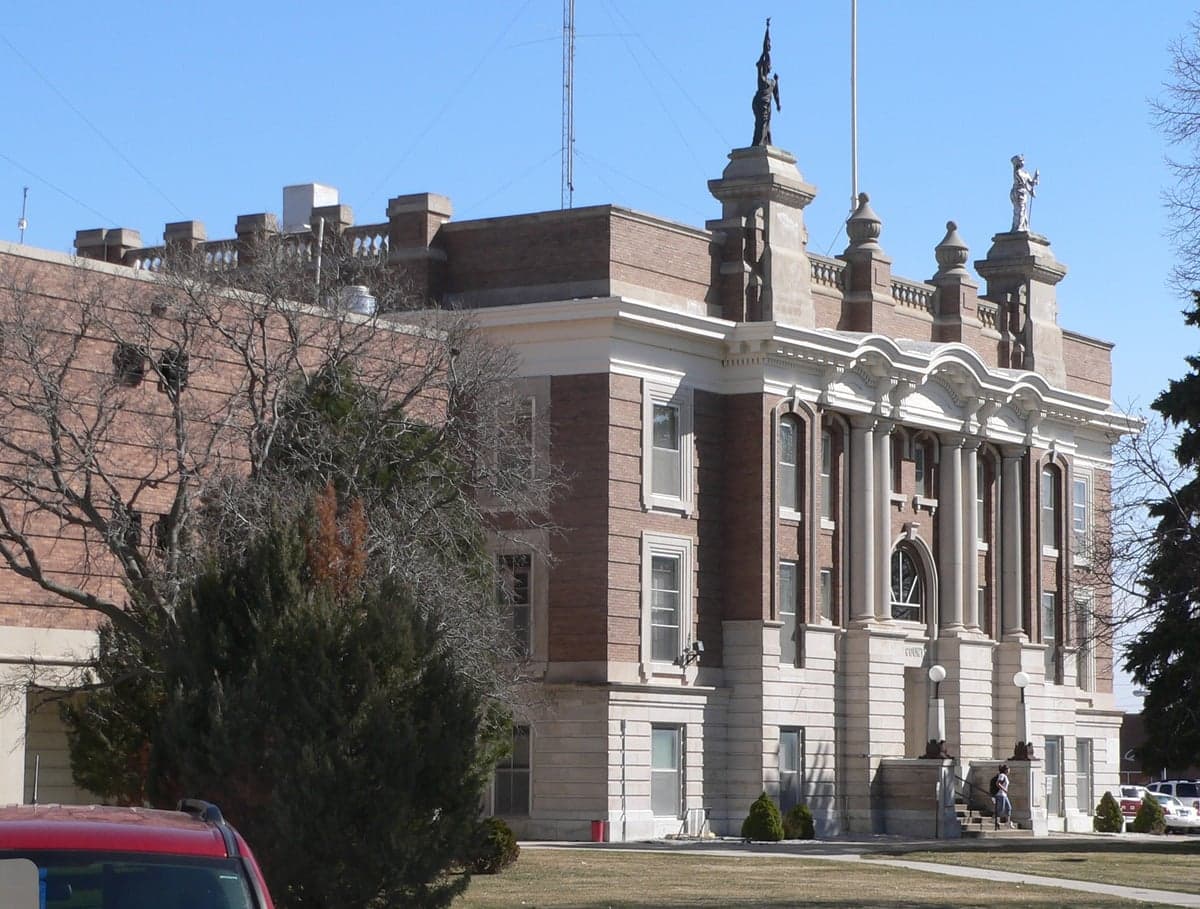
Dawson County is about as reliably Republican as it gets in Nebraska, with a Cook PVI of R+27 that puts it deep in the red column. That's a full 17 points more conservative than the state's already solid R+10 rating, and it's been trending that way for decades. The county hasn't voted for a Democratic presidential candidate since Lyndon Johnson in 1964, and even then it was a squeaker. In 2024, Donald Trump carried Dawson County by a margin of roughly 78% to 20%, a spread that mirrors the county's long-term trajectory. The real story, though, isn't just the overall lean — it's the quiet variation between towns that gives the place its political texture.
How it compares
Compared to Nebraska as a whole, Dawson County is a conservative outlier. The state's R+10 PVI already makes it a safe Republican stronghold, but Dawson County is in a different league entirely. The county's politics are shaped by its agricultural economy and small-town culture, with Lexington — the county seat and largest town — serving as the only real counterweight. Lexington's growing Hispanic population, now over 50% of the town's residents, has shifted some precincts toward the center, and in 2020, Biden actually carried a handful of Lexington's precincts, a rare blue patch in a sea of red. Meanwhile, Cozad and Gothenburg are reliably conservative, with GOP vote shares consistently above 80%. Overton and Farnam, smaller towns to the west, are even more deeply Republican. The swing precincts are almost nonexistent outside Lexington; the county's political spectrum runs from red to deeper red.
What this means for residents
For conservative residents, Dawson County is a comfortable place to live politically. Local offices — county commissioners, school boards, and the sheriff — are almost uniformly held by Republicans, and policy decisions reflect that. Taxes are low, gun rights are broadly supported, and the county's approach to land use and agriculture is business-friendly. For liberal residents, the reality is more isolating. There's no organized Democratic Party presence in the county, and progressive candidates rarely appear on the ballot outside of Lexington. That said, the county's politics are more pragmatic than ideological in daily life. People here care about roads, schools, and the local hospital — issues that don't break neatly along party lines. The biggest political friction point in recent years has been immigration, given Lexington's large immigrant workforce in meatpacking and agriculture. That debate is real and ongoing, but it's also nuanced, with many longtime residents acknowledging the economic necessity of immigrant labor even as they vote for candidates who take a hard line on border security.
Culturally, Dawson County is defined by its rural, agricultural character and a strong sense of self-reliance. The county's political identity is woven into its history as a farming and ranching community, and that's not changing anytime soon. But the demographic shift in Lexington is slowly reshaping the conversation. The county's Republican lean is stable, but the internal dynamics — between towns, between generations, between economic interests — are more layered than the raw voting numbers suggest. For anyone moving here, the political climate is straightforward: it's a deeply conservative place where the real debates are about how to manage growth, water, and labor, not about which party runs things.

State Political ClimatePolitical Climate in Nebraska
State Political AnalysisPolitical Environment in the State
Nebraska is a solidly Republican state with a Cook PVI of R+10, but it’s far from a monolith. The state’s political landscape is shaped by a deep urban-rural split, with the Omaha metro area (Douglas County) and Lincoln (Lancaster County) providing the only real Democratic strongholds, while the rest of the state—from the Sandhills to the Platte River valley—votes overwhelmingly red. Over the last 10-20 years, the trajectory has been one of slow, steady Republican consolidation in rural areas, offset by a slight Democratic drift in the state’s two largest cities, making Nebraska a fascinating case of a state that’s both deeply conservative and surprisingly nuanced.
Urban vs. rural divide
The political map of Nebraska is a textbook example of the urban-rural chasm. Omaha, the state’s largest city and economic engine, is the Democratic anchor. Douglas County has voted blue in every presidential election since 2008, and in 2020, Joe Biden carried it by about 10 points. Lincoln, home to the University of Nebraska, is a similar but smaller blue island; Lancaster County has trended Democratic over the past decade, though it’s still more competitive than Omaha. These two counties are the only real Democratic strongholds in a sea of red. Drive 20 minutes outside either city, and you’re in deep Republican territory. Sarpy County, a suburban and exurban area south of Omaha (home to Bellevue and Papillion), is reliably Republican but has shown slight shifts toward the center as Omaha’s suburbs grow more diverse. Meanwhile, the rest of the state—places like Grand Island, Kearney, North Platte, and Scottsbluff—vote Republican by wide margins. The rural counties in the Panhandle and the Sandhills regularly deliver 75-80% of their votes to GOP candidates. This divide means that statewide elections are rarely competitive, but the 2nd Congressional District (Omaha and its immediate suburbs) is a perennial swing district, often deciding control of the House and earning Nebraska its unique split electoral vote system.
Policy environment
Nebraska’s policy environment is unmistakably conservative, but with a pragmatic, Midwestern bent. The state has no personal or corporate income tax on the horizon—though it currently has a progressive income tax with a top rate of 6.84%—and property taxes are a perennial hot-button issue. The legislature, which is officially nonpartisan (the only unicameral in the nation), is dominated by Republicans, but the nonpartisan structure often forces cross-party coalitions on specific bills. On education, Nebraska has a robust system of public schools, but school choice and parental rights have become major legislative priorities. In 2023, the state passed a school choice program (LB 753) that provides tax credits for donations to scholarship-granting organizations, a move that pleased conservatives but drew fire from rural public school advocates. Healthcare policy is a mixed bag: Nebraska expanded Medicaid under the Affordable Care Act via a 2018 ballot initiative, but the state has also imposed work requirements for able-bodied adults. Election laws are generally conservative but not restrictive; Nebraska has no-excuse absentee voting and early voting, but voter ID was enacted in 2022 (LB 535) and took effect in 2024. The state’s regulatory posture is business-friendly, with a right-to-work law and relatively low occupational licensing burdens.
Recent policy direction
The last few years have seen Nebraska move decisively to the right on several fronts, while maintaining some moderate guardrails. On gun rights, Nebraska is a constitutional carry state (permitless carry for adults 21 and older, passed in 2023 via LB 77), and there are no state-level assault weapons bans or magazine capacity limits. Parental and education rights have been a major focus: the 2023 “Parents’ Bill of Rights” (LB 705) requires schools to notify parents about curriculum changes and medical services, and it restricts instruction on sexual orientation and gender identity in elementary grades. On abortion, Nebraska is one of the most restrictive states in the region: a 2023 law (LB 574) bans abortion after 12 weeks, with exceptions for rape, incest, and medical emergencies, and it also banned gender-affirming care for minors. Property rights are generally strong, though eminent domain disputes occasionally flare up around pipeline projects (e.g., the Keystone XL saga). Taxation is trending downward: the state has been gradually reducing its top income tax rate, with a goal of reaching 5.84% by 2027. Voting and ballot access remain relatively open compared to other red states: no-excuse absentee voting is still in place, and voter ID requirements are considered moderate (accepted forms include concealed carry permits and student IDs). On privacy and surveillance, Nebraska has no broad state-level data privacy law, but it does have a biometric privacy law (LB 1068, passed in 2024) that regulates the collection of facial recognition and fingerprint data.
Civil unrest & political movements
Nebraska is not a hotbed of civil unrest, but it has seen its share of political flashpoints. The 2020 George Floyd protests in Omaha were significant, with several nights of demonstrations and some property damage, but they were smaller and less violent than in many other cities. The state has a small but active progressive movement centered in Omaha and Lincoln, focused on issues like police reform, environmental justice, and immigrant rights. On the right, the Nebraska Republican Party has seen a growing populist, anti-establishment wing, often clashing with the more traditional, business-friendly GOP leadership. Immigration politics are a recurring issue: while Nebraska is not a border state, it has a significant immigrant population in meatpacking towns like Grand Island, Lexington, and South Sioux City. There have been periodic local debates over sanctuary policies, but no city in Nebraska has adopted a formal sanctuary ordinance. Election integrity controversies have been relatively muted compared to other states, though the 2020 election saw some local GOP activists push for audits and tighter rules, leading to the voter ID law. The state’s unique electoral college system—where Nebraska awards one electoral vote per congressional district—has made the 2nd District a national battleground, with both parties pouring resources into Omaha-area races. A new resident would notice that political engagement is high in Omaha and Lincoln, but much lower in rural areas, where local issues like property taxes and water rights dominate.
Projection
Over the next 5-10 years, Nebraska’s political trajectory is likely to be one of slow, incremental change rather than dramatic shifts. The Omaha metro area will continue to grow and diversify, making the 2nd District more competitive and potentially pushing Douglas County further left. Lincoln will likely follow a similar path, though more slowly. Meanwhile, rural areas will continue to depopulate and become even more Republican, reinforcing the state’s overall red hue. The biggest wildcard is in-migration: Nebraska is not a high-growth state, but it is attracting some newcomers from the coasts, particularly to Omaha and Lincoln, which could gradually shift the political center. However, the state’s conservative policy environment—especially on taxes, guns, and abortion—is likely to remain stable, as the Republican majority in the legislature is not seriously threatened. A new resident moving in now should expect a state that is reliably Republican in statewide elections, with a vibrant and competitive political scene in the Omaha area, and a policy environment that is conservative but not extreme by national standards. The nonpartisan legislature will continue to produce occasional surprises, like the 2023 trans care ban, but the overall direction is clear: Nebraska will remain a red state with a blue urban core.
For a new resident, the bottom line is that Nebraska offers a politically stable environment where conservative values dominate state policy, but where urban centers provide a counterbalance. If you’re a conservative, you’ll find a state that generally aligns with your views on taxes, guns, and education. If you’re a liberal, you’ll find welcoming communities in Omaha and Lincoln, but you’ll need to accept that state-level politics will often be at odds with your preferences. Either way, Nebraska’s politics are less volatile and more pragmatic than in many other states, making it a relatively predictable place to put down roots.
* Values derived from national, state, county, city and local statistics and may differ in a specific area. Last updated: 2026-07-08T16:20:11.000Z
Narrative content on this page is AI-generated and may contain mistakes. Verify any details that matter before acting on them.
ReloMaps may earn a commission from affiliate links at no extra cost to you.

