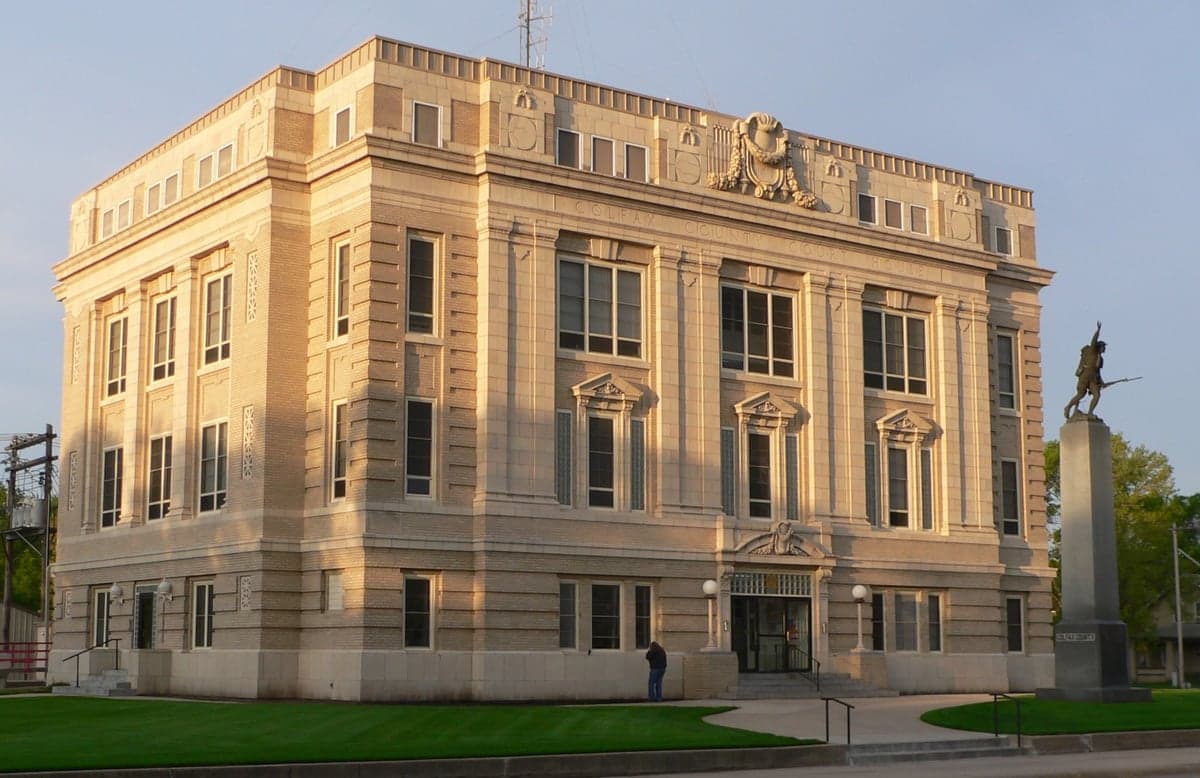
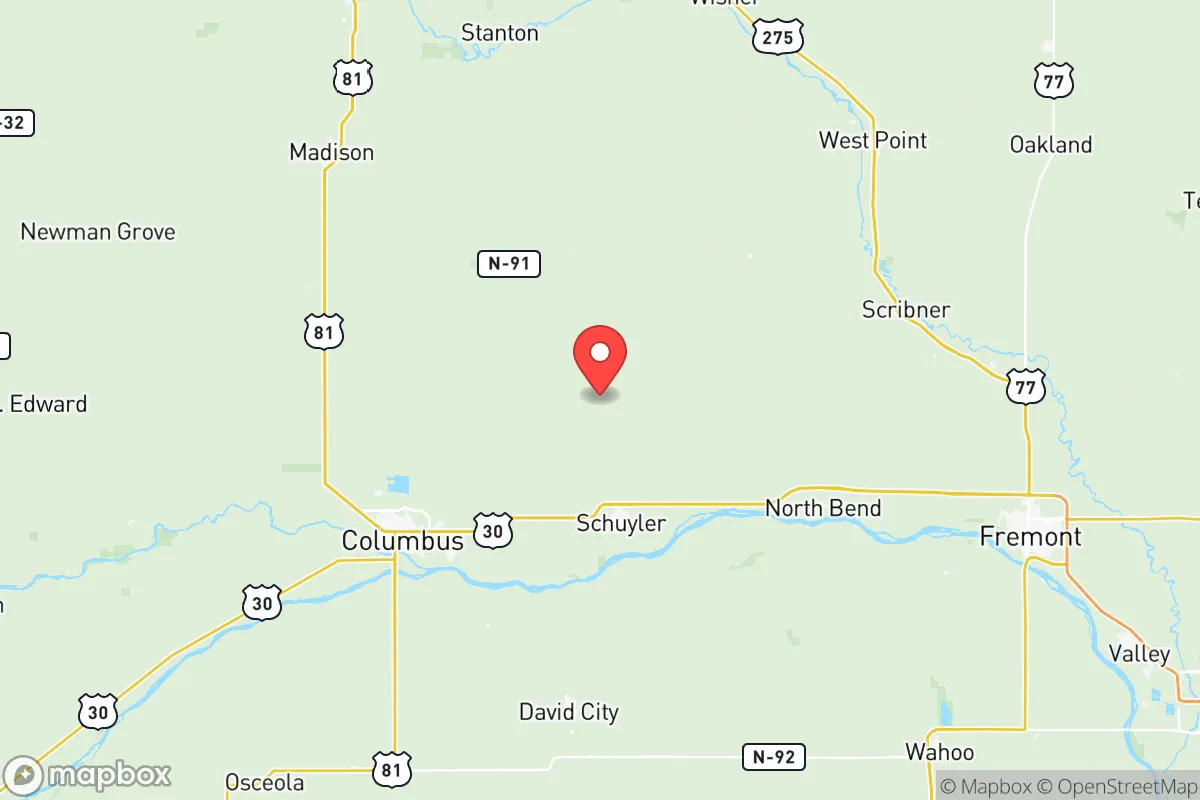
Photo: Wikipedia
Political ClimatePolitical Climate in Colfax County
Showing district-level results — no local-only data available.
Local Political AnalysisPolitical Analysis of Colfax County
Colfax County, Nebraska, leans reliably Republican, but it's not as deep red as the rest of the state. With a Cook Partisan Voting Index (PVI) of R+6, it's a solid four points more competitive than Nebraska's statewide R+10 rating. This isn't a fluke—it's a reflection of the county's unique mix of agricultural roots, a growing meatpacking workforce, and a significant Latino population that's been reshaping local politics over the past two decades.
How it compares
Nebraska as a whole is a Republican stronghold, with Omaha's Douglas County being the only reliably blue area. Colfax County, by contrast, is a microcosm of a shifting rural America. The county seat, Schuyler, is the political anchor—it's where you'll find the most Democratic-leaning precincts, driven largely by the Latino community employed at the Cargill and Hormel plants. In the 2020 presidential election, Schuyler's precincts voted about 55% Democratic, while the surrounding farm towns like Howells and Clarkson went 75% or more Republican. The swing precincts are in the unincorporated areas and smaller villages like Rogers and Leigh, where independent and split-ticket voters can tip a countywide race by a few hundred votes. This internal divide makes Colfax one of the few counties in Nebraska where a well-funded Democrat can sometimes win a local office, especially in county commission or school board races.
What this means for residents
For conservative residents, Colfax County feels like a safe bet for Republican candidates at the state and federal level, but they can't take local elections for granted. The county's R+6 lean means that a moderate Republican who appeals to Schuyler's working-class voters often does better than a hardline conservative. For liberal residents, the political reality is more nuanced: they have a real voice in Schuyler city politics, but they're largely outnumbered in countywide and state elections. The practical effect is that policy debates here are less about national culture wars and more about local bread-and-butter issues—like property taxes for farmers, housing affordability for plant workers, and funding for the Schuyler Community Schools, which is one of the most diverse districts in the state. Both sides tend to agree on the need for good roads and reliable water infrastructure, which keeps the political temperature lower than in many other parts of Nebraska.
Culturally, Colfax County stands apart from the rest of Nebraska because of its bilingual reality. In Schuyler, Spanish is heard as often as English in grocery stores and at high school football games. This has created a more pragmatic, less ideologically rigid political environment than you'd find in, say, nearby Platte County. The county's trajectory is toward becoming slightly more competitive over time, as the Latino population grows and younger voters in Howells and Clarkson drift away from straight-ticket voting. But don't expect a flip to blue anytime soon—the R+6 rating is likely to hold steady for the next decade, making Colfax a fascinating bellwether for how rural Nebraska is changing, one precinct at a time.

State Political ClimatePolitical Climate in Nebraska
State Political AnalysisPolitical Environment in the State
Nebraska is a solidly Republican state with a Cook PVI of R+10, but it’s not a monolith—it’s a state where the political reality is shaped by a deep urban-rural split, a fiercely independent streak, and a recent shift toward more culturally conservative policy. Over the last 10-20 years, the state has moved rightward in statewide races, but the Omaha metro area has become a Democratic stronghold, while Lincoln and the rest of the state lean heavily red. This means a relocator will find a place where conservative values dominate state law, but where local politics can vary dramatically from one county to the next.
Urban vs. rural divide
The political map of Nebraska is a textbook example of the urban-rural divide. The state’s two major population centers—Omaha (Douglas County) and Lincoln (Lancaster County)—are the Democratic anchors. Omaha, home to about half the state’s population, has trended blue in presidential elections, with Douglas County voting for Joe Biden in 2020 by about 10 points. Lincoln is more purple but leans Democratic, especially in state legislative races. In contrast, the rest of the state is deeply Republican. Counties like Scotts Bluff (panhandle), Hall (Grand Island), and Platte (Columbus) routinely vote 70-80% Republican. The rural areas are driven by agriculture, gun rights, and opposition to federal overreach, while the metros are more diverse, with younger voters and a growing professional class. A notable exception is Sarpy County (south of Omaha), a fast-growing suburban area that has shifted from solid red to a competitive lean-Republican, reflecting national trends in suburban moderation.
Policy environment
Nebraska’s policy environment is defined by low taxes, limited regulation, and a strong conservative tilt on social issues. The state has a flat income tax (currently 3.99%, with a scheduled drop to 3.99% by 2027) and no state sales tax on groceries or prescription drugs. Property taxes are high relative to the region, but the state has a property tax credit program. Education policy is a flashpoint: Nebraska has a robust school choice movement, with a 2023 law creating a tax-credit scholarship program for private school tuition, though it’s been challenged in court. The state also has a constitutional carry law (permitless concealed carry, effective 2023) and a “Stand Your Ground” law. On healthcare, Nebraska expanded Medicaid under the Affordable Care Act in 2020 via a ballot initiative, but the state legislature has resisted further expansion. Election laws are moderately restrictive: voter ID is required (passed in 2021), and the state has a closed primary system for major parties. Nebraska is also one of two states that splits its electoral votes by congressional district, meaning Omaha’s 2nd District can be a swing vote in presidential races.
Recent policy direction
Over the past five years, Nebraska has moved decisively toward cultural conservatism. In 2023, the legislature passed a 12-week abortion ban (with exceptions for rape, incest, and life of the mother), overriding a filibuster. The same year, a “Let Them Grow Act” banned gender-affirming care for minors, and a “Parents’ Bill of Rights” was enacted, requiring schools to notify parents about curriculum changes and student health decisions. On gun rights, the 2023 constitutional carry law removed the permit requirement for concealed carry, and the state has no red-flag law. On property rights, Nebraska has a “Right to Farm” constitutional amendment, protecting agricultural operations from nuisance lawsuits. On voting, the 2021 voter ID law was strengthened in 2024 with stricter proof-of-citizenship requirements for registration. On privacy, the state has no comprehensive data privacy law, but a 2024 bill to restrict government surveillance of social media failed. For a relocator, this means a state that is actively restricting abortion and transgender rights, expanding gun access, and prioritizing parental control in schools—all while keeping taxes low and regulation light.
Civil unrest & political movements
Nebraska is not known for large-scale civil unrest, but there have been notable flashpoints. In 2020, Omaha saw protests after the death of George Floyd, with some property damage and a heavy police response. The state has a small but vocal “Three Percenters” militia presence in rural areas, though it’s not as prominent as in neighboring states. Immigration politics are a hot-button issue: in 2024, the legislature debated a bill to require local law enforcement to cooperate with ICE, but it failed. There is no sanctuary city policy in Nebraska, though Lincoln has a “welcoming city” resolution that doesn’t carry legal weight. Election integrity controversies flared after 2020, with some rural counties pushing for hand-counting ballots, but no major changes were enacted. The “Nebraska Freedom Coalition” (a conservative activist group) has been active in school board races and library board elections, pushing for book bans and curriculum oversight. For a new resident, the most visible political movement will be the school choice and parental rights advocacy, which is highly organized and well-funded.
Projection
Over the next 5-10 years, Nebraska’s political trajectory points toward continued conservative consolidation, but with a growing Democratic foothold in Omaha and Lincoln. The state’s population is aging and slowly declining in rural areas, while the Omaha metro is growing, driven by tech and insurance jobs (e.g., Mutual of Omaha, Google’s data center). This demographic shift could make the 2nd Congressional District more competitive, but it won’t flip the state legislature, which is heavily gerrymandered. Expect more legislation on school choice, tax cuts, and cultural issues like transgender rights and abortion. The state’s unicameral, nonpartisan legislature (unique in the U.S.) may slow down the most extreme bills, but the conservative majority is likely to hold. For a relocator, this means a state that will remain reliably red for statewide races, but where local politics in Omaha and Lincoln will become more liberal. If you’re moving to Kearney or Norfolk, expect a deeply conservative environment; if you’re moving to Omaha’s Dundee or Benson neighborhoods, you’ll find a blue bubble with progressive neighbors.
For a new resident, the bottom line is that Nebraska offers a stable, low-tax, culturally conservative environment in most of the state, with two urban islands of liberalism. If you’re conservative, you’ll find your values reflected in state law and local governance. If you’re liberal, you’ll need to live in Omaha or Lincoln to feel politically comfortable, and you’ll face a state government that is actively hostile to your views on abortion, transgender rights, and gun control. The state is safe, affordable, and politically predictable—but the divide between city and country is real and growing. Choose your county carefully.
* Values derived from national, state, county, city and local statistics and may differ in a specific area. Last updated: 2026-06-18T04:22:40.000Z
Narrative content on this page is AI-generated and may contain mistakes. Verify any details that matter before acting on them.
ReloMaps may earn a commission from affiliate links at no extra cost to you.

