
Photo: Wikipedia
Strategic Assessment of Colfax County
Strong survivability profile. Good buffer from population centers, with manageable environmental and tactical risks.
What does the Strategic Assessment tell us?
Our Strategic Assessment grades tactical survivability of an area. Major population centers, military targets, fallout zones, natural disasters, and border exposure all drive risk — lower exposure means a more defensible position in a crisis.
This is heavily inspired by Joel Skousen's Strategic Relocation book. Highly recommended you checkout the book ($)What does this tell us?
Our Strategic Assessment grades tactical survivability of an area. Major population centers, military targets, fallout zones, natural disasters, and border exposure all drive risk — lower exposure means a more defensible position in a crisis.
This is heavily inspired by Joel Skousen's Strategic Relocation book. Highly recommended you checkout the book ($)Strategic Pillars

Key Distances
Strategic Assessment Analysis
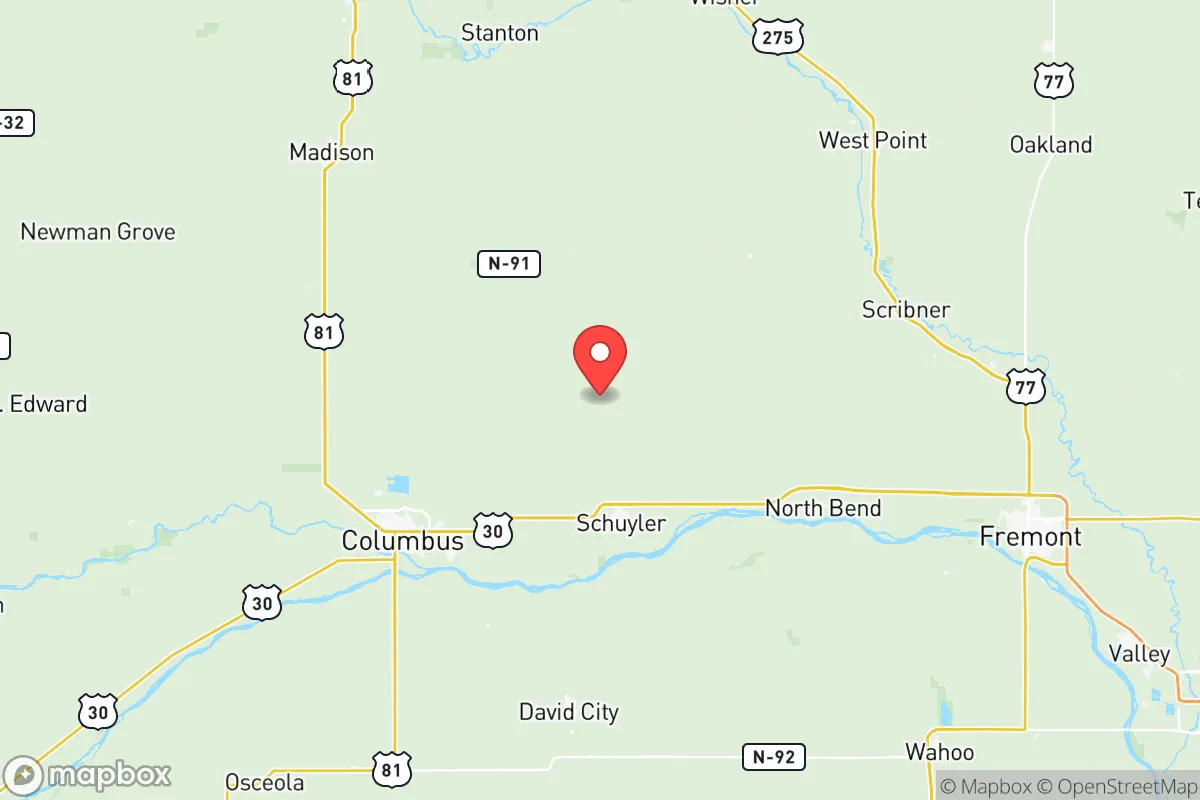
Colfax County, Nebraska, offers a strategic relocation option for those prioritizing resilience and self-sufficiency, combining a low-profile agricultural economy with a location that is both remote from major metropolitan vulnerabilities and well-connected to essential supply routes. Situated in the fertile Platte River Valley, the county is anchored by the towns of Schuyler and Clarkson, which provide a modest but functional base for daily life. Its position roughly 80 miles northwest of Omaha and 90 miles west of Lincoln places it outside the immediate blast and fallout zones of those population centers, while still allowing access to their medical and logistical resources when needed. For a reader weighing disaster readiness, Colfax County presents a balanced trade-off: it lacks the dramatic natural defenses of mountainous regions, but its flat, open terrain, strong agricultural base, and distance from high-value targets make it a quietly viable option for long-term stability.
Geographic position and natural advantages for long-term stability
Colfax County sits at the intersection of U.S. Highway 30 and Nebraska Highway 15, with the Union Pacific Railroad mainline running through Schuyler—a dual transportation advantage that supports both personal mobility and supply-chain access. The Platte River, which cuts across the county's southern half, provides a reliable surface water source and recharges the underlying Ogallala Aquifer, which is tapped by local wells. The county's topography is predominantly flat to gently rolling farmland, which simplifies construction, road maintenance, and off-grid infrastructure like solar panel placement. Winters are cold but manageable, with average January highs around 30°F, and summers are warm and dry, reducing the risk of mold or structural decay common in wetter climates. The absence of major forests also limits wildfire risk, though the open landscape offers little concealment—a trade-off that favors visibility over cover. For a relocator, the key natural advantage is water: the Platte River and the aquifer beneath it provide a buffer against drought that many other Plains counties lack.
Risks, exposures, and proximity to fallout-relevant landmarks
Colfax County's primary risk exposure comes not from natural disasters but from its proximity to infrastructure that could become a target or a liability during a major conflict or grid-down scenario. The Union Pacific rail line through Schuyler is a critical freight corridor connecting the Midwest to the West Coast, and while it is not a high-value military target, it could see disruption from broader supply-chain attacks. More significantly, the county lies roughly 100 miles from Offutt Air Force Base near Omaha, a major U.S. Strategic Command (STRATCOM) headquarters—a high-priority target in any nuclear exchange. Fallout from a strike on Offutt could reach Colfax County depending on wind patterns, though the distance provides a meaningful buffer. The county is also about 150 miles from the Nebraska-Lincoln area, which hosts the University of Nebraska's National Strategic Research Institute, another potential target. On the positive side, there are no major refineries, nuclear power plants, or military installations within the county itself. The nearest refinery is in Omaha, and the closest nuclear plant is the Fort Calhoun Station (now decommissioned) near Blair, about 90 miles away. For a relocator, the realistic risk is not a direct hit but secondary effects: supply chain interruptions, refugee movement along Highway 30, and potential fallout from a strike on Offutt. The county's low population density (roughly 10,500 residents across 413 square miles) reduces the likelihood of being caught in a panic-driven exodus.
Practical resilience for a relocator: food, water, energy, and defensibility
Colfax County's agricultural base is its strongest resilience asset. The county is a major producer of corn, soybeans, and livestock, with Schuyler hosting a large Cargill beef processing plant that employs over 2,000 workers. In a crisis, local food availability would be high, though reliance on industrial agriculture means that distribution networks could be disrupted. For a relocator, establishing direct relationships with local farmers—particularly in the smaller communities of Clarkson, Howells, and Leigh—would be essential for securing bulk grains, eggs, and meat outside the supermarket system. Water access is excellent: the Platte River runs year-round, and the Ogallala Aquifer provides deep groundwater that is less vulnerable to surface contamination. Most rural properties have private wells, and the county's water table is generally high, making hand-pump or solar-powered well retrofits feasible. Energy resilience is moderate. The county is served by the Nebraska Public Power District, which relies on a mix of coal, natural gas, and nuclear (from the Cooper Nuclear Station near Brownville, about 100 miles southeast). Grid failure would leave most residents without power, but the flat terrain and consistent wind (average 12-15 mph) make small-scale wind turbines a practical supplement. Solar is also viable, with roughly 200 sunny days per year. Defensibility is the county's weakest point. The open farmland offers little natural cover, and the major highways (U.S. 30 and Nebraska 15) could become avenues for unwanted traffic. However, the county's rural character means that most homes are spaced far apart, with clear sightlines and limited access points. A relocator with a well-chosen property—ideally set back from main roads, with a good well and room for a garden—could achieve a high degree of self-sufficiency. The local population is predominantly of Czech and German descent, with a strong tradition of hunting, gardening, and mechanical skills, which bodes well for community cooperation in a prolonged crisis.
Overall, Colfax County presents a solid, if unglamorous, strategic picture for the disaster-conscious relocator. It lacks the dramatic defensive terrain of the Rockies or the Pacific Northwest, but it compensates with reliable water, abundant local food production, and a location that is far enough from major targets to offer a real buffer, yet close enough to urban resources to be practical for daily life. The county's greatest vulnerability is its exposure to fallout from a strike on Offutt Air Force Base, but that risk is manageable with basic preparation—a basement or interior room, potassium iodide, and a weather radio. For a family or individual seeking a place to ride out a long-term disruption without retreating to a completely off-grid wilderness, Colfax County offers a realistic middle ground: a working agricultural community with the infrastructure to support a resilient lifestyle, provided you arrive with skills, supplies, and a willingness to integrate into a tight-knit rural culture. It is not a fortress, but it is a defensible, productive, and stable piece of the Plains—and in a world of increasing uncertainty, that counts for a lot.

* Values derived from national, state, county, city and local statistics and may differ in a specific area. Last updated: 2026-06-18T04:22:40.000Z
Narrative content on this page is AI-generated and may contain mistakes. Verify any details that matter before acting on them.
ReloMaps may earn a commission from affiliate links at no extra cost to you.

