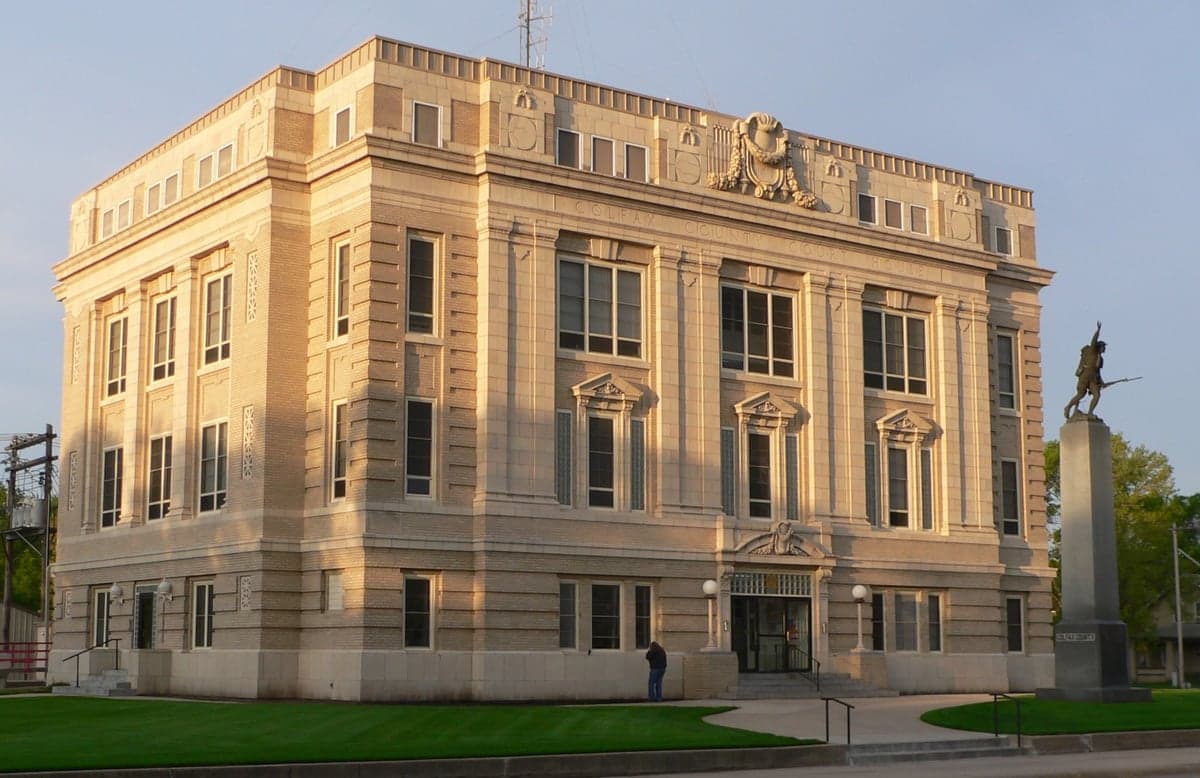
Photo: Wikipedia
Demographics of Colfax County
Affluence Level in Colfax County
A middle-class area roughly in line with national averages across income, home values, education, and employment.
People of Colfax County
Colfax County, Nebraska, is home to approximately 10,541 residents, making it one of the state’s smaller counties by population but one of its most distinctive in character. The county is nearly evenly split between a White non-Hispanic population of 45.7% and a Hispanic population of 47.3%, a direct legacy of a century of agricultural labor migration and settlement. With a foreign-born share of 21.0%—more than triple the national average—and a college attainment rate of just 14.1%, Colfax County is a working-class, rural community where meatpacking and agriculture anchor both the economy and the social fabric. The county seat, Schuyler, serves as the demographic and cultural hub, while smaller towns like Howells, Clarkson, and Leigh retain distinct ethnic enclaves from earlier waves of European settlement.
Settlement & growth (pre-1960)
Before Euro-American settlement, the area that is now Colfax County was part of the traditional territory of the Pawnee and Omaha nations. The Pawnee, in particular, had a significant presence along the Platte River and its tributaries, using the region for seasonal hunting and agriculture. The U.S. government forcibly removed the Pawnee to a reservation in Oklahoma in the 1870s, opening the land to homesteaders under the Homestead Act of 1862. The county itself was organized in 1869, carved from Platte County and named after Schuyler Colfax, Ulysses S. Grant’s first vice president.
The first major wave of Euro-American settlers arrived in the 1870s and 1880s, overwhelmingly German-speaking immigrants from the Austro-Hungarian Empire. These were primarily ethnic Germans from Bohemia (modern-day Czech Republic) and Moravia, along with a smaller number of Czechs and Poles. They were drawn by the promise of cheap, fertile farmland along the Platte River valley. The town of Howells, founded in 1889, became a nearly pure Bohemian-German Catholic enclave, a character it retains to this day. Similarly, Clarkson, platted in 1881, was settled by Czech and German immigrants and remains a stronghold of Czech cultural heritage, with an annual Czech Festival. Leigh, founded in 1882, was another German-Czech settlement, while Schuyler, the county seat, grew as a more mixed commercial center serving the surrounding farms. Rogers, a smaller village, was also part of this German-Czech settlement belt. By 1900, the county’s population had reached roughly 11,000, a figure it would not surpass until the late 20th century.
These early settlers were almost entirely Catholic or Lutheran, and the county’s religious landscape—dotted with steepled churches and parochial schools—was set for generations. The economy was purely agricultural: corn, wheat, oats, and livestock. The Union Pacific Railroad, which ran through Schuyler, was the critical link to outside markets. For the next sixty years, Colfax County remained a stable, homogeneous, German-Czech farming community. The population peaked at 11,564 in 1910 and then slowly declined as farm consolidation reduced the number of families needed to work the land. By 1960, the county had 9,655 residents, still overwhelmingly White and of German or Czech descent.
Modern era (post-1965)
The demographic transformation of Colfax County began in the late 1960s and accelerated through the 1970s and 1980s, driven by a single industry: meatpacking. In 1965, the Schuyler Packing Company (later a Cargill plant) opened in Schuyler, offering steady, relatively well-paying jobs that required little English and no formal education. The plant’s labor recruiters actively sought workers from Mexico and Central America, and by the 1970s, a significant Hispanic community had formed in Schuyler. This was not a post-1965 Hart-Cellar immigration story in the classic sense—most of the early arrivals were Mexican nationals, many of whom came through family networks and temporary worker programs rather than the new preference system—but the effect was the same: a rapid influx of non-European immigrants into a previously homogeneous rural county.
By the 1990s, the Hispanic population had grown to roughly 20% of the county total. The 2000s saw an even sharper increase, as the Cargill plant expanded and drew workers not only from Mexico but also from Guatemala, El Salvador, and Honduras. The 2010 Census recorded a Hispanic share of 37.5%, and by 2020 it had reached 47.3%. Today, the Hispanic population is concentrated in Schuyler, where it forms a clear majority, and to a lesser extent in Rogers. The towns of Howells, Clarkson, and Leigh, by contrast, remain overwhelmingly White and non-Hispanic, reflecting the persistence of the original German-Czech settlement patterns. The Black population, at 3.4%, is small but notable, consisting primarily of a few dozen families who moved to Schuyler for meatpacking work in the 2000s, largely from African American communities in the South and Midwest.
The foreign-born share of 21.0% is almost entirely Hispanic, with a small number of workers from Central America. There are no measurable East/Southeast Asian or Indian-subcontinent populations in the county. The college attainment rate of 14.1% is among the lowest in Nebraska, reflecting the fact that the meatpacking plant and related agricultural jobs do not require higher education. The county’s median household income, around $55,000, is below the state average, but the cost of living is low, and homeownership rates among Hispanic families have risen steadily since 2000.
The future
Colfax County is likely to become more Hispanic over the next 10-20 years, but the pace of change may slow. The Hispanic population is younger (median age around 25, compared to 45 for the White population) and has higher birth rates, so natural increase will continue to shift the balance. However, the Cargill plant, while still the dominant employer, has not expanded significantly in recent years, and automation in meatpacking may reduce future labor demand. Out-migration of young White adults to larger cities like Omaha and Lincoln has been steady for decades, further accelerating the demographic shift. The county’s total population has been essentially flat since 2010, hovering around 10,500, suggesting that Hispanic in-migration is roughly offsetting White out-migration.
Culturally, the county is becoming a bilingual, bicultural community, but not without friction. Schuyler’s public schools now serve a student body that is over 70% Hispanic, and Spanish is commonly heard in stores and on the streets. The older German-Czech towns—Howells, Clarkson, Leigh—remain culturally distinct and largely separate, with little Hispanic settlement. This geographic sorting may persist, as housing is scarce in the smaller towns and the social networks of new arrivals are centered in Schuyler. The county’s political leanings, historically Republican, have shifted slightly toward the center as the Hispanic electorate grows, but Colfax County still votes reliably Republican in most elections, reflecting the conservative social values of both its White and Hispanic populations.
For someone moving in now, Colfax County offers a low-cost, family-oriented rural lifestyle with a strong sense of community, but it is not a place of rapid economic growth or high educational opportunity. The meatpacking plant is the economic engine, and most jobs are in manufacturing, agriculture, or services that support those sectors. The county is becoming more diverse, but that diversity is concentrated in Schuyler, while the outlying towns remain ethnically homogeneous. The next decade will likely see a continued gradual Hispanicization of the county’s population, with Schuyler becoming increasingly Latino and the smaller towns aging and shrinking.

* Values derived from national, state, county, city and local statistics and may differ in a specific area. Last updated: 2026-06-18T04:22:40.000Z
Narrative content on this page is AI-generated and may contain mistakes. Verify any details that matter before acting on them.
ReloMaps may earn a commission from affiliate links at no extra cost to you.

