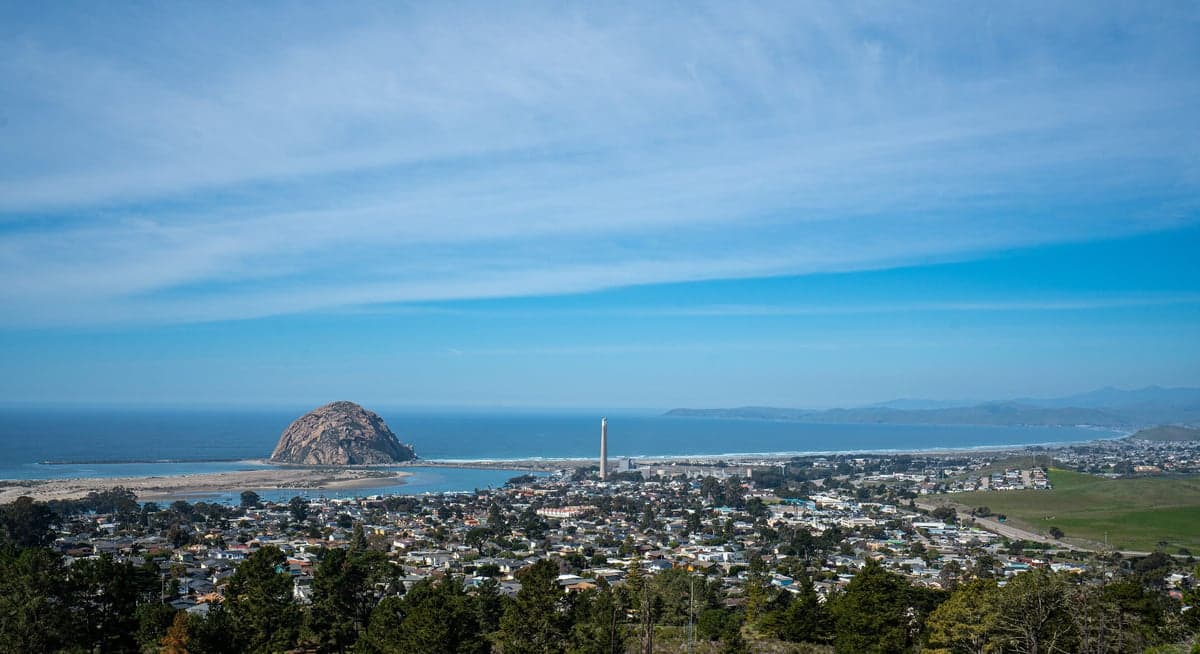
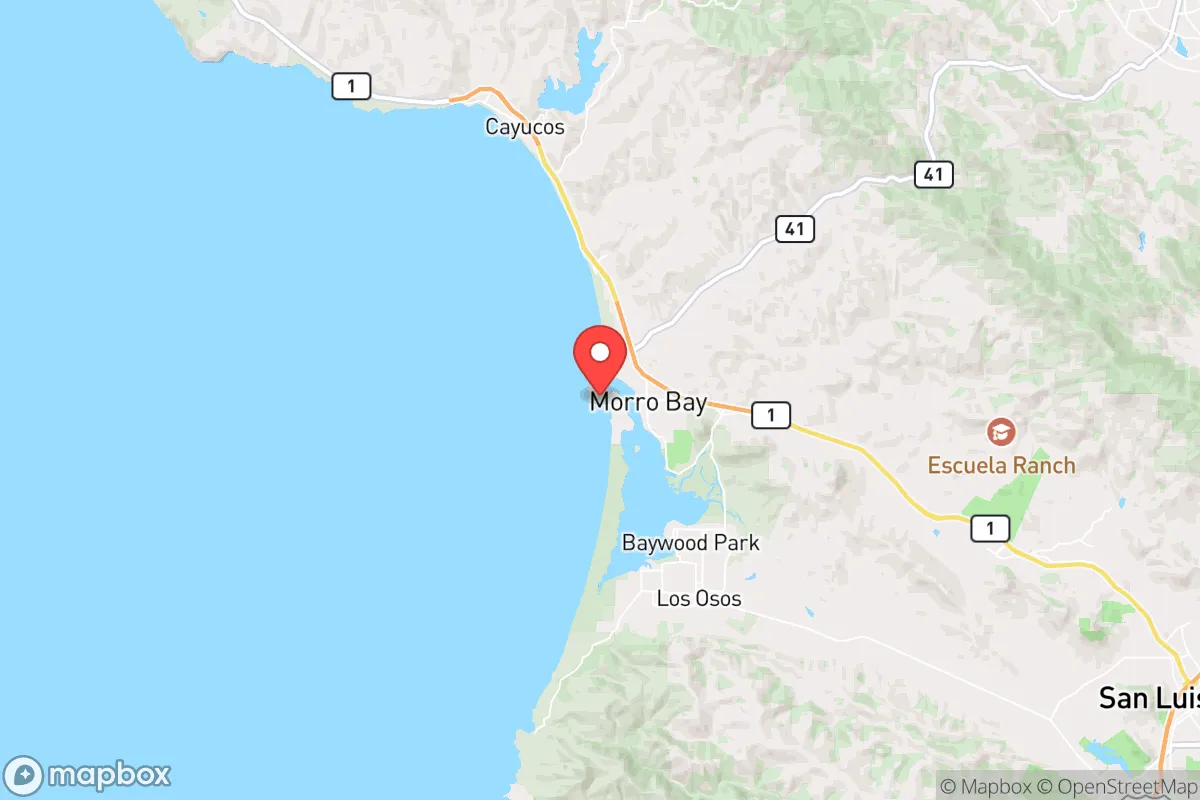
Photo: Wikipedia
Demographics of Morro Bay, CA
Affluence Level in Morro Bay, CA
An upper-middle-class area. Household wealth, education levels, and homeownership run ahead of national benchmarks.
People of Morro Bay, CA
The people of Morro Bay today number roughly 10,700, forming a predominantly White (77.1%) community that is older and more educated than the state average, with nearly half of adults holding a college degree. The city’s character is defined by its working waterfront, a strong retiree and second-home presence, and a notably low foreign-born population of just 3.5%. While the city feels culturally homogenous compared to nearby San Luis Obispo, a growing Hispanic (12.7%) and Indian-subcontinent (3.0%) population is slowly diversifying the residential base, particularly in newer developments on the city’s eastern edge.
How the city was settled and grew
Morro Bay’s human history is almost entirely a 20th-century story. The area was originally inhabited by the Chumash people, but the modern city was not formally incorporated until 1964. The first permanent non-Native settlers arrived in the 1870s, drawn by the deep-water harbor and the promise of shipping and fishing. The construction of the Pacific Coast Railway in the 1880s connected Morro Bay to San Luis Obispo, turning the waterfront into a commercial hub for dairy, grain, and lumber. The fishing industry—especially abalone and later albacore tuna—brought Portuguese and Italian immigrants in the early 1900s, who settled in the Waterfront District and along Embarcadero, building the small cottages and fish-packing plants that still define the area. A second wave came during the 1940s and 1950s, when the U.S. Navy established a small base and the harbor was dredged for commercial shipping. This era attracted workers from the Central Valley and the Midwest, who built modest ranch-style homes in the North Morro Bay neighborhood, near the current golf course and state park. The city remained a small, insular fishing village through the 1960s, with little ethnic diversity beyond the Portuguese and Italian enclaves.
Modern era (post-1965)
After the 1965 Immigration and Nationality Act, Morro Bay did not experience the large-scale immigration that transformed other California coastal cities. The foreign-born share remains very low at 3.5%. Instead, the post-1965 era was defined by domestic in-migration: retirees from the Bay Area and Los Angeles, and second-home buyers seeking a quieter, more affordable coastal lifestyle. This wave built out the Morro Bay Heights neighborhood on the hills above South Bay Boulevard, where larger single-family homes with ocean views became the norm. The Hispanic population grew gradually, from roughly 5% in 1990 to 12.7% today, with families concentrated in the South Morro Bay area near the high school and along Quintana Road. The most notable recent shift is the arrival of Indian-subcontinent professionals, now 3.0% of the population, many of whom work in tech or healthcare in San Luis Obispo and have settled in the newer Baywood Park subdivision (technically within Los Osos but overlapping Morro Bay’s commuter shed) and the Eastern Morro Bay tracts near Highway 1. East/Southeast Asian residents (2.0%) are a smaller, longer-established group, many descended from Filipino fishermen who arrived in the 1970s and live in the Waterfront District. The Black population remains negligible at 0.3%.
The future
Morro Bay’s population is projected to grow slowly, if at all, due to strict coastal development limits and a lack of buildable land. The city’s 2023 general plan update projects a population of roughly 11,500 by 2040, a gain of under 800 people. The Hispanic share is expected to rise gradually, possibly reaching 18-20% by 2040, driven by younger families moving into the South Morro Bay and Eastern Morro Bay areas where multi-generational households are more common. The Indian-subcontinent population may also grow modestly as remote tech workers from the Bay Area seek lower housing costs, though the limited housing stock will constrain this trend. The White, non-Hispanic share will likely decline slowly as older residents age out and younger, more diverse families replace them. The city’s cultural identity is unlikely to shift dramatically: it will remain a predominantly White, retiree-friendly, nature-oriented community, but with a slightly more diverse and younger family base in the southern and eastern neighborhoods. The Waterfront District will stay the historic, tourist-facing core, while Morro Bay Heights and Eastern Morro Bay will absorb most new residential growth.
For someone moving in now, Morro Bay offers a stable, low-diversity, high-amenity coastal environment with a clear demographic trajectory: slow, modest diversification concentrated in specific neighborhoods, with the overall character remaining that of a quiet, educated, and predominantly White retirement and tourism town. The city is not becoming a melting pot, but it is becoming slightly less homogenous, particularly in its eastern and southern residential areas.

* Values derived from national, state, county, city and local statistics and may differ in a specific area. Last updated: 2026-09-20T22:01:51.000Z
Narrative content on this page is AI-generated and may contain mistakes. Verify any details that matter before acting on them.
ReloMaps may earn a commission from affiliate links at no extra cost to you.

