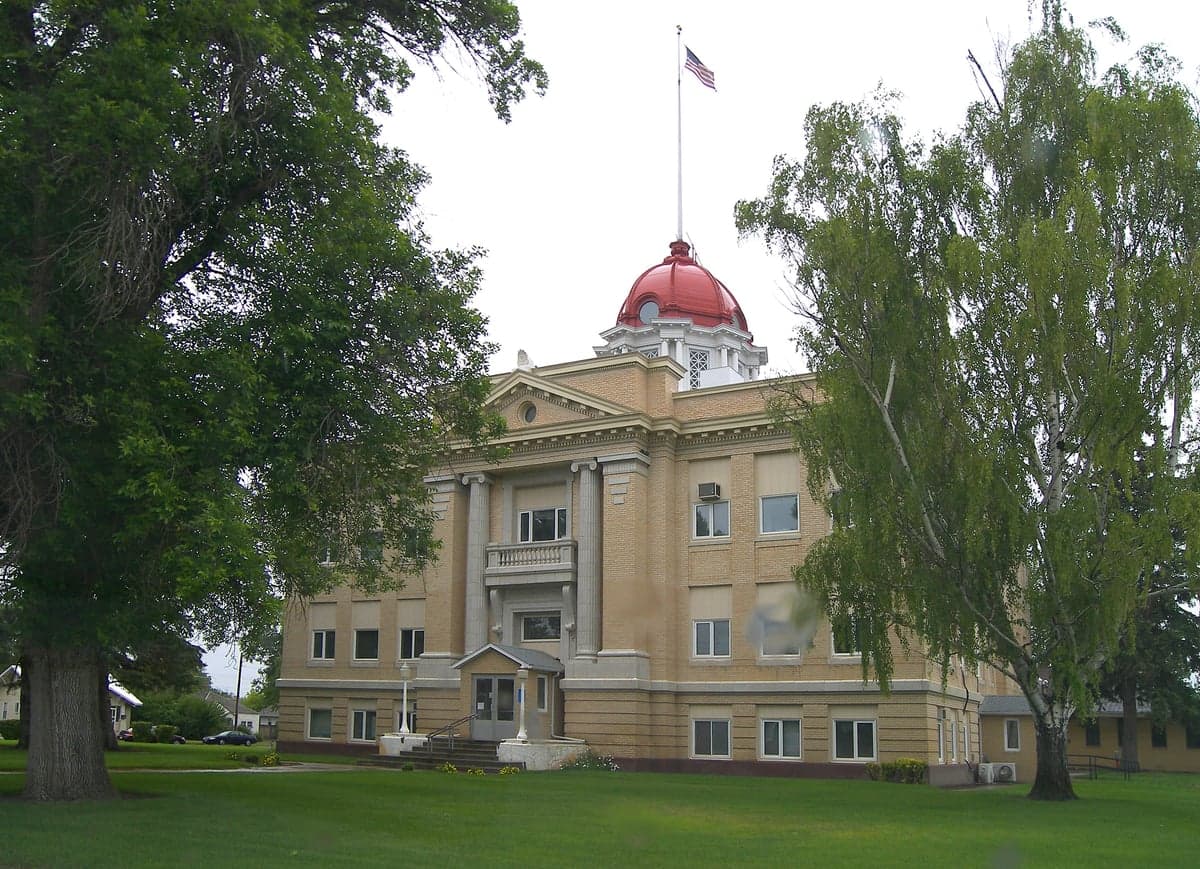
Photo: Wikipedia
Political ClimatePolitical Climate in Richland County
Showing district-level results — no local-only data available.
Local Political AnalysisPolitical Analysis of Richland County
Richland County, Montana, is a reliably conservative area that leans significantly to the right of the state as a whole. With a Cook Partisan Voting Index (PVI) of R+15, it is 5 points more Republican than Montana’s statewide R+10 rating. This isn't a new trend; the county has voted for the GOP presidential candidate in every election since 2000, often by margins exceeding 30 points. The political center of gravity is firmly in the county seat of Sidney, where oil and agriculture interests dominate the local economy and political conversation.
How it compares
While Montana as a state is solidly red, Richland County is a deeper shade of that red. The R+15 PVI means the county is roughly 15 points more Republican than the national average, while the state is 10 points more Republican. In practice, this means that in a close statewide race—like the 2024 U.S. Senate contest—Richland County’s votes can be a critical part of a Republican candidate’s margin of victory. The political variation within the county is minimal but real. The city of Sidney itself is the most reliably Republican area, with precincts routinely delivering 75-80% of the vote to GOP candidates. The smaller towns of Fairview and Savage lean even more heavily Republican, often exceeding 80% for conservative candidates. There are no notable blue-leaning towns; the only precincts that occasionally dip below 70% Republican are in the more rural, sparsely populated areas near the Missouri River, where a handful of independent-minded ranchers and a small number of out-of-state oil workers can create a slight, but not decisive, shift.
What this means for residents
For conservative residents, the political climate is comfortable and affirming. Local elected offices—county commissioners, school board members, and the sheriff—are almost always held by Republicans. Policy debates tend to focus on resource extraction, property taxes, and agricultural regulations, with a strong presumption in favor of limited government. For liberal or moderate residents, the reality is more about navigating a community where their views are a distinct minority. There is no organized Democratic Party presence in the county, and progressive candidates rarely appear on the ballot. Socially, it means that political conversations at the coffee shop or at a community event like the Richland County Fair are likely to assume a conservative baseline. However, most residents report that the community is neighborly and pragmatic; political differences rarely interfere with daily life, especially when it comes to shared concerns like school funding, road maintenance, or the local hospital.
Culturally, Richland County is distinct from Montana’s more liberal enclaves like Missoula or Bozeman. The local economy is heavily tied to the Bakken oil fields, which brings a transient workforce and a more pragmatic, less ideological brand of conservatism than in some other parts of the state. Gun rights are widely supported, and the county is a Second Amendment sanctuary. There is also a strong local emphasis on energy independence and agricultural self-sufficiency. The biggest policy distinction from the rest of Montana is the county’s aggressive support for oil and gas development, which sometimes puts it at odds with state-level environmental regulations. Looking ahead, the political trajectory is stable: as long as the oil and agriculture sectors remain strong, Richland County will stay deeply red, with no signs of a shift toward the center or left in the near future.

State Political ClimatePolitical Climate in Montana
State Political AnalysisPolitical Environment in the State
Montana has shifted decisively Republican over the past two decades, with a Cook PVI of R+10 reflecting a state that now reliably votes GOP at the presidential level by double digits. The dominant coalition is a mix of rural conservatives, libertarian-leaning ranchers, and a growing influx of out-of-state transplants, many of whom are drawn by low taxes and wide-open spaces. Over the last 10-20 years, the state has moved from a purple swing state—where it voted for Clinton in 1992 and Bush in 2000—to a solid red stronghold, with Trump winning by 16 points in 2020 and 20 points in 2024. This trajectory is driven by rural depopulation in Democratic-leaning counties and explosive growth in conservative-leaning areas like Gallatin County, though the latter has also introduced some suburban moderation.
Urban vs. rural divide
The political map of Montana is a classic story of urban islands in a rural red sea. The largest metro, Billings (Yellowstone County), is a Republican stronghold that has only grown redder, voting +24 for Trump in 2024. Missoula (Missoula County) is the state’s most liberal city, consistently voting Democratic by 20+ points, driven by the University of Montana and a strong environmental activist base. Bozeman (Gallatin County) is the most dynamic—once a conservative ranching town, it has become a purple battleground as tech workers and remote professionals flood in; it voted for Trump by just 4 points in 2024, down from 11 in 2020. Helena (Lewis and Clark County) leans slightly left due to state government workers, while Great Falls (Cascade County) and Butte (Silver Bow County) are working-class towns that have swung hard right as union influence waned. The rural counties—like Phillips, Garfield, and Petroleum—routinely vote 80-90% Republican, while the Flathead Reservation and parts of the Hi-Line (e.g., Blaine County) show Native American communities voting heavily Democratic.
Policy environment
Montana’s policy environment is defined by a low-tax, limited-government ethos that appeals strongly to conservative relocators. There is no state sales tax, and the income tax is a flat 5.9% as of 2025, down from a progressive top rate of 6.9% in 2020. Property taxes are moderate but vary by county, with Gallatin County seeing sharp increases due to rising home values. The state has a Republican trifecta (governor, House, Senate) and a supermajority in the legislature, which has passed a slew of conservative bills. Education policy is decentralized, with no state-level curriculum mandates beyond basic standards; school choice is limited but expanding, with a 2023 law creating education savings accounts for special-needs students. Healthcare is a mixed bag: Montana expanded Medicaid under the ACA in 2015, but the program faces annual reauthorization battles. Election laws are moderately restrictive—voter ID is required, same-day registration is allowed, and mail-in voting is universal by default, though a 2021 law tightened absentee ballot deadlines.
Recent policy direction
The last three legislative sessions have pushed Montana sharply right on nearly every liberty axis a relocator might weigh. On gun and self-defense law, Montana became a constitutional carry state in 2021, allowing permitless concealed carry, and a 2023 law prohibits state enforcement of federal gun regulations (the “Second Amendment Preservation Act”). Parental and education rights saw a major win with the 2023 “Parents’ Bill of Rights,” which requires schools to notify parents about curriculum changes and medical services. Speech is broadly protected, with no state-level hate speech laws and a 2022 law banning “critical race theory” in public schools. Privacy and surveillance are a mixed bag—Montana passed one of the nation’s strongest data privacy laws in 2023 (the Montana Consumer Data Privacy Act), but law enforcement has broad leeway for warrantless searches in certain contexts. Medical and bodily autonomy is a flashpoint: abortion remains legal up to fetal viability under a 1999 state Supreme Court ruling, but a 2023 law banned abortion after 20 weeks and requires parental consent for minors; a 2024 ballot initiative to enshrine abortion rights failed by 4 points. Property rights are strong, with a 2021 law limiting eminent domain for carbon pipelines. Taxation is trending downward, with a 2023 law cutting the top income tax rate from 6.75% to 5.9% and a 2025 proposal to eliminate the income tax entirely. Voting and ballot access remain stable, though a 2021 law requiring a photo ID for in-person voting was upheld by the state Supreme Court in 2023.
Civil unrest & political movements
Montana has seen relatively low levels of civil unrest compared to coastal states, but political movements are active and visible. The most prominent flashpoint is the “Standing Rock” legacy—while the 2016 Dakota Access Pipeline protests were centered in North Dakota, Montana’s Native American communities (especially the Fort Peck and Blackfeet reservations) remain deeply engaged in land and water rights battles. On the right, the “Yellowstone County Republican Party” has been a hotbed of election integrity activism, with a 2022 audit of the 2020 election in the county finding no fraud but sparking ongoing controversy. Immigration politics are muted—Montana has a tiny foreign-born population (about 2%), but a 2024 law banned “sanctuary city” policies and requires local law enforcement to cooperate with ICE. Secession rhetoric is rare but not absent; a 2021 “Montana Independence” bill failed in committee. The most visible political movement is the “property rights” coalition, which has clashed with environmental groups over grizzly bear reintroduction and mining permits in the Cabinet Mountains. New residents in Bozeman or Missoula will notice frequent protests outside the state capitol in Helena during legislative sessions, usually centered on abortion access or public lands management.
Projection
Over the next 5-10 years, Montana’s political trajectory points further right, but with a twist. In-migration is heavily conservative—many newcomers from California, Washington, and Oregon are fleeing high taxes and progressive policies, and they tend to vote Republican once settled. This is supercharging growth in Gallatin, Flathead, and Ravalli counties, which are becoming more conservative but also more suburban and NIMBY-ish. The Democratic strongholds—Missoula, Butte, and the reservations—are shrinking in relative population, meaning the statewide GOP margin will likely widen to R+12 or R+14 by 2030. However, the new conservatives are often libertarian-leaning, which could create friction with the old-school “establishment” GOP over issues like property taxes (newcomers want lower taxes, but locals fear losing services) and land use (newcomers oppose development, while ranchers want to sell). The biggest wildcard is climate change: as wildfires worsen and water rights become contested, the state’s libertarian ethos may clash with the need for coordinated disaster response. A relocator moving in now should expect a state that is reliably Republican but internally fractious, with a growing tension between rural traditionalists and suburban libertarians.
For a new resident, the bottom line is that Montana offers a deeply conservative policy environment with low taxes, strong gun rights, and limited government interference in daily life. Liberal residents will find Missoula and Bozeman’s city councils friendly, but state-level policies will feel hostile on issues like abortion and education. Conservative families will feel at home almost everywhere outside of Missoula, but should be prepared for rising property costs in the desirable mountain towns and a political culture that is increasingly shaped by out-of-state transplants rather than native ranchers. The state is safe, stable, and politically engaged—but the debates are real and visible, especially during legislative sessions in Helena.
* Values derived from national, state, county, city and local statistics and may differ in a specific area. Last updated: 2026-06-11T18:56:10.000Z
Narrative content on this page is AI-generated and may contain mistakes. Verify any details that matter before acting on them.
ReloMaps may earn a commission from affiliate links at no extra cost to you.

