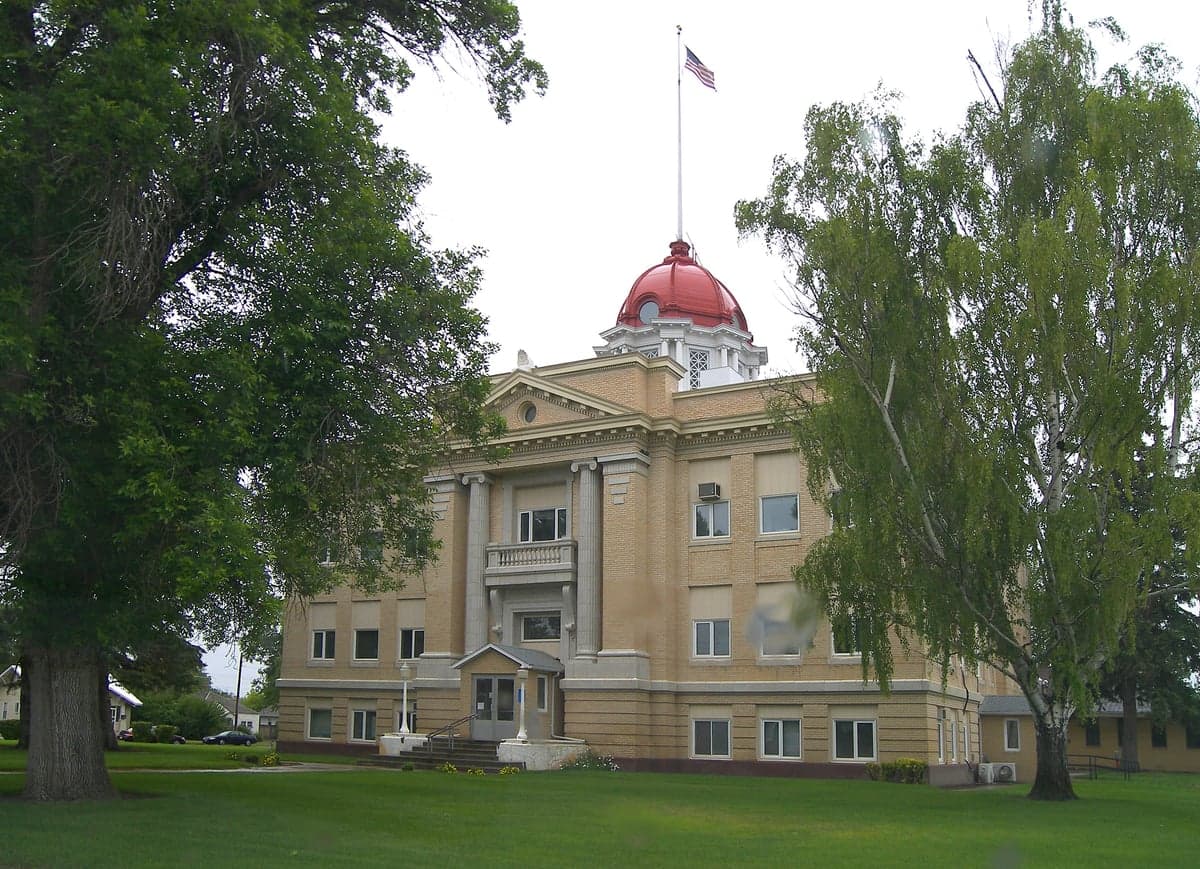
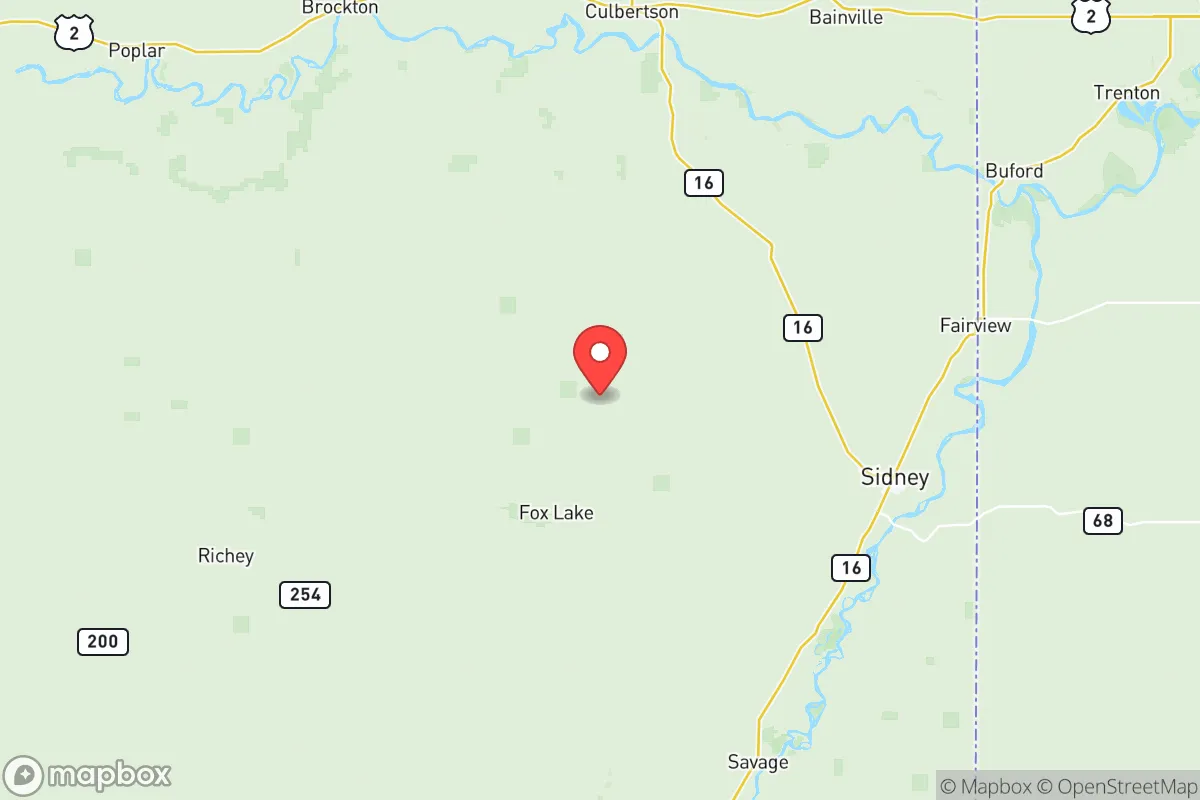
Photo: Wikipedia
Demographics of Richland County
Affluence Level in Richland County
A middle-class area roughly in line with national averages across income, home values, education, and employment.
People of Richland County
The people of Richland County, Montana, are a predominantly white, native-born population of just over 11,300, concentrated in the county seat of Sidney and the smaller towns of Fairview and Savage. With a foreign-born share of only 2.0% and a Hispanic population of 5.5%, the county remains one of the most ethnically homogeneous in the state, shaped by a deep agricultural heritage and a boom-and-bust energy economy. The population is notably less college-educated than the national average, at 19.4%, reflecting a workforce rooted in farming, ranching, and oil field labor rather than professional services. This is a community where family ties to the land run generations deep, and where the cultural identity is distinctly rural, conservative, and self-reliant.
Settlement & growth (pre-1960)
Before American settlement, the area that is now Richland County was part of the vast territory controlled by the Assiniboine and Sioux (Lakota) nations, who followed the bison herds across the northern Great Plains. The Yellowstone and Missouri Rivers, which converge near the county's western edge, served as major travel and trade corridors. The first permanent American presence came with the fur trade in the early 19th century, but significant Euro-American settlement did not begin until the 1880s, when the Great Northern Railway extended its line through the region. The town of Sidney, founded in 1888 as a railroad stop, became the county seat and the primary hub for homesteaders arriving under the 1862 Homestead Act.
The first major wave of settlers were Northern European immigrants, primarily Norwegians, Germans, and Swedes, who arrived between 1890 and 1910. These families were drawn by the promise of 160-acre homesteads on the fertile bottomlands of the Yellowstone River. They established farms and small communities like Fairview (platted 1906) and Savage (founded 1910), naming their towns after railroad officials or local landmarks. A smaller but notable group of Russian-Germans (ethnic Germans who had lived in the Volga region of Russia) arrived in the 1910s, bringing expertise in dryland wheat farming that proved crucial during the drought-prone 1920s and 1930s.
The Dust Bowl and Great Depression hit Richland County hard, causing a net population decline as some homesteaders abandoned their claims. However, the construction of the Fort Peck Dam (1933-1940) on the Missouri River brought a temporary influx of thousands of construction workers, many of whom stayed on to farm or work in the nascent oil industry. The discovery of oil in the Williston Basin in 1951 transformed the county's economy. The small town of Richey (founded 1910) and the unincorporated community of Brockton saw a surge of oil-field workers, many from Texas and Oklahoma, who brought a distinctly Southern, evangelical Christian influence that persists today. By 1960, the county's population had stabilized around 10,000, with Sidney as the undisputed commercial center.
Modern era (post-1965)
The 1965 Hart-Cellar Act had minimal direct impact on Richland County, as the region never attracted significant post-1965 immigration from Asia, Africa, or Latin America. The foreign-born population has consistently remained below 3%, a figure far lower than Montana's state average and the national norm. Instead, the county's demographic story since 1965 has been one of domestic boom-and-bust cycles tied to the energy sector. The oil boom of the 1970s and early 1980s brought a wave of domestic migrants from the Rust Belt and the Mountain West, many of them skilled tradesmen and roughnecks who settled in Sidney and Fairview. When oil prices collapsed in 1986, the county lost roughly 15% of its population, as workers moved on to the next boomtown.
The most dramatic modern shift came with the Bakken oil boom (2008-2015), which transformed Richland County into a temporary destination for tens of thousands of workers from across the United States. While most of these workers were transient "man camp" residents who did not settle permanently, the boom did leave a lasting imprint. The Hispanic population, which was negligible before 2000, grew to 5.5% by 2020, largely driven by Mexican-American and Central American workers who came for construction and oil-field service jobs and chose to stay. These families have concentrated in Sidney, where a small but visible Hispanic community now supports a Spanish-language church and a handful of Latino-owned businesses. The Black population, at 0.2%, and the East/Southeast Asian population, at 0.3%, remain statistically insignificant, with most non-white residents being individuals married into long-established white families or professionals recruited for the oil industry.
Suburbanization has been limited. The county's population remains overwhelmingly rural, with no incorporated place exceeding 7,000 residents. The only notable suburban-style development has been along the Highway 200 corridor east of Sidney, where a few subdivisions of single-family homes have been built to accommodate oil-field managers and medical professionals. The county's population peaked at 11,329 in the 2020 census, a figure that includes a significant number of people who live in the county but work in the oil fields of neighboring McKenzie County, North Dakota.
The future
Richland County's population is projected to remain stable or decline slightly over the next decade, as the Bakken boom recedes and the region returns to its agricultural and energy-service baseline. The county is not becoming more diverse in any meaningful sense. The Hispanic share may edge up to 7-8% as existing families grow, but there is no sign of significant new immigration from any source. The white population, at 87.6%, will remain dominant, though it is aging: the median age is 42, and many young adults leave for college or jobs in Billings or the Twin Cities and do not return.
The most likely demographic scenario is a slow, gradual decline, similar to other Great Plains counties that lack a major university or a diversified economy. The towns of Savage and Richey are particularly vulnerable to population loss, as their school enrollments shrink and their main streets hollow out. Sidney will likely hold its own as a regional service center, but it will not grow significantly. The county's cultural identity will remain deeply conservative, agrarian, and white, with the Hispanic community remaining a small but accepted minority. For someone moving in now, Richland County offers a quiet, safe, family-oriented life with strong community ties, but little economic or demographic dynamism.
This is a place where the past still shapes the present. The descendants of Norwegian and German homesteaders still farm the same sections of land, and the oil-field workers who arrived in the 1950s and 1970s have become the county's establishment. The future is not one of transformation, but of continuity — a slow, steady persistence of a rural, white, working-class culture that is increasingly rare in the United States. For a conservative family seeking affordable land, low crime, and a community where neighbors know each other, Richland County remains a viable choice. For anyone seeking diversity, rapid growth, or urban amenities, it is not.

* Values derived from national, state, county, city and local statistics and may differ in a specific area. Last updated: 2026-06-11T18:56:10.000Z
Narrative content on this page is AI-generated and may contain mistakes. Verify any details that matter before acting on them.
ReloMaps may earn a commission from affiliate links at no extra cost to you.

