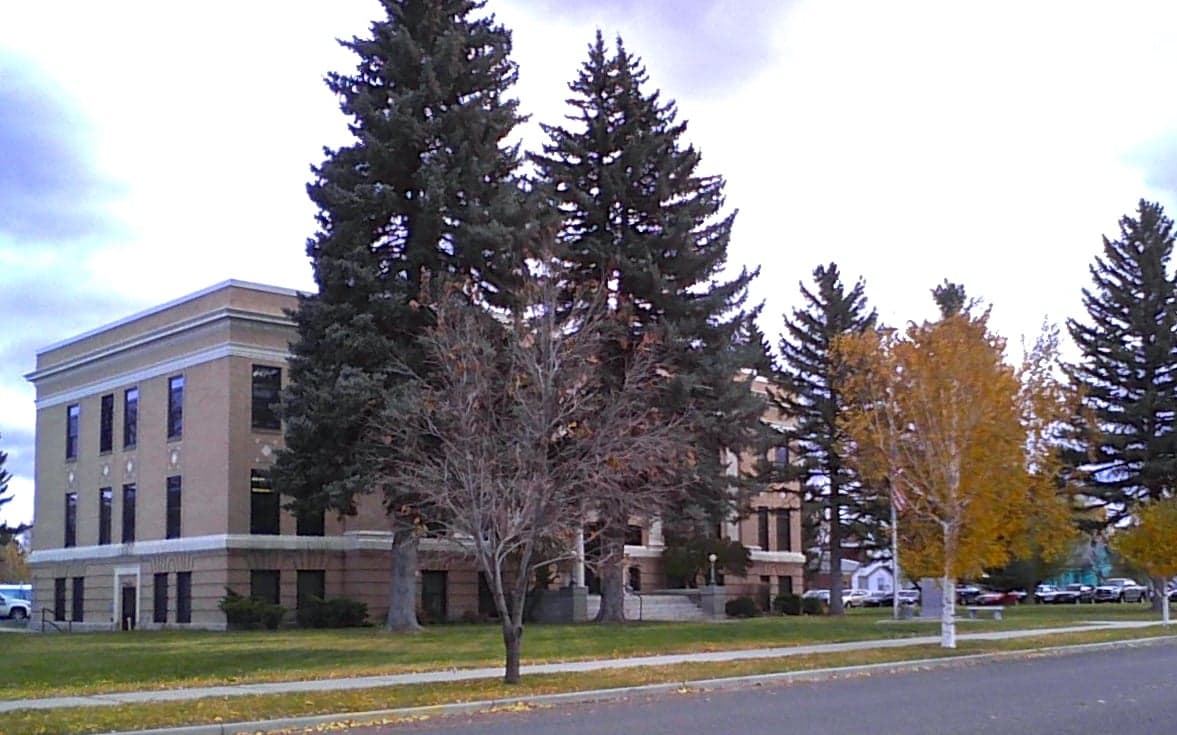
Photo: Wikipedia
Political ClimatePolitical Climate in Powell County
Showing district-level results — no local-only data available.
Local Political AnalysisPolitical Analysis of Powell County
Powell County, Montana, leans reliably Republican with a Cook PVI of R+5, but it's not the deep-red monolith you might expect from a rural western county. The county's politics are more nuanced than the state's overall R+10 rating suggests, with a noticeable libertarian streak and a few pockets where Democrats can still put up a fight. Over the past decade, the county has shifted slightly rightward, driven by in-migration from more conservative parts of the state and the West Coast, but the change has been gradual—not a sudden flip.
How it compares
Powell County's R+5 rating makes it significantly less Republican than Montana as a whole (R+10). That five-point gap is real on the ground. In the 2024 presidential race, Powell County voted for Trump by about 58% to 38%, while the state overall hit roughly 62% to 35%. The difference comes down to a few key areas. Deer Lodge, the county seat and home to the Montana State Prison, is the blue dot—it consistently votes 5-8 points more Democratic than the rest of the county, thanks to a mix of state employees, unionized prison workers, and a small but active arts community. In contrast, Garrison and Avon lean hard red, often pushing 65-70% Republican, driven by ranching families and retirees from out of state. The swing precincts are around Elliston and the rural areas east of Deer Lodge, where independent-minded voters—often loggers, small-scale miners, and remote workers—split tickets based on local issues rather than party loyalty. Compared to neighboring Granite County (R+16) or Powell's western neighbor Mineral County (R+14), Powell is a relative moderate, closer in profile to Lewis and Clark County (Helena area, R+4) than to the deep-red eastern plains.
What this means for residents
For conservative residents, Powell County is a comfortable place to live. The county commission, sheriff's office, and school board are reliably Republican. Gun rights are broadly supported, property taxes are low relative to the Front Range, and there's little appetite for new land-use regulations. You'll see Trump signs in yards from Deer Lodge to Avon, and the local GOP is active but not aggressive. For liberal residents, life is more of a balancing act. Deer Lodge offers a small but genuine progressive community—the Powell County Democrats meet monthly, and there's a local food co-op and a fledgling farmers market. But outside of town, you'll encounter plenty of "Don't Tread on Me" flags and open carry. The key is that most people here are live-and-let-live types. Political arguments at the bar are rare; the real friction comes over land use (grazing vs. recreation) and the prison's economic role, not national culture wars.
What sets Powell County apart culturally and politically
The biggest distinction from the rest of Montana is the prison's influence. The Montana State Prison employs about 400 people, making it the county's largest employer, and that creates a pragmatic, union-friendly strain of Republicanism you don't see in, say, Flathead County. Local politics often revolve around prison funding, inmate healthcare, and the county's share of state payments in lieu of taxes. There's also a stronger environmental streak than in neighboring counties—the Clark Fork River runs through Deer Lodge, and local anglers and rafters have pushed for cleanup of the old Anaconda Smelter Superfund site, a rare issue that unites both parties. The county's population is aging (median age 46, vs. 40 statewide), which means school funding and senior services are perennial local issues. Looking ahead, if the prison workforce continues to shrink due to state consolidation, the county's political center of gravity could shift further right as the remaining population becomes more retiree-heavy and less unionized. But for now, Powell County remains a place where a Democrat can win a county commission seat in Deer Lodge, and a Republican can win it in Avon, and neither side feels the need to move.

State Political ClimatePolitical Climate in Montana
State Political AnalysisPolitical Environment in the State
Montana has shifted from a purple battleground to a solidly Republican state over the past two decades, with a Cook PVI of R+10 reflecting a durable conservative lean. The state’s political trajectory has been defined by a steady rightward drift since 2008, driven by in-migration from more liberal states, a growing rural-urban divide, and a Republican Party that has consolidated control over every lever of state government. While Democrats once held both U.S. Senate seats and the governorship as recently as 2016, the GOP now holds a supermajority in the legislature, all statewide offices, and both congressional seats, with the last Democrat to win a statewide race being Governor Steve Bullock in 2016.
Urban vs. rural divide
The political map of Montana is a textbook case of the urban-rural split. The state’s two population centers—Billings and Missoula—anchor opposite ends of the spectrum. Missoula County, home to the University of Montana, is the state’s most reliably Democratic stronghold, voting for Joe Biden by 20 points in 2020. Billings, the largest city, is more competitive but leans Republican; Yellowstone County went for Donald Trump by 13 points in 2020. The real action is in the fast-growing suburbs and exurbs. Bozeman and Gallatin County have been a political flashpoint: once a purple area, Gallatin County flipped from narrowly Democratic in 2016 to Republican by 5 points in 2020, driven by an influx of out-of-state transplants and tech workers. Kalispell and the Flathead Valley are deeply conservative, with Flathead County voting +30 for Trump. Meanwhile, the rural eastern plains—places like Miles City, Glendive, and Wolf Point—are among the most Republican areas in the nation, often voting 80%+ for GOP candidates. The only other Democratic-leaning counties are the tribal nations like Roosevelt County (Fort Peck Reservation) and Lake County (Flathead Reservation), which vote reliably blue but have small populations.
Policy environment
Montana’s policy environment is defined by low taxes, limited regulation, and a strong emphasis on individual liberty. The state has no sales tax, a flat income tax rate of 5.9% (recently cut from 6.75%), and property taxes that are moderate by national standards. The regulatory posture is business-friendly, with no state-level occupational licensing for many trades and a right-to-work law that has been in place since 1947. Education policy is decentralized; the state has no school choice voucher program, but charter schools are allowed and homeschooling is lightly regulated. Healthcare policy is a mixed bag: Montana expanded Medicaid under the Affordable Care Act in 2015, but the program is now administered under a conservative waiver that includes work requirements. Election laws are relatively open—same-day voter registration is allowed, and no-excuse absentee voting is permanent—but the legislature has tightened voter ID requirements and banned ballot harvesting. Gun laws are among the most permissive in the nation: no permit is needed for concealed carry, no background checks for private sales, and the state has a “stand your ground” law.
Recent policy direction
The last five years have seen a dramatic acceleration of conservative policy. In 2021, the Republican supermajority passed a slate of bills that reshaped the state’s legal landscape. On gun and self-defense law, Montana enacted a “constitutional carry” law in 2021, eliminating the permit requirement for concealed carry, and passed a law prohibiting state and local enforcement of federal gun laws that don’t exist in state statute. On parental and education rights, the legislature banned critical race theory and “divisive concepts” in public schools, and passed a law requiring parental notification for any medical or mental health treatment of minors. On speech and privacy, Montana passed one of the nation’s strongest data privacy laws (the Montana Consumer Data Privacy Act) in 2023, giving residents control over how companies use their personal data. On medical and bodily autonomy, the state banned abortion after 20 weeks in 2021, and in 2023 passed a law prohibiting gender-affirming care for minors. On property rights, the legislature strengthened eminent domain protections and passed a law requiring compensation for landowners when regulations reduce property value by more than 30%. On taxation, the flat income tax rate was cut from 6.75% to 5.9% in 2023, with a further reduction to 5.5% scheduled for 2026 if revenue targets are met. On voting and ballot access, the state enacted a voter ID law requiring a photo ID or a signed affidavit, and banned ballot harvesting by third parties.
Civil unrest & political movements
Montana has seen relatively little civil unrest compared to other states, but political movements are active and visible. The most prominent flashpoint has been the Montana Freedom Caucus, a hardline conservative faction within the state legislature that has pushed for further tax cuts, school choice, and restrictions on immigration. In 2023, the group successfully blocked a proposed property tax relief bill they deemed insufficient, leading to a special session. On the left, the Montana Environmental Information Center and other green groups have organized protests against fossil fuel development, particularly around the proposed Signal Peak coal mine near Billings and the Keystone XL pipeline (which was canceled in 2021). Immigration politics are less heated than in border states, but the legislature passed a law in 2023 requiring local law enforcement to cooperate with federal immigration authorities, and there are no sanctuary cities in Montana. Election integrity controversies have been muted compared to other states, though the 2020 election saw Trump win Montana by 16 points, and the state’s Republican secretary of state has defended the integrity of the voting system. A new resident would notice the prevalence of “Don’t Tread on Me” flags and “Montana is not for sale” bumper stickers, reflecting a strong libertarian streak that cuts across party lines.
Projection
Over the next 5-10 years, Montana is likely to become even more Republican, but with a twist. The in-migration wave—driven by remote workers, retirees, and second-home buyers from California, Washington, and Oregon—is reshaping the political geography. These newcomers tend to be moderate to conservative on fiscal issues but more libertarian on social issues, which could create internal tensions within the GOP. The fast-growing counties of Gallatin (Bozeman), Missoula, and Flathead (Kalispell) are where the demographic action is, and while Gallatin County is currently Republican, it could become a swing county again if the libertarian-leaning newcomers break with the party on social issues. The rural eastern plains will continue to vote overwhelmingly Republican, but their population is declining, reducing their political weight. The Democratic Party is likely to remain competitive only in Missoula and the tribal nations, and may struggle to win any statewide office without a moderate candidate who can appeal to the libertarian-leaning exurban voters. A new resident moving in now should expect a state that is reliably Republican but with a growing internal debate between traditional conservatives and libertarian-leaning newcomers, particularly on issues like land use, property rights, and environmental regulation.
For a new resident, the bottom line is that Montana offers a policy environment that is broadly conservative but with a strong libertarian streak. Taxes are low and falling, gun laws are permissive, and the state government is unlikely to interfere with personal choices on most issues. However, the political climate is not monolithic: the urban-rural divide means that living in Missoula or Bozeman will feel very different from living in Miles City or Kalispell. If you lean conservative, you’ll find a state that largely aligns with your values, but you may encounter friction with the growing number of out-of-state transplants who bring different cultural expectations. If you lean liberal, you’ll find a state where your vote carries less weight, but where the natural beauty and outdoor lifestyle may outweigh the political downsides. Either way, the state’s trajectory is clear: Montana is becoming more Republican, more libertarian, and more divided between its growing urban centers and its shrinking rural heartland.
* Values derived from national, state, county, city and local statistics and may differ in a specific area. Last updated: 2026-07-17T01:06:06.000Z
Narrative content on this page is AI-generated and may contain mistakes. Verify any details that matter before acting on them.
ReloMaps may earn a commission from affiliate links at no extra cost to you.

