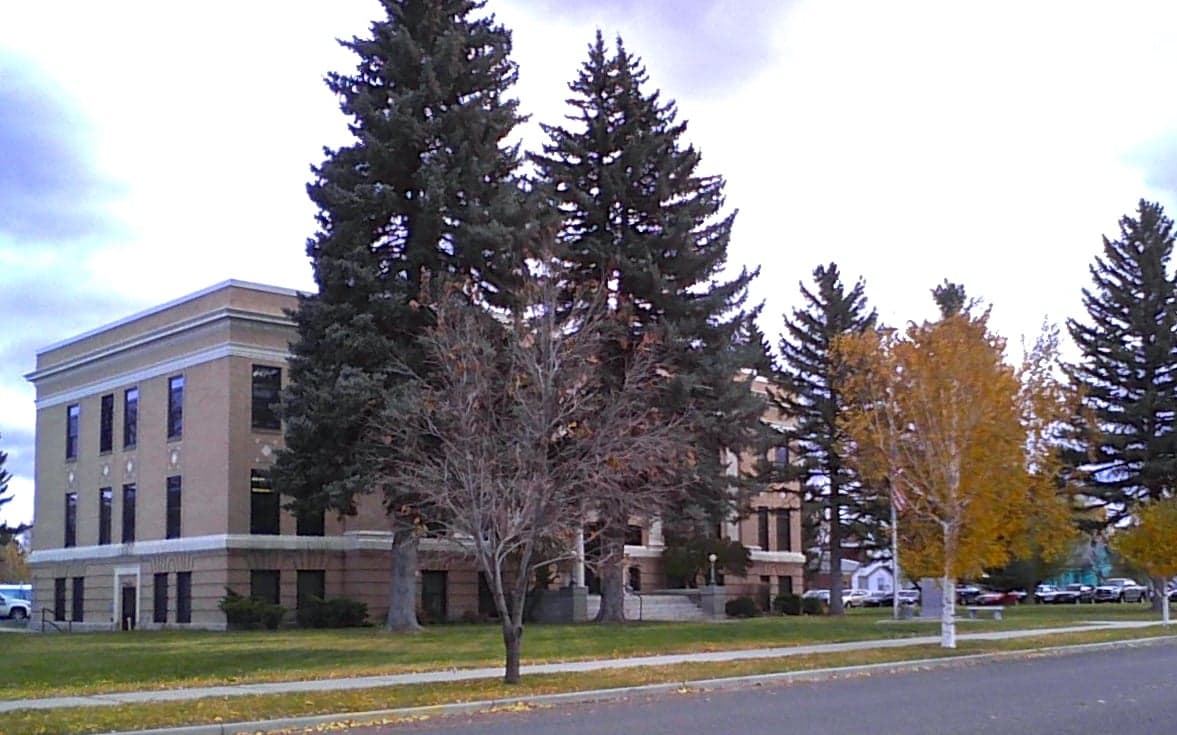
Photo: Wikipedia
Demographics of Powell County
Affluence Level in Powell County
A middle-class area roughly in line with national averages across income, home values, education, and employment.
People of Powell County
Powell County, Montana, is a sparsely populated, predominantly white, rural community of 7,029 residents, characterized by its deep-rooted ranching and mining heritage. With a foreign-born population of just 0.4% and a 87.4% white demographic, the county retains a distinctly homogeneous, native-born character that sets it apart from Montana's growing urban centers. The population is concentrated in the county seat of Deer Lodge and the smaller communities of Garrison and Avon, where a strong sense of local history and self-reliance defines daily life.
Settlement & growth (pre-1960)
The human history of Powell County begins with the Salish (Flathead) and Pend d'Oreille peoples, who used the Deer Lodge Valley as a seasonal hunting and gathering ground for centuries. The valley's abundant game and warm springs made it a vital resource, but no permanent Native villages were established here. The first recorded European-American presence came in the 1850s, when Jesuit missionaries and fur trappers passed through, followed by the discovery of gold in nearby Gold Creek in 1852—a find that triggered a modest rush of prospectors. However, it was the construction of the Northern Pacific Railroad in the 1880s that truly opened the county to settlement. The railroad established a depot in Deer Lodge in 1883, transforming it into a supply hub for miners, ranchers, and loggers.
The dominant settlement wave came from the 1880s through 1910, when Anglo-American homesteaders—primarily of English, Irish, and Scottish descent—arrived from the Midwest and the Pacific Northwest. They were drawn by the promise of cheap land under the Homestead Act and the economic anchor of the railroad. These families established cattle and sheep ranches that still operate today, particularly around Deer Lodge and the smaller hamlets of Elliston and Helmville. A smaller but notable wave of immigrants from Finland and Sweden settled in the logging camps near Avon and Racetrack, working in the timber industry that boomed alongside the railroad. The county's population peaked at roughly 14,000 in the 1910s, driven by copper mining in the nearby Butte district and the construction of the Montana State Prison in Deer Lodge in 1912, which became a major employer. The prison, along with the Anaconda Copper Mining Company's smelter operations in nearby Anaconda, anchored the local economy for decades, drawing a working-class population that was overwhelmingly native-born and of Northern European ancestry.
By the 1930s, the mining and timber booms had faded, and Powell County entered a long period of population decline. The Dust Bowl and Great Depression accelerated out-migration, as many homesteaders abandoned marginal farms. The county's population fell to around 8,000 by 1950, with the remaining residents concentrated in Deer Lodge and the surviving ranching communities. The post-World War II era saw little new immigration; the county remained a quiet, rural backwater, with the prison and agriculture as the primary economic pillars.
Modern era (post-1965)
The 1965 Hart-Cellar Act had virtually no impact on Powell County. Unlike Montana's urban counties—such as Missoula or Gallatin—which saw modest increases in Asian and Hispanic populations after 1965, Powell County's foreign-born share remained negligible. The county's demographic story since 1965 is one of continued domestic out-migration and aging. Young adults have consistently left for college and jobs in larger Montana cities like Missoula (60 miles west) or Helena (50 miles east), while the population has aged in place. The 2020 census showed a median age of 48.5, significantly higher than the national median of 38.8.
The most notable modern demographic shift has been the arrival of a small but visible East/Southeast Asian community, primarily of Hmong and Vietnamese descent, who began settling in Deer Lodge in the 1990s. These families came as secondary migrants from larger Hmong communities in Wisconsin and California, drawn by affordable housing and the availability of low-skill work at the prison and local meatpacking plants. Today, the Asian population stands at 1.8%, concentrated almost entirely in Deer Lodge. The Hispanic population, at 2.3%, is largely composed of Mexican-American families who moved from the Southwest for agricultural work on ranches and in the potato fields near Deer Lodge. The Black population, at 1.2%, is primarily composed of prison employees and their families, as the Montana State Prison remains the county's largest employer. The Indian subcontinent population is negligible at 0.1%, with no established community.
Suburbanization has not occurred in Powell County. The communities of Deer Lodge, Garrison, and Avon remain small, unincorporated towns with no significant new housing developments. The county's population has been essentially flat since 2000, fluctuating between 6,900 and 7,100. The prison, which employs roughly 600 people, remains the economic anchor, but its workforce is increasingly drawn from outside the county, as local labor pools have shrunk.
The future
Powell County's population is projected to remain stable or decline slightly over the next 10-20 years. The county's high median age and low birth rate (roughly 10 births per 1,000 residents, below the state average) suggest natural decrease—more deaths than births—will continue. Immigration from abroad is unlikely to increase significantly, as the county lacks the job diversity and housing stock to attract new foreign-born residents. The small East/Southeast Asian and Hispanic communities are expected to grow slowly through secondary migration, but they will remain small minorities.
The most likely demographic change is a modest influx of domestic migrants from higher-cost states, particularly retirees and remote workers seeking affordable land. Montana's recent population growth has largely bypassed Powell County, but rising home prices in Missoula and Bozeman may push some buyers into the Deer Lodge Valley. If this occurs, it could slightly lower the median age and increase the share of college-educated residents (currently 19.0%, well below the state average of 33.0%). However, the county's cultural identity—rooted in ranching, prison employment, and a conservative, self-reliant ethos—is unlikely to shift dramatically.
For someone moving in now, Powell County offers a stable, quiet, and deeply traditional community where neighbors know each other and the pace of life is slow. The population is aging and homogeneous, but the county is not in crisis; it is simply a place that time has passed by, content in its own rhythms. New residents will find a welcoming but insular culture, where fitting in means respecting the land and the history that shaped it.

* Values derived from national, state, county, city and local statistics and may differ in a specific area. Last updated: 2026-07-17T01:06:06.000Z
Narrative content on this page is AI-generated and may contain mistakes. Verify any details that matter before acting on them.
ReloMaps may earn a commission from affiliate links at no extra cost to you.

