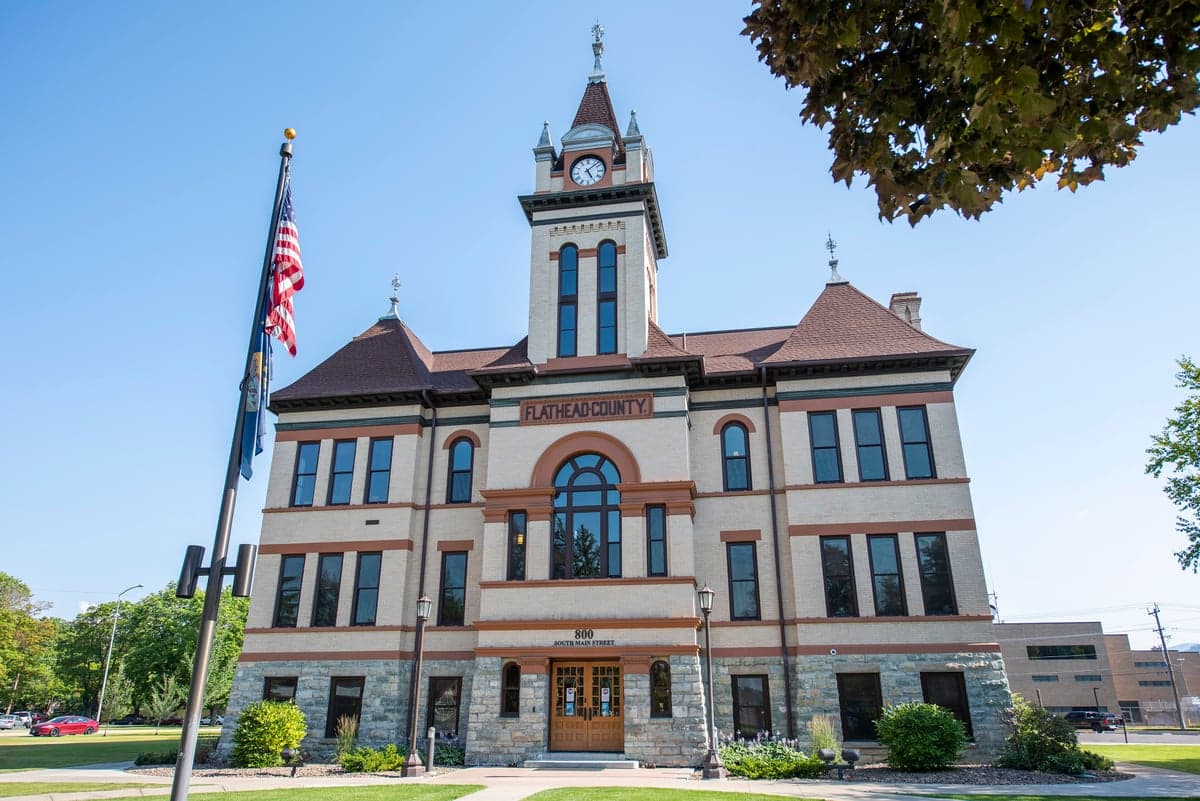
Photo: Wikipedia
Political ClimatePolitical Climate in Flathead County
Showing district-level results — no local-only data available.
Local Political AnalysisPolitical Analysis of Flathead County
Flathead County has long been a Republican stronghold, but its politics are more nuanced than the county's overall red tint suggests. With a Cook PVI of R+5, it is notably less conservative than Montana as a whole, which sits at R+10. This difference reflects a county that is reliably Republican but contains meaningful pockets of Democratic and independent voters, particularly in and around the city of Whitefish, which has developed a reputation as a more liberal enclave within the otherwise conservative valley.
How it compares
The gap between Flathead County's R+5 and Montana's R+10 is significant. It means that while statewide races are often decided by double-digit margins for Republicans, local races in Flathead County can be more competitive. The political geography of the county is not uniform. Whitefish consistently votes more Democratic than the rest of the county, driven by a mix of out-of-state transplants, second-home owners, and a younger workforce tied to the ski and tourism industries. In contrast, Kalispell, the county seat, leans reliably Republican, though its precincts show some variation—the more established neighborhoods near downtown are slightly more moderate than the fast-growing subdivisions on the outskirts. Columbia Falls and Bigfork are both solidly red, with Columbia Falls historically tied to the timber and aluminum industries, which have long aligned with conservative economic views. The swing precincts, if they exist, are in the unincorporated areas between Whitefish and Kalispell, where newer residents—often remote workers from California or Washington—have introduced a more libertarian or independent streak that doesn't always fit neatly into either party.
What this means for residents
For conservative residents, Flathead County offers a comfortable political environment where Republican candidates usually win, but the margin is not so overwhelming that they feel their vote is wasted. Local government, from the county commission to the school board, is dominated by Republicans, which means tax policy, land use, and development decisions tend to favor limited regulation and private property rights. For liberal residents, the picture is more mixed. Whitefish provides a visible counterweight, with a city council that has occasionally taken progressive stances on issues like affordable housing and environmental protections. However, living as a Democrat in the broader county means being in the minority, and statewide ballot measures—such as those on marijuana legalization or Medicaid expansion—often pass here despite local Republican opposition, reflecting a libertarian streak that crosses party lines. The practical effect is that while social conservatives hold sway on cultural issues, economic and environmental debates can produce surprising coalitions, especially around growth management and access to public lands.
Culturally, Flathead County is defined by a tension between its ranching and timber heritage and the influx of wealthy newcomers and outdoor recreationists. This has created a political landscape where the old guard—longtime residents who remember when the county was poorer and more isolated—often finds common cause with newer arrivals on issues like opposing overdevelopment, even as they disagree on social questions. The result is a county that is red, but not reflexively so, and where local elections can turn on a candidate's stance on a specific subdivision or road project rather than national party loyalty. For anyone moving here, understanding that Whitefish is not Flathead County, and that the politics of the valley floor differ from the lakeshore communities, is essential to navigating the local scene.

State Political ClimatePolitical Climate in Montana
State Political AnalysisPolitical Environment in the State
Montana has shifted from a purple-leaning state to a solidly Republican one over the past two decades, carrying a Cook PVI of R+10 as of 2026. The state hasn't voted for a Democratic presidential candidate since Bill Clinton in 1992, and the GOP now holds every statewide office, both U.S. Senate seats, and a supermajority in the state legislature. That said, the political reality here is more nuanced than the raw numbers suggest—Montana has a long libertarian streak, a deep distrust of federal overreach from both parties, and a growing urban-rural split that keeps things interesting.
Urban vs. rural divide
The political map of Montana breaks down along a clear urban-rural axis, but the urban centers are smaller than outsiders expect. Missoula and Bozeman are the two main Democratic strongholds—Missoula County went for Biden by about 20 points in 2020, and Gallatin County (Bozeman) has been trending blue as it fills with out-of-state transplants and tech workers. Helena, the state capital, leans left but is more moderate, while Butte is a fading union town that still votes Democratic out of habit. On the other side, the eastern two-thirds of the state is deeply red—Billings, the largest city, votes Republican by comfortable margins, and counties like Glendive and Miles City routinely deliver 80%+ GOP votes. The fastest-growing counties are Gallatin and Missoula, which is slowly pulling the state leftward, but the rural counties that are losing population are getting redder, so the net effect is a slow, grinding polarization.
Policy environment
Montana's policy environment is defined by low taxes, light regulation, and a strong emphasis on local control. There is no state sales tax—the state relies on property and income taxes, with a flat individual income tax rate of 5.9% as of 2026. Property taxes are moderate but vary significantly by county, with Gallatin County seeing sharp increases due to rising home values. The regulatory posture is business-friendly, particularly for agriculture, energy, and mining. Education policy is decentralized; the state funds schools through a per-student formula, and there is a growing charter school movement, though it remains smaller than in states like Arizona. Healthcare policy has been a battleground: Montana expanded Medicaid under the Affordable Care Act in 2015, and the program was reauthorized in 2023 with bipartisan support, but conservative legislators continue to push work requirements. Election laws have tightened in recent cycles—voter ID requirements were strengthened in 2021, and same-day voter registration was eliminated in 2023, a move that drew sharp criticism from voting rights groups.
Recent policy direction
The last five years have seen Montana move decisively right on a broad set of issues. On gun and self-defense law, the state passed permitless carry in 2021, allowing concealed carry without a permit for anyone 18 or older who can legally possess a firearm. Stand-your-ground laws have been on the books since 2009 and remain popular. On parental and education rights, the legislature passed a "parents' bill of rights" in 2023, requiring schools to notify parents about curriculum changes and medical services, and a school choice expansion that created education savings accounts for special-needs students. Speech and privacy issues have been less central, but the state passed a law in 2023 restricting TikTok on government devices and has debated data privacy bills without major action. Medical and bodily autonomy is a flashpoint: Montana has a 2022 law banning abortion after 20 weeks, and a 2024 trigger law that would ban abortion entirely if Roe v. Wade were overturned—but the state Supreme Court has blocked enforcement, citing a 1999 ruling that protects abortion rights under the state constitution. Property rights are strongly protected; Montana has no statewide zoning, and counties have limited ability to regulate land use, which has fueled a housing affordability crisis in Bozeman and Missoula. Taxation remains a conservative priority—the 2023 legislature passed a series of income tax cuts, bringing the top rate down from 6.75% to 5.9%, with further cuts tied to revenue triggers. Voting and ballot access has tightened, as noted, with the elimination of same-day registration and stricter ID rules, but mail-in voting remains universal and popular.
Civil unrest & political movements
Montana is not a state known for street protests, but it has a long history of organized political movements on both sides. The Yellowstone County area around Billings has seen periodic anti-government sentiment, including militia-adjacent groups that gained attention during the 2014 Bundy Ranch standoff and the 2016 occupation of the Malheur National Wildlife Refuge in Oregon—several participants were from Montana. On the left, environmental activism is strong, particularly around public lands and mining issues. The proposed Black Butte Copper Mine near White Sulphur Springs drew sustained protests from conservation groups, and the Smith River watershed has been a flashpoint for water rights and development debates. Immigration politics are less visible than in border states, but there have been local controversies over sanctuary policies—Missoula declared itself a "welcoming city" in 2017, which drew backlash from the state legislature, which passed a law in 2021 prohibiting sanctuary policies. Election integrity controversies have been muted compared to states like Arizona or Georgia, but the 2020 election did see a partisan audit in Flathead County that found no irregularities, and the issue has largely faded. Secession and nullification rhetoric is rare but not absent—there is a small "Liberty State" movement that advocates for greater autonomy from federal land management, given that 30% of Montana is federally owned.
Projection
Over the next 5-10 years, Montana is likely to remain Republican-leaning but with a slowly narrowing margin. In-migration is concentrated in the blue-trending counties of Gallatin and Missoula, which will continue to pull the state leftward, but the rural counties that are losing population are becoming more conservative, so the net partisan shift is modest. The state's growing Latino population, concentrated in agricultural areas like the Flathead Valley and around Havre, is not yet a major political force but could become one. The biggest wildcard is housing affordability—if Bozeman and Missoula become too expensive for the young families and workers who drive Democratic turnout, the urban growth could stall, leaving the rural conservative majority intact. Climate change is also a factor: hotter, drier summers and more frequent wildfires are reshaping the economy and could drive out-migration from fire-prone areas, which tend to be rural and conservative. A new resident moving in now should expect a state that remains Republican-controlled but with a more competitive Democratic minority, especially in the western third of the state.
For a new resident, the bottom line is that Montana offers a low-tax, lightly regulated environment with strong property rights and a conservative social tilt, but it is not a monolith. If you move to Missoula or Bozeman, you'll find a liberal-leaning community with high housing costs and a vibrant outdoor culture. If you settle in Billings or Great Falls, you'll experience a more traditionally conservative, family-oriented lifestyle. The state's politics are real and consequential—your tax bill, your children's education, and your access to healthcare will all be shaped by the Republican supermajority in Helena—but the day-to-day reality is less polarized than the headlines suggest. Most Montanans, regardless of party, share a fierce independence and a suspicion of outsiders telling them how to live, which is probably the most honest summary of the state's political culture you'll get.
* Values derived from national, state, county, city and local statistics and may differ in a specific area. Last updated: 2026-07-14T13:26:52.000Z
Narrative content on this page is AI-generated and may contain mistakes. Verify any details that matter before acting on them.
ReloMaps may earn a commission from affiliate links at no extra cost to you.

