Photo: Wikipedia
Demographics of Flathead County
Affluence Level in Flathead County
A middle-class area roughly in line with national averages across income, home values, education, and employment.
People of Flathead County
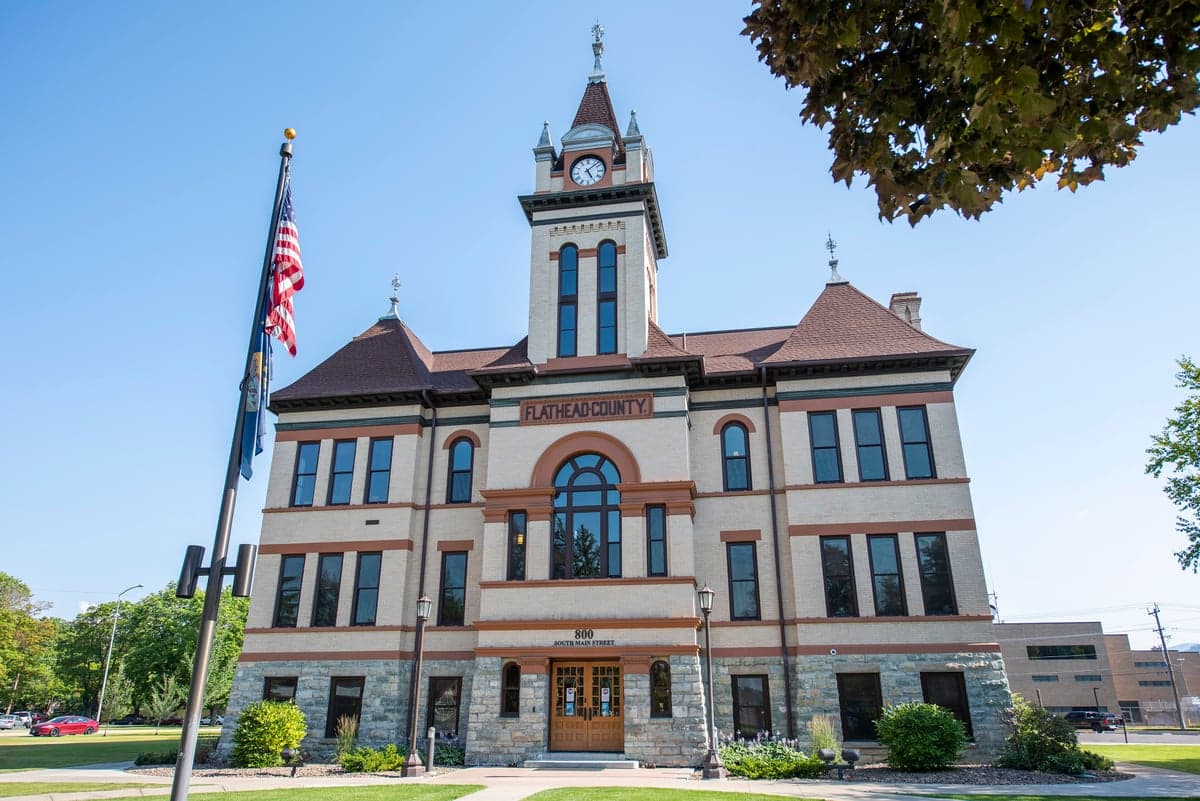
Flathead County, Montana, is home to roughly 108,445 residents, a population that remains overwhelmingly white (90.7%) and native-born (only 1.1% foreign-born), giving it a demographic profile more akin to the rural Midwest than the rapidly diversifying West. The county’s identity is shaped by a deep-rooted ranching and timber heritage, a growing outdoor-recreation economy centered on Kalispell and Whitefish, and a steady influx of domestic migrants from California, Washington, and the Pacific Northwest seeking lower taxes and a slower pace. Despite its size, the population is relatively well-educated (36.0% hold a bachelor’s degree or higher), and the area retains a distinctly conservative, self-reliant character that appeals to families and individuals looking for space and traditional values.
Settlement & growth (pre-1960)
Long before European settlement, the Flathead Valley was the homeland of the Salish (Flathead), Kootenai, and Pend d’Oreille peoples, who lived along the rivers and lakes for thousands of years. The 1855 Hellgate Treaty forced these tribes onto the Flathead Reservation to the south, opening the valley to American homesteaders. The first permanent non-Native settlers arrived in the 1860s and 1870s, drawn by the promise of fertile bottomland and abundant timber. These early pioneers were overwhelmingly of Northern European stock — Scots-Irish, English, and German — who established farms and small logging camps around what would become Kalispell, the county seat founded in 1891 by the Great Northern Railway.
The railroad’s arrival triggered the county’s first major growth spurt. The Great Northern built a line through the valley, and the towns of Whitefish (founded 1904) and Columbia Falls (founded 1891) sprang up as division points and timber hubs. Logging and sawmilling dominated the economy, drawing waves of Scandinavian immigrants — Swedes, Norwegians, and Finns — who arrived between 1890 and 1910 to work in the woods and mills. These groups concentrated in Whitefish and Columbia Falls, where their descendants remain a visible part of the cultural fabric. A smaller number of Italian and Slavic laborers also came to work on the railroad and in the mines of nearby Lincoln County, but they never formed large enclaves in Flathead County itself.
By 1920, the county’s population had reached roughly 18,000, a figure that grew slowly through the Great Depression and World War II. The Dust Bowl of the 1930s sent some displaced farmers from the Great Plains into the valley, but the numbers were modest compared to other parts of Montana. The post-war era brought a modest suburban expansion around Kalispell, but the county remained a quiet, resource-dependent region through the 1950s. The completion of Hungry Horse Dam in 1953, just east of Columbia Falls, provided cheap hydroelectric power and spurred a brief construction boom, but the population only inched upward to about 32,000 by 1960.
Modern era (post-1965)
The 1965 Hart-Cellar Act had minimal direct impact on Flathead County, as the area never attracted significant post-1965 immigration from Asia, Latin America, or Africa. The foreign-born share remains just 1.1%, one of the lowest in the nation. Instead, the county’s modern demographic story is one of domestic migration — specifically, a steady stream of Americans relocating from the West Coast and, to a lesser extent, the Rust Belt. This began in earnest in the 1970s and accelerated after 2000, driven by the region’s relatively affordable land, low crime, and conservative politics.
The most visible change has been the growth of Whitefish as a resort and second-home destination. The development of Whitefish Mountain Resort (formerly Big Mountain) in the 1970s and 1980s attracted affluent migrants from California, Washington, and Colorado, many of whom bought vacation homes or relocated permanently. This influx pushed Whitefish’s population from about 3,000 in 1970 to over 7,000 today, and the town’s character shifted from a working-class railroad and logging town to a tony, amenity-rich mountain community. Kalispell absorbed a more moderate share of this migration, growing from roughly 10,000 in 1970 to over 25,000 today, with new subdivisions spreading south toward Lakeside and Somers along Flathead Lake.
Hispanic residents, while still a small share (3.5%), have grown from near-zero in 1990, largely through domestic migration from other Western states rather than direct immigration. They are dispersed across the county, with small clusters in Kalispell and Columbia Falls, often working in construction, hospitality, and agriculture. The East/Southeast Asian population (0.7%) and Indian-subcontinent population (0.1%) remain tiny, concentrated mostly among professionals in Kalispell’s healthcare and tech sectors. The Black population (0.2%) is negligible, and there is no significant Arab community. The county’s racial homogeneity is a defining feature, and it has not meaningfully diversified in the past 30 years.
The future
Flathead County’s population is projected to continue growing at a moderate pace, driven almost entirely by domestic in-migration from the West Coast and Mountain West. The county added roughly 15,000 residents between 2010 and 2020, and that trend shows no sign of reversing, as remote work and housing-cost disparities push more families and retirees to the valley. The population will likely become slightly more diverse, but only incrementally: the Hispanic share may rise to 5-6% by 2040, and the Asian and Indian populations may grow to 1-2% each, primarily through professional migration to Kalispell’s expanding medical and tech sectors.
The most significant demographic shift will be geographic: new development is pushing outward from Kalispell and Whitefish into smaller communities like Bigfork, Marion, and Kila, as housing prices in the core towns push working-class families to the periphery. This is creating a ring of exurban subdivisions that are less dense and more car-dependent, but also more affordable. The cultural identity of the county is likely to remain conservative and resource-oriented, though the influx of West Coast migrants may introduce a moderate-libertarian strain that tempers the area’s traditional Republicanism. The county will not become a multicultural melting pot, but it will become a more economically diverse and politically nuanced version of itself.
For someone moving in now, Flathead County offers a rare combination of natural beauty, low crime, and a like-minded community for those seeking a traditional, family-oriented lifestyle. The trade-off is a lack of racial and cultural diversity, a high and rising cost of housing relative to local wages, and a growing tension between long-time residents and newcomers. It remains a place where conservative values, outdoor recreation, and self-reliance define daily life, and it is likely to stay that way for the foreseeable future.

* Values derived from national, state, county, city and local statistics and may differ in a specific area. Last updated: 2026-07-14T13:26:52.000Z
Narrative content on this page is AI-generated and may contain mistakes. Verify any details that matter before acting on them.
ReloMaps may earn a commission from affiliate links at no extra cost to you.

